Professor Kim Seong-geun Emphasizes ESG Civic Movement
"ESG practice moves toward a civic movement."
Professor Kim Seong-geun, Director of the ESG Management Research Institute at Silla University (President Heo Nam-sik), gave a presentation on the theme of "ESG Civic Movement" at the 'ESG Management Conference.'
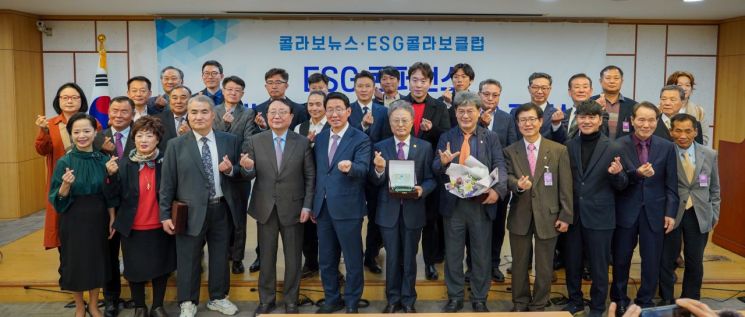
On the 1st, Professor Kim Seong-geun, Director of the ESG Management Research Institute at Silla University (Professor of Business Administration), took the stage as a speaker at the 'ESG Management Conference' held in the 3rd Seminar Room of the National Assembly Members' Office Building, co-hosted by Congressman Kim Sang-hoon, Collabo News, and the ESG Collabo Club.
On this day, Professor Kim emphasized the importance of civic movements by presenting four subtopics, stating, "If ESG management does not spread as a national participation movement, it can only achieve half the success."
The amount of plastic waste discarded annually in Korea is about 10 million tons, ranking first in the world in per capita plastic usage. It is known that 10% of the "Great Pacific Garbage Patch" in the North Pacific Ocean consists of products produced on the Korean Peninsula.
Professor Kim pointed out, "There are 235 illegal landfill sites nationwide, and nearby residents suffer from odors and other issues caused by these landfills."
Although Korea is known as a country that separates and recycles waste well, according to a material flow analysis conducted by a research team from Chungnam National University, the recycling rate is only about 27%.
According to Professor Kim, a 2019 study by a research team from New York University in the United States investigated 259 bottles of bottled water from 11 brands in 9 countries and reported that microplastics were detected in 93% of the bottled water. In 2022, a research team from Vrije Universiteit Amsterdam announced that microplastics were detected in the blood of 17 out of 22 healthy adults.
A study by the University of Hawaii at Manoa found microplastics in the placentas of all 10 mothers surveyed.
Domestic food waste amounts to 14,000 tons per day and 5.4 million tons annually, with treatment costs reaching 900 billion to 1 trillion won per year. About 61% of this food waste is discarded from households.
Professor Kim argued that as our lives have become more convenient since industrialization, factors harming the environment and health have increased. He stated that efforts must start from the home, not only in environmental aspects but also in social aspects such as health management, accident prevention, and a society without discrimination, as well as governance aspects including anti-corruption, principles and fairness, not harming others, and creating healthy families.
Professor Kim, who serves as the Director of the ESG Management Research Institute at Silla University, emphasized, "To revitalize the ESG civic movement, government and local governments' interest and support, corporate participation, banning the broadcast of single-use product usage scenes on various media (TV, individual broadcasts, etc.), using six-compartment trays at funeral homes nationwide, and preventing the sacrifice of trees due to redevelopment and reconstruction must be enforced."
The ESG Management Research Institute at Silla University has prepared and published "ESG Management Practice Plans for Households, Small Business Owners (Manufacturing, Service, Food Service), and Educational Institutions," and has completed copyright registration.
Additionally, they have conducted a policy research project on "The Necessity and Expansion Plan of the ESG Civic Movement in Busan," producing 76 instructors through a specialized training course for ESG civic movement instructors and conducting special lectures on ESG civic movements, striving to expand it as a broad civic movement.
© The Asia Business Daily(www.asiae.co.kr). All rights reserved.

















