McKinsey Releases Generative AI Value Report
Banks Could Increase Profits by 15% with AI Adoption
70% of Future Tasks Expected to Be Automated
Goldman, Citi, and Others Rapidly Implement AI
Global banks could gain up to $340 billion (approximately 446 trillion KRW) in additional annual profits by adopting generative artificial intelligence (AI) such as 'ChatGPT' in their operations, according to an analysis. Wall Street firms like Goldman Sachs and Citigroup are already accelerating efforts to enhance productivity by integrating AI into banking tasks.
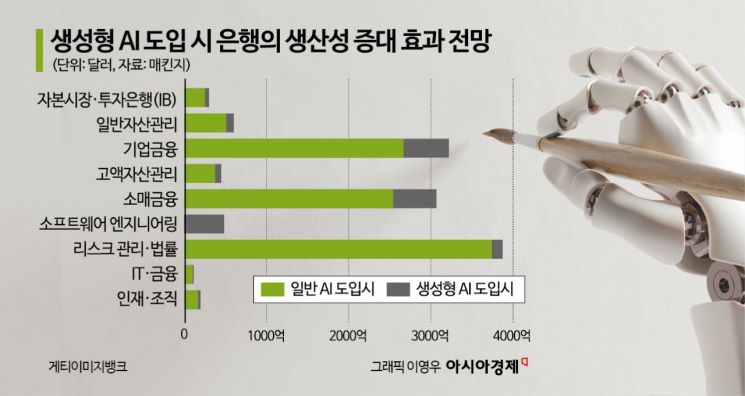
On the 5th (local time), global consulting firm McKinsey released a report titled "The Value of Generative AI Captured in Banking," identifying banking as one of the industries where productivity is expected to increase the most through the adoption of generative AI.
According to the report, banks worldwide are expected to experience productivity gains ranging from $200 billion (approximately 262 trillion KRW) to $340 billion annually by adopting generative AI, which learns and analyzes large-scale data to create new content. This corresponds to about 9-15% of the current operating profits in the banking sector. Previously, McKinsey projected that generative AI adoption would generate an economic impact of $2.6 trillion to $4.4 trillion (approximately 3,412 trillion to 5,774 trillion KRW) globally each year, with banking accounting for 7.7% of that total, according to this new analysis.
By business segment, corporate finance and retail finance are expected to generate added values of $56 billion (approximately 73 trillion KRW) and $54 billion (approximately 71 trillion KRW), respectively, showing the largest productivity gains. When adopting general AI that performs simple commands, corporate finance productivity was estimated to increase by $265 billion (approximately 348 trillion KRW) and retail finance by $252 billion (approximately 331 trillion KRW). However, with more advanced generative AI, productivity is expected to rise further to $321 billion (approximately 421 trillion KRW) and $306 billion (approximately 402 trillion KRW), respectively. In the software engineering field, generative AI adoption is estimated to create added value of about $48 billion (approximately 63 trillion KRW). Given these productivity enhancements, McKinsey forecasts that generative AI will automate up to 70% of future work.
Wall Street has already begun integrating generative AI into banking operations. Goldman Sachs is applying AI to coding tasks that require extensive manual labor to boost developer productivity. Developers can use AI to reduce repetitive tasks and focus on identifying customer priorities. Citigroup is utilizing generative AI to analyze new capital regulations that exceed 1,000 pages in length. Additionally, banks are experimenting with AI applications in derivative trading, financial fraud detection, and performance reviews. McKinsey noted that the adoption of generative AI is progressing at a faster pace than the spread of mobile banking driven by smartphone penetration.
Jared Moon, Senior Partner at McKinsey, analyzed that banks are "improving productivity, creating better content for customers, and securing more time to spend with customers" by applying AI. However, he also predicted significant job reductions. He stated, "Sales, marketing, software engineering, and call centers in banking will be the most affected sectors by AI," adding, "While no companies have yet been confirmed to reduce jobs substantially through AI, conclusions about job losses due to AI have not yet been reached."
Earlier, Goldman Sachs also forecasted that if companies worldwide adopt AI, global real GDP could increase by 7% over the next decade. Elon Musk, CEO of Tesla, has predicted the arrival of a universal high-income era where AI does the work and people receive basic income. He said, "There will come a time when no jobs are necessary," and "If you want a job, you can have one, but an era where AI can do everything is coming."
© The Asia Business Daily(www.asiae.co.kr). All rights reserved.
![Clutching a Stolen Dior Bag, Saying "I Hate Being Poor but Real"... The Grotesque Con of a "Human Knockoff" [Slate]](https://cwcontent.asiae.co.kr/asiaresize/183/2026021902243444107_1771435474.jpg)
















