In the past three years, nearly 30,000 complaints related to inter-floor noise have been received by the Korea Environment Corporation's 'Neighbor Noise Center,' but it was found that only about 3% of these cases proceeded to actual noise measurement by the corporation. The Citizens' Coalition for Economic Justice (CCEJ) argued that the government and construction companies should strengthen their management responsibilities to fundamentally resolve the inter-floor noise issue.
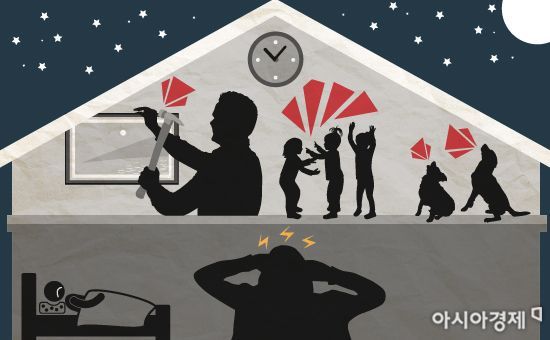
On the morning of the 6th, CCEJ held a press conference at the CCEJ auditorium in Jongno-gu, Seoul, to announce the results of an analysis of complaints from victims of inter-floor noise received by the Neighbor Noise Center over the past three years. The Neighbor Noise Center has been operated by the Korea Environment Corporation, a public institution under the Ministry of Environment, since 2012 to mediate inter-floor noise issues.
According to CCEJ, from April 2020 to April this year, a total of 27,773 inter-floor noise complaints were filed. Among these, simple telephone consultations accounted for 72% (19,923 cases), and only 3.7% (1,032 cases) proceeded to actual noise measurement. Kim Seong-dal, Secretary General of CCEJ, pointed out, "Not only are measurements not properly conducted, but there is also no way to verify whether disputes were resolved after the measurements," adding, "With the current formal inter-floor noise tasks by the Ministry of Environment and the Ministry of Land, Infrastructure and Transport, inter-floor noise disputes cannot be prevented."
By region, the number of inter-floor noise complaints was 9,141 in Gyeonggi, 5,709 in Seoul, 1,931 in Incheon, and 1,825 in Busan, among others. By housing type, apartments accounted for 84% and multi-family houses 12%. The most common type of damage was noise from the upper floor at 85%, and among noise sources, sounds of running or walking accounted for 68%. Through this type analysis, CCEJ estimated that the cause of inter-floor noise problems is the floor impact noise issue in multi-family housing. Most apartments in Korea are built with a 'wall-type structure' (a construction structure that supports loads with walls), which has the advantage of shorter construction periods and lower costs but the disadvantage of severe inter-floor noise. According to the Ministry of Land, Infrastructure and Transport, among apartments with 500 or more units built nationwide over ten years from 2007, 98.5% are wall-type structures.
In particular, most of the top 100 construction companies by construction capability had inter-floor noise complaints. Among 9,553 inter-floor noise complaints where the construction company was accurately identified, 7,643 cases occurred in multi-family housing built by 87 construction companies ranked within the top 100. Specifically, the top 5 construction companies accounted for 2,099 cases, ranks 6 to 30 for 3,332 cases, and ranks 31 to 100 for 2,212 cases.
Cases of neighbor conflicts due to inter-floor noise escalating into violent crimes are also increasing. Analyzing court rulings and other documents, CCEJ found that the 'five major violent crimes' such as murder and assault related to inter-floor noise increased tenfold from 11 cases in 2016 to 110 cases in 2021 over five years. However, there are no official government statistics related to crimes caused by inter-floor noise. CCEJ reported that in July last year, they requested data on the number of reports and crime status related to inter-floor noise from the police and fire departments but received a response that there were no data classified under inter-floor noise.
CCEJ urged the government and construction companies to strengthen their responsibilities to fundamentally resolve the inter-floor noise problem. Secretary General Kim said, "We need to legislate a full survey and labeling system for inter-floor noise in newly built multi-family housing, establish penalty regulations for construction companies that fail to meet standards, and further introduce a post-construction sale system." He added, "During environmental impact assessments for redevelopment and reconstruction of multi-family housing, inter-floor noise target standards should be set at grades 1 to 2, and if the standards are exceeded, measures to reduce noise should be established and implemented by amending the Environmental Impact Assessment Act." He continued, "More proactive measures should be promptly prepared, such as imposing fines on project entities that construct housing not meeting standards, delaying completion inspections until corrections are made, and holding them liable for damages."
© The Asia Business Daily(www.asiae.co.kr). All rights reserved.

















