IIHS Evaluation Ranks Grades Considering Repair Costs
Hyundai and Kia with Most TSP+ Vehicles Alongside Toyota
Lexus UX, NX, RX and Kia Telluride
All Models Receive Highest Ratings in Every Category
Everyone wonders how safe the car they drive is. Safety often becomes a marketing tool. Volvo Cars, known as the "symbol of safety," even released a video showing their vehicle being hung from a crane and dropped to the ground.
Each country has different standards for measuring safety. Typically, crash tests are conducted separately in each country by colliding objects with various parts of the vehicle, such as the front and rear, to assess safety. Among these, the most stringent crash test is reputed to be the one conducted by the U.S. Insurance Institute for Highway Safety (IIHS). Established in 1959, IIHS is a nonprofit organization that comprehensively evaluates the crash safety and prevention performance of vehicles released in the U.S. each year. Although it is a private research institute, it receives funding from automobile insurance companies. Due to this support, the ratings consider not only safety but also repair costs resulting from vehicle collisions. Manufacturers do their best to achieve good results in the demanding IIHS evaluations.
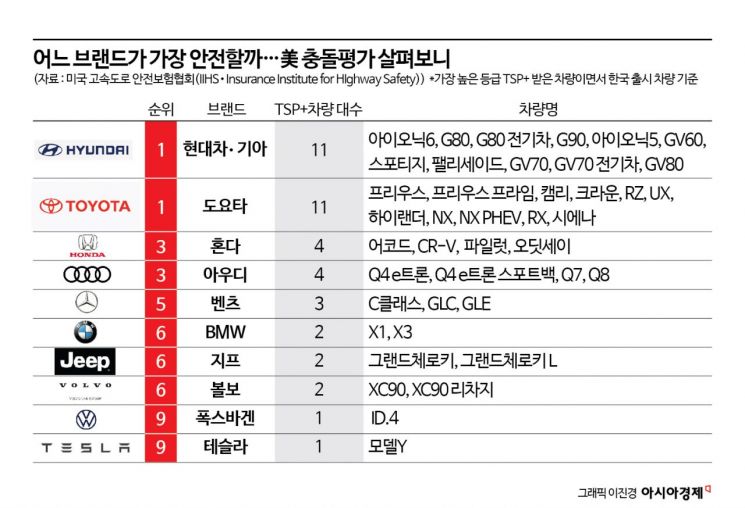
Looking at this year’s IIHS crash test results (limited to vehicles released in Korea), the manufacturers that received the highest number of top safety ratings (Top Safety Pick Plus, TSP+) were Hyundai Motor Company, Kia, and Toyota (including Lexus). Each of these companies had 11 vehicles earn the TSP+ rating. Following them were Honda and Audi with 4 vehicles each, and Mercedes-Benz with 3. BMW, Jeep, and Volvo had 2 vehicles each rated TSP+, while Tesla and Volkswagen had 1 each.
To receive the TSP+ rating, a vehicle must earn the highest rating of “Good” in four categories: driver-side small overlap (a test where the vehicle crashes into a wall on the driver’s side), passenger-side small overlap (passenger safety test), frontal crash, and side crash. The ratings are ranked from safest to least safe as Good, Acceptable, Marginal, and Poor.
At the same time, the vehicle must also perform well in safety-related system tests. It must receive an Advanced or Superior rating in the daytime and nighttime front crash prevention system tests, and an Acceptable or higher rating in headlight evaluations across all trims. This year, the side crash evaluation was especially strengthened. The crash object became heavier (from 1497 kg to 1896 kg) and the speed increased (from 49.8 km/h to 59.5 km/h).
By vehicle type, Hyundai and Kia received the highest safety ratings for 4 sedans (Ioniq 6, G80, G80 Electric, G90) and 7 sport utility vehicles (SUVs) (Ioniq 5, Sportage, Palisade, GV60, GV70, GV70 Electric, GV80). Except for the Sportage (produced locally at the Georgia plant in the U.S.), all these vehicles are manufactured at Korean plants and exported.
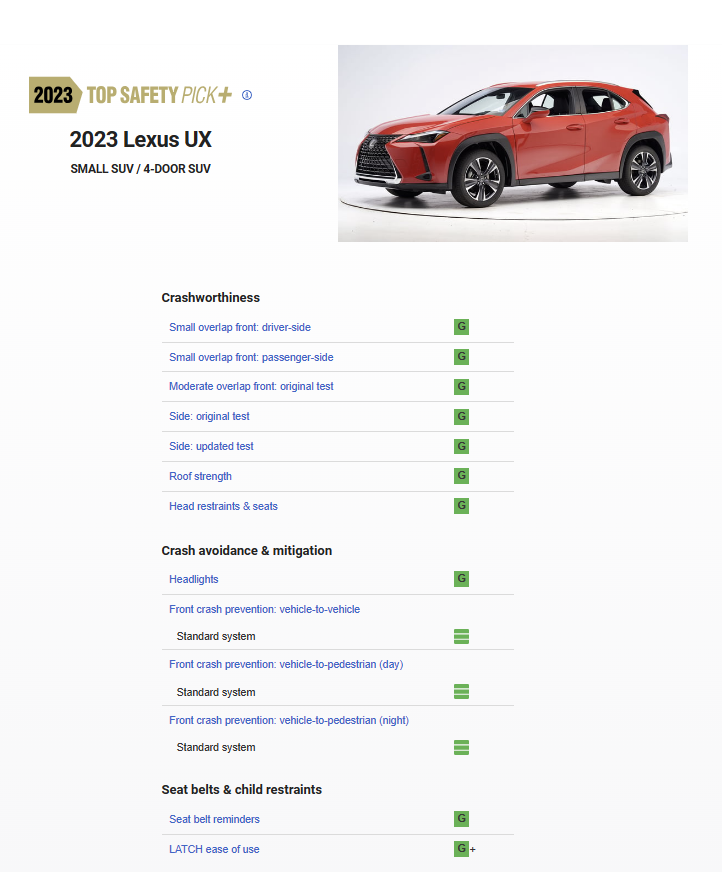 Among the vehicles that received the TSP+ rating, the Lexus UX, NX, and RX are the only ones to achieve the highest grade in all evaluations.
 [Photo by IIHS website]
Toyota also earned TSP+ ratings for 4 sedans (Prius, Prius Prime, Camry, Crown) and 7 SUVs (Lexus RZ, UX, NX, NX PHEV, RX, Highlander, Sienna). Honda’s highest-rated vehicles were the Accord, CR-V, Pilot, and Odyssey. Mercedes-Benz included the compact sedan C-Class and SUVs GLC and GLE. From BMW to Tesla, all the vehicles rated were SUVs (X1, X3, two Grand Cherokee models, two XC90 models, ID.4, Model Y).
Among the vehicles that received the TSP+ rating, those that earned the highest rating in all evaluations were the Lexus UX, NX, RX, and Kia’s mid-large SUV Telluride. All of these received a “Good” rating even in the strengthened side crash test. However, the Telluride is a U.S.-only model not released in Korea.
© The Asia Business Daily(www.asiae.co.kr). All rights reserved.


















