Throughout this year, cooling signals have been continuously confirmed in the labor market, which has supported the strong U.S. economy. The number of job openings, which indicates labor demand flow, recorded its lowest level in two years and seven months, and the wage growth that has fueled inflation has slowed. These are all signals that add weight to the market's expectation that the Federal Reserve (Fed) will cut interest rates in the first half of next year.
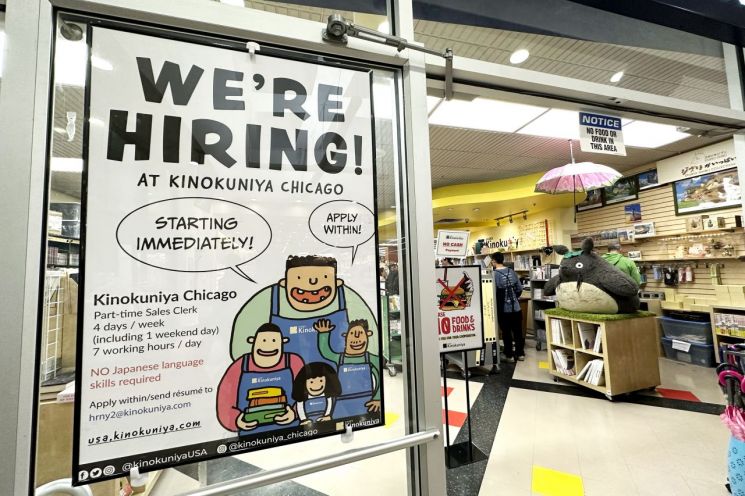
According to the Job Openings and Labor Turnover Survey (JOLTs) report released by the U.S. Department of Labor on the 5th (local time), the number of new job postings in October was 8.73 million, down about 610,000 from the previous year. This figure is far below Dow Jones' estimate of 9.4 million and marks the lowest level since March 2021. The proportion of job postings among total openings was 5.3%, down from 5.7% in the previous month. The number of jobs per job seeker also decreased from 2.0 last year to about 1.3.
Bill Adams, Chief Economist at Comerica Bank, said, "The hot labor market is definitely cooling down," adding, "The frenzy of rapid wage increases due to the surge in employment and resignations after the pandemic has ended." Noah Yosif, Chief Economist at workforce management company UKG, noted in a memo that day, "The continued cooling of job openings suggests progress toward a soft landing path," and "It shows that the labor market supply-demand balance is improving."
Bloomberg News reported, "The decline in job postings was widespread across the board. This is the gradual cooling of the labor market that the Fed wants," adding, "It will be welcomed by the Fed."
The signals showing that the labor market overheating is cooling down are not limited to the reduced number of new job postings. The Wall Street Journal (WSJ) highlighted five signals of labor market weakening in an article titled 'Signs of Labor Market Weakness in 5 Charts': ▲a decrease in U.S. job demand, ▲workers not quitting easily, ▲slowing wage growth, ▲increased difficulty in finding new jobs, and ▲slower hiring pace.
In the report released that day, the number of voluntary quits, which reflects labor market confidence, was 3.6 million, showing little change from the previous month. The voluntary quit rate in October remained at 2.3%, the same as the previous month, continuing a gradual decline from the 3% peak in April last year. WSJ reported, "Economists see the falling quit rate as a sign that workers are less confident about the labor market or more satisfied with their current positions." The Beveridge curve, which shows the inverse relationship between job vacancies and unemployment, is also approaching pre-pandemic levels. WSJ evaluated this as "adding to the signs that the labor market is normalizing."
Wage growth is also slowing. According to the Federal Reserve Bank of Atlanta, the average hourly wage growth rate was 5.2% as of October. After peaking at 6.7% in August last year, it has gradually declined to 6.4% in October last year, 6.1% in February this year, and 5.6% in June. For companies and employers, this means there is less need to raise wages to hire employees amid labor shortages. This trend is confirmed by other data as well. According to the U.S. Department of Labor, the wage growth rate in the leisure and hospitality sector, which was around 7% in January this year, fell to 4.5% in October. Tim Quinlan, an economist at Wells Fargo, said, "As labor market rigidity eases, wage pressures are decreasing."
Moreover, the number of people struggling to find new jobs is increasing. The number of continuing unemployment claims, for those applying for unemployment benefits for at least two weeks, is approaching 2 million. The continuing claims for the week of the 19th to 25th increased by 86,000 from the previous week to 1.927 million, the highest level since November 2021. This is interpreted as meaning that existing unemployed individuals are facing greater difficulties in finding new jobs.
Now, market attention is focused on the November employment report to be released on the 8th. This is considered a key indicator to confirm that the labor market overheating is cooling due to the accumulated effects of tightening. The Fed has been monitoring related reports, viewing wage increases driven by excess labor demand as a potential cause of inflation entrenchment. WSJ emphasized that based on employment reports released this year, nonfarm payrolls increased by an average of only 239,000 per month through October, evaluating that "the hiring pace is slowing." Considering that the monthly average was around 400,000 in 2022, this is a clear slowdown. Currently, Wall Street estimates that nonfarm payrolls will increase by 190,000 in November.
If the labor market slowdown is reconfirmed in the employment report on the 8th, expectations for interest rate cuts next year are likely to strengthen further. Stuart Paul, an economist at Bloomberg Economics, said, "The labor market is easing, economic activity is slowing, and disinflation is likely to continue in the short term," adding, "The Fed will start cutting interest rates from the end of the first quarter next year."
Currently, the market has largely priced in a rate hold at the Federal Open Market Committee (FOMC) meeting scheduled for December next week. According to the CME FedWatch tool, federal funds futures markets reflect a 99.9% probability that the Fed will hold rates steady this month. The probability of holding rates through January next year exceeds 85%. The chances of a rate cut of 0.25 percentage points or more in March or May next year are above 64% and 90%, respectively. However, local media added that Fed Chair Jerome Powell is likely to draw a line against market expectations for rate cuts, fearing that inflation expectations could surge.
© The Asia Business Daily(www.asiae.co.kr). All rights reserved.

















