Association "Government Must Take Action"... Disease Control Agency "Preparing for Possible Situations"
Recently, Mycoplasma pneumonia (pediatric pneumonia) has been spreading from China to neighboring countries such as Taiwan.
In response, domestic pediatricians have urged the government to prepare countermeasures, and quarantine authorities have expanded information sharing between the two countries to understand the epidemic situation of Mycoplasma pneumonia bacteria in China. However, based on the spread trend, it was assessed that the domestic and international outbreaks are not unusual situations.
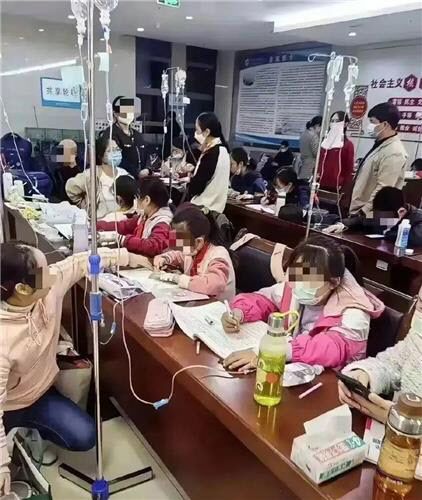 Chinese students infected with respiratory diseases such as Mycoplasma pneumoniae infection are studying in the hospital corridor while receiving intravenous fluids.
 [Photo by Beijing Daily/Yonhap News]
However, Taiwan is recommending that elderly people and children with weakened immune systems refrain from traveling to China, and the World Health Organization (WHO) has requested an investigation in China.
Mycoplasma pneumonia is a bacterial pneumonia that mainly infects infants and young children. It mostly occurs in children aged 5 to 9. When infected, it is usually accompanied by a high fever over 38 degrees Celsius and severe coughing, with phlegm mixed in the cough lasting about 3 to 4 weeks. It is also characterized by poor response to general antibiotics and antipyretics.
Quinolone antibiotics are usually used for Mycoplasma pneumonia, but when used in children, side effects such as cartilage deposition may occur, so they are rarely used for those under 18 years old.
In Korea, it is classified as a level 4 legally designated infectious disease that recurs every 3 to 4 years. The number of patients increases around September when autumn begins and decreases after March when the weather gets warmer. After the COVID-19 pandemic started in 2020, domestic patient cases sharply decreased, and the epidemic ended after 2019.
Korea Disease Control and Prevention Agency: "This year's epidemic pattern is not severe"
 (This photo is not directly related to the article.) In front of the pediatrics department [Photo by Yonhap News Agency, archive photo]
Although the Korean Pediatric Hospital Association pointed out the need to review the domestic Mycoplasma pneumonia management system, the Korea Disease Control and Prevention Agency judged that this year's epidemic pattern is not severe.
According to the agency, among 218 hospital-level medical institutions with more than 200 beds participating in the sentinel surveillance system, 210 include pediatric departments, allowing monitoring of the occurrence in children.
According to this status, among 280 patients hospitalized with bacterial acute respiratory infections in the 47th week (November 19?25), 270 (96.4%) were infected with Mycoplasma pneumonia bacteria.
Looking at the epidemic pattern, the number increased steadily from 60 patients during the 35th week (August 27?September 2) to 173 in the 44th week (October 29?November 4), then 226 in the 45th week, 232 in the 46th week, and 270 in the 47th week.
The Korean Pediatric Hospital Association criticized the government’s response. Earlier on the 4th, the association warned, "Pediatric infectious diseases have the characteristic that if initial responses are poor, outbreaks can spread instantly due to unavoidable group activities such as attending school or kindergarten," adding, "Although Mycoplasma pneumonia is not yet at an epidemic stage, if it becomes epidemic, a pediatric care crisis worse than confusion like open runs will occur."
They continued, "There is no sign of any government countermeasures for Mycoplasma pneumonia, and public health centers only urge personal hygiene," criticizing, "Countries like India and Taiwan are making efforts such as travel restrictions to China and issuing alerts to prevent the inflow of Mycoplasma pneumonia, but it seems the Korean government is doing nothing."
© The Asia Business Daily(www.asiae.co.kr). All rights reserved.
![Clutching a Stolen Dior Bag, Saying "I Hate Being Poor but Real"... The Grotesque Con of a "Human Knockoff" [Slate]](https://cwcontent.asiae.co.kr/asiaresize/183/2026021902243444107_1771435474.jpg)

















