Female Production Value 356 Trillion Won... Male 134.9 Trillion Won
The value of household labor services produced by women, such as cleaning and caregiving, was found to be 2.6 times greater than that produced by men.
According to the key analysis results of the "National Time Transfer Account In-depth Analysis" announced by the Korea Institute for Statistics Development on the 5th, the value of domestic household labor services in 2019 reached 490.9 trillion won. This corresponds to 25.5% of the Gross Domestic Product (GDP). This was calculated based on the time use survey.

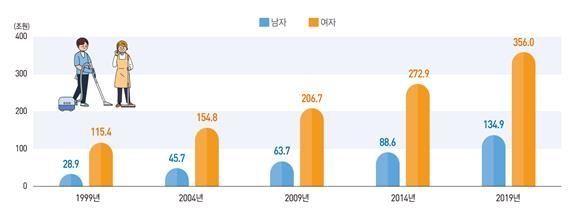
By gender, the value of household labor services produced by women was 356 trillion won, 2.6 times higher than the 134.9 trillion won produced by men.
By age group, the working-age population (15-64 years) accounted for 410 trillion won (83.5%), and the elderly population (65 years and older) accounted for 80.9 trillion won (16.5%).
The share of household labor service production by men and the elderly steadily increased from 20.1% and 8.4% in 1999 to 27.5% and 16.5% in 2019, respectively. The value of household labor services produced by men increased from 28.9 trillion won in 1999 to 63.7 trillion won in 2009, and further to 134.9 trillion won in 2019.
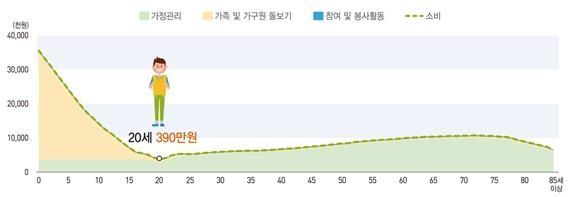
Household labor services were intensively consumed during childhood, when caregiving is needed. In 2019, the childhood group (0-14 years) consumed 131.6 trillion won worth of household labor services, centered on caregiving (105.7 trillion won). The working-age and elderly groups consumed 281.9 trillion won and 77.4 trillion won, respectively, mainly focused on household management (259.2 trillion won and 72.7 trillion won, respectively).
By age, per capita household labor consumption was highest at 36.38 million won at age 0, when caregiving needs are greatest, and lowest at 3.9 million won at age 20.
When distinguishing the transfer of household labor services caused by the difference between consumption and production within households (family members living together) and between households (family members not living together), services were transferred between the working-age group and childhood group within households. Between households, services were transferred from the grandparent age group (55-75 years) to the grandchild age group (0-15 years).
The Korea Institute for Statistics Development plans to publish the main research results of this in-depth analysis in the "KOSTAT Statistics Plus Winter 2023" issue, scheduled for release on the 22nd.
Song Junhyuk, President of the Korea Institute for Statistics Development, stated, "We hope that the National Time Transfer Account, which allows detailed examination of the production and consumption structure and flow of household labor services by gender, age, and household, will be usefully utilized as basic data for establishing various government policies such as childcare and family care, as well as for academic research."
Meanwhile, according to the "Changes in Youth Consciousness Seen Through Social Surveys" announced by Statistics Korea last August, nearly half of young people identified childcare burdens as the biggest obstacle to women's employment. The perception that childcare burden is the biggest barrier to women's employment was similar among men (44.3%) and women (48.5%). However, the perception that unequal working conditions are the biggest factor differed, with 19.1% of women and 8.8% of men recognizing this.
© The Asia Business Daily(www.asiae.co.kr). All rights reserved.
![Clutching a Stolen Dior Bag, Saying "I Hate Being Poor but Real"... The Grotesque Con of a "Human Knockoff" [Slate]](https://cwcontent.asiae.co.kr/asiaresize/183/2026021902243444107_1771435474.jpg)


















