"Increase in Per Capita Occupied Area... Vacancy Rate Expected to Remain Low Next Year"
Since the end of the COVID-19 pandemic, office vacancy rates in Seoul have been virtually close to 'zero (0)'. This is attributed to limited new office supply, a sharp decline in remote work, and increased corporate demand to move to higher-quality offices.
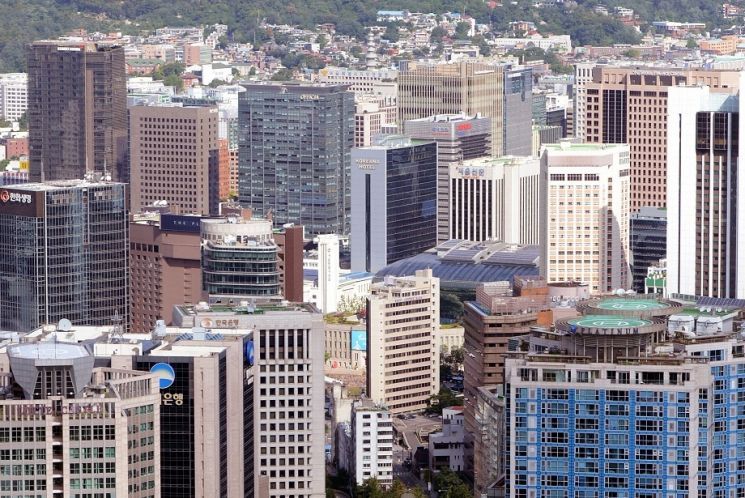
Global real estate consulting firm Cushman & Wakefield held a press conference on the 5th at the Seoul Finance Center in Jung-gu, Seoul, to present a review of this year's office market and outlook for next year.
As of the third quarter of this year, the office vacancy rate in Seoul stood at 2.2%. It has maintained the 2% range since the third quarter of last year. Considering that the natural vacancy rate due to lease expirations is 5%, this essentially means there is no vacancy. Compared to vacancy rates in Hong Kong (17.7%) and Japan (Tokyo, 5.1%) during the same period, it is clear how robust the demand for Seoul offices is.
Jinwoo Jeong, head of the research team, attributed this to the abolition and reduction of remote work. Jeong explained, "According to our survey, the average number of remote work days per week in Korea is 0.4 days, which is significantly lower than the global average of 0.9 days. To improve work productivity, the office space occupied per employee is increasing, and corporate demand to move to better offices is also rising." According to Cushman & Wakefield, the office space per person increased from 13㎡ in 2010 to 14㎡ in 2020, and the ratio of shared office space also rose from 16% to 23% during the same period.
On the other hand, new office supply is insufficient. The annual average new office supply area in Seoul was about 290,600㎡ until last year, but from this year until 2026, only about half of last year's supply is expected. Jeong said, "Rising raw material costs and interest rates are accelerating the contraction of new office supply," adding, "Construction of new office buildings is also being delayed, so vacancy rates are expected to remain low." He also predicted that the impact of worsening corporate conditions on office vacancies will be limited, with vacancy rates expected to hover around 3% next year.
Jeong also assessed that solid economic growth contributed to lowering vacancy rates. In 2020, when COVID-19 occurred, South Korea's economic growth rate fell by 0.7%, which was a smaller decline compared to the UK (-11.0%), Japan (-4.2%), and Germany (-3.8%). He said, "Although next year's economic growth rate has been revised downward due to increased uncertainty, it remains robust compared to major countries." With vacancy rates remaining low, rental prices are expected to continue rising.
Meanwhile, unlike the leasing market, the office investment market is expected to struggle to recover next year. The office transaction volume from the first to third quarter of this year was 6.2 trillion KRW, down about 45% compared to the same period last year. This was largely due to reduced market liquidity caused by high interest rates. Jeong said, "The office investment market will recover when market interest rates fall and liquidity increases," adding, "If some properties come onto the market due to interest rate burdens, there will be opportunities to purchase high-quality office buildings at a low price next year."
© The Asia Business Daily(www.asiae.co.kr). All rights reserved.

















