The Middle East construction market is expected to grow by more than 4% annually until 2027. In particular, Saudi Arabia is projected to grow at an average annual rate of 5%. To secure orders in the Middle East, which is recovering mainly in major oil-producing countries, Korean construction companies need to strengthen localization policies and prepare for the shift in procurement patterns toward investment and development projects (PPP).
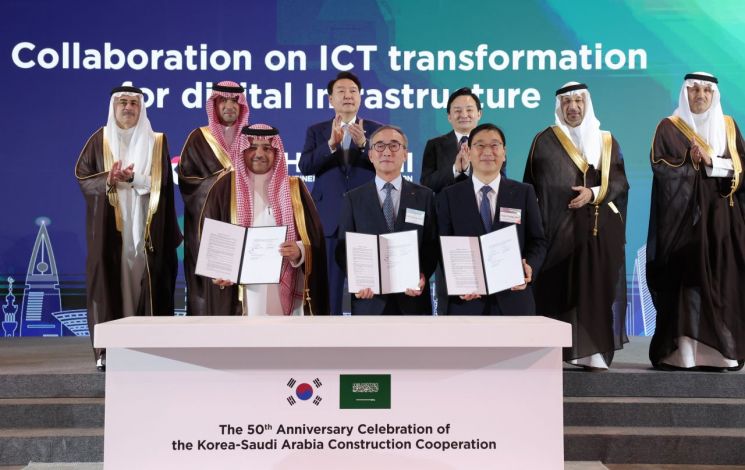 Kim Young-seop, CEO of KT (center front row), and Yoon Young-joon, CEO of Hyundai Construction (right front row), signed a memorandum of understanding (MOU) on digital infrastructure with STC during the 50th anniversary ceremony of Korea-Saudi construction cooperation held at the NEOM Exhibition Hall in Riyadh, Saudi Arabia, on October 23 (local time), attended by President Yoon Suk-yeol. / Photo by Yonhap News
According to the report "Trends and Prospects of the Middle East Construction Market after the Israel-Hamas Armed Conflict," published on the 5th by the Overseas Construction Policy Support Center, the Middle East construction market is expected to grow by 3.3% this year and by an average of 4.42% annually until 2027. By country, the construction market size was largest in Saudi Arabia, the United Arab Emirates (UAE), Israel, Iran, Algeria, and Qatar, in that order.
This year, the Saudi construction market size is estimated at $139.1 billion (approximately 180.691 trillion KRW), a 4.5% increase from the previous year. From next year, an average annual growth rate of 5% is forecasted for the next four years. This outlook is based on improved economic conditions following the end of the COVID-19 pandemic and rising oil prices due to increased oil demand. The money earned from high oil prices is being invested in major industrial development projects such as energy, further expanding the construction market.
Currently, Saudi Arabia is promoting "Vision 2030," which aims to develop 24,000 housing units and 3.6 million square meters of office space by 2030. A core project is the NEOM project, in which Saudi Arabia plans to invest $500 billion (approximately 650 trillion KRW). Domestic construction companies are also competing to secure orders. Additionally, renewable energy capacity, which was about 4.9 GW in 2021, is planned to increase to 27.3 GW by 2024 and 58.7 GW by 2030. Construction of related facilities is expected to expand accordingly.
Meanwhile, the report emphasized the need to prepare for Saudi Arabia's strengthened localization policies. These include mandatory employment of Saudi nationals, increased purchase ratios of locally produced products during bidding, and local technical training. It suggested that Korean companies collaborate with competitive local firms or establish partnerships and recruit talented local personnel.
The report also noted the shift in procurement patterns toward investment and development types. As infrastructure projects in each country become more advanced, private investment is actively attracted, and participating contractors are not only involved in simple engineering, procurement, and construction (EPC) but also participate as project owners with some equity stakes. For example, Saudi Arabia enacted the Private Sector Participation Law (PSP) to expand private investment participation.
The report also highlighted the Middle East's move toward decarbonization. Over the past decade, more than $48 billion has been ordered for renewable energy projects in the Middle East, and Saudi Arabia is expected to invest about $30 billion in expanding renewable energy capacity by 2030.
Meanwhile, the cumulative overseas construction orders through the end of October this year amounted to $25.646 billion, an increase of about 4% compared to the same period last year. During this period, the Middle East accounted for about 30% of total orders, securing $8.061 billion.
© The Asia Business Daily(www.asiae.co.kr). All rights reserved.
![Clutching a Stolen Dior Bag, Saying "I Hate Being Poor but Real"... The Grotesque Con of a "Human Knockoff" [Slate]](https://cwcontent.asiae.co.kr/asiaresize/183/2026021902243444107_1771435474.jpg)
















