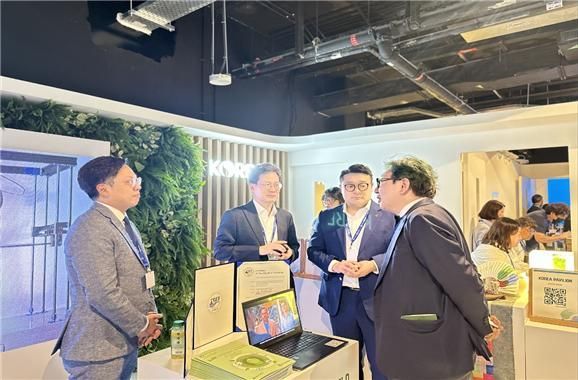
 Jung Young-hoon, CEO of Doshi Ujeon (second from the right), is explaining the 'Low-temperature Treatment Technology for Waste Vinyl/Plastic' to event participants at the Korea Pavilion of the 28th United Nations Climate Change Conference of the Parties (COP28) held at Expo City, Dubai, United Arab Emirates.
Dosiyujeon Co., Ltd. announced on the 5th that it participated in the 28th United Nations Climate Change Conference of the Parties (COP28), held from November 30 to December 3 at Expo City in Dubai, United Arab Emirates, and introduced its waste low-temperature treatment technology (RGO) using ceramic emission waves.
COP28 is an international conference attended by representatives of 198 parties to the convention, where cooperation and discussions on global carbon reduction take place. Dosiyujeon presented its "Non-traditional Low-Temperature Treatment Technology for Waste Vinyl/Plastic" at the "Public-Private Joint Carbon Neutral Conference for Overcoming the Climate Crisis" held on November 30. Then, on December 2, at the KEITI Environmental Innovation Network event attended by the World Bank, it presented carbon-neutral collaboration technologies and models between countries and companies for climate change response and greenhouse gas reduction under the United Nations Framework Convention on Climate Change. The World Bank decided to visit Dosiyujeon directly in 2024.
A Dosiyujeon official explained, "At the COP28 event, we held supply and export consultations on the RGO system with UN member state government officials, companies, and local buyers." It was also reported that the Saudi Arabian government showed interest in this technology.
Dosiyujeon's low-temperature pyrolysis method is a technology that uses heater rods powered solely by electric energy and ceramic catalysts to decompose and treat waste plastics and waste vinyl at low temperatures (below 300°C), extracting naphtha or refined oil. Dosiyujeon explained that it can produce up to 0.8 tons of refined fuel oil and ultra-light oil (recycled naphtha) per 1 ton of waste plastic and waste vinyl.
This technology is non-combustion, so it may be excluded from air pollution emission facilities under the law, and compared to existing high-temperature thermal incineration methods, it has the advantage of reducing the generation of environmental pollutants such as dioxins. Younghoon Jeong, CEO of Dosiyujeon, said, "The low-temperature pyrolysis treatment technology unique to Dosiyujeon can recycle waste plastics to produce high-quality fuel, has less environmental impact, and can efficiently utilize renewable energy."
© The Asia Business Daily(www.asiae.co.kr). All rights reserved.

















