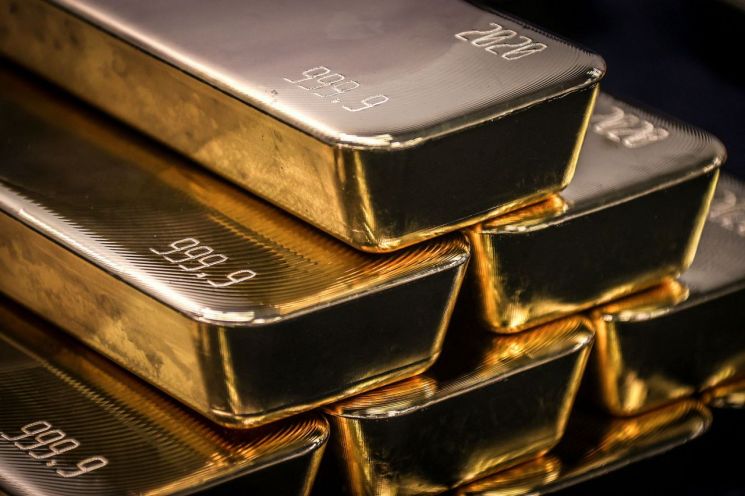
There are forecasts that the price of gold, which recently hit an all-time high, could rise further next year. It is expected that interest rate cuts and a weaker dollar will drive up gold prices. Structural changes among central banks worldwide, increasing their gold reserves instead of holding the declining dollar, are also acting as a driving force behind the rise in gold prices.
On the 4th (local time) at the New York Mercantile Exchange, gold was trading at $2,048.20 per ounce, down 1.99% from the previous day (as of 5 p.m.). International gold prices reached an all-time high of $2,135.39 per ounce during the previous day's session. This marks an increase of more than 14% from the beginning of the year, when prices were at $1,846.10. The previous record was $2,075.47 in August 2020, during the COVID-19 pandemic.
Due to prolonged concerns over a long-term recession, gold prices had once retreated to around $1,800 per ounce during the year but have recently resumed an upward trend amid expectations of early interest rate cuts. International gold prices have risen by 15% over the past year. During the same period, the commodity market (based on the S&P GSCI) recorded a negative return of -8.54%.
The U.S. financial media CNBC evaluated that "major central banks, including the U.S. Federal Reserve (Fed) and the European Central Bank (ECB), are expected to start cutting benchmark interest rates as early as the second quarter of next year, which is pushing gold prices higher." Gold, which does not yield interest, typically moves inversely to interest rates. When interest rates rise, gold's investment appeal decreases, and when rates fall, its preference tends to increase.
The weak dollar phenomenon driven by expectations of interest rate cuts has also acted as a driving force behind the rise in gold prices. When the value of the dollar falls, the real price of gold decreases, stimulating demand. John Reade, a market strategist at the World Gold Council (WGC), said in an interview with CNN, "Gold prices could break another all-time high."
However, some analyses suggest that policy changes by central banks around the world are a greater driving force behind the rise in gold prices than the preference for gold assets as a hedge. As central banks worldwide have increased the proportion of gold in their reserves, gold purchases reached a record high last year. According to the WGC, emerging market central banks bought 1,100 tons of gold last year alone. This is about three times the average annual gold purchases (473 tons) between 2010 and 2021.
A British media outlet pointed out, "With the intensification of geopolitical crises such as the Ukraine war and U.S.-China conflicts, emerging countries are reducing the dollar share and increasing the gold share in their reserve portfolios." It added, "While it is difficult to assert that this trend signals the end of dollar hegemony, it is clear that the dollar's status is changing among central banks worldwide, and this is affecting gold prices." According to a WGC survey conducted last May, 24% of central banks worldwide responded that they plan to increase their gold reserves over the next 12 months.
The bullish trend in gold prices is expected to continue next year. Wang Kunhou, Head of Global Economic Research and Market Strategy at Singapore-based investment bank UOB, said, "Expectations of interest rate cuts and a weaker dollar are major drivers of gold price increases," and predicted that gold prices could rise to as much as $2,200 per ounce by the end of next year. Nikki Shields, Head of Metals Strategy at MKS, also forecasted, "Gold prices will maintain the current upward momentum and reach $2,200 per ounce next year."
© The Asia Business Daily(www.asiae.co.kr). All rights reserved.

















