Statistics Korea Announces 'November Consumer Price Trends'
Agricultural Products Up 13.6%... Largest Increase in 30 Months
Last month, the consumer price inflation rate maintained a rise in the 3% range for the fourth consecutive month, but the rate of increase slowed for the first time in four months. The government assessed that the inflation rate would stabilize and maintain a steady trend until the end of this year. However, concerns have emerged that the burden of grocery prices felt by ordinary citizens will persist for the time being, as agricultural product prices surged sharply compared to last year due to adverse weather conditions this summer.
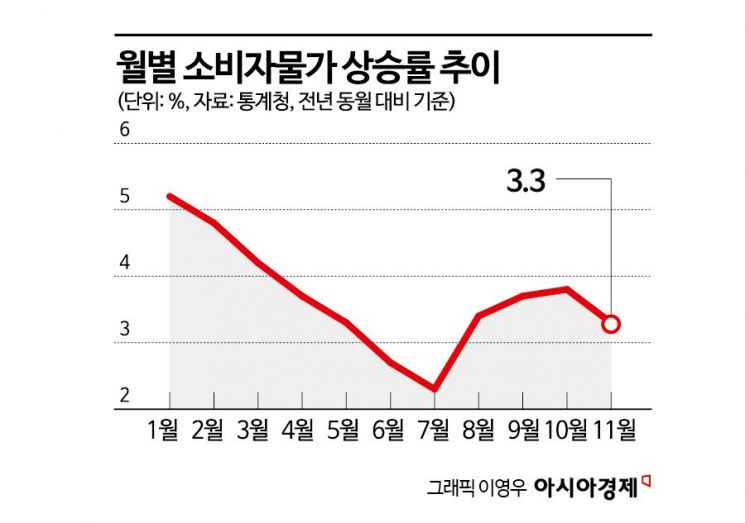
According to the 'November Consumer Price Trends' released by Statistics Korea on the 5th, consumer prices last month rose 3.3% compared to a year earlier. The inflation rate had slowed from 5.2% in January to 2.3% in July this year, but then rose to 3.4% in August, and 3.7% and 3.8% in September and October respectively, remaining in the 3% range for four consecutive months. Fortunately, the rate of price increase last month slowed by 0.5 percentage points compared to the previous month.
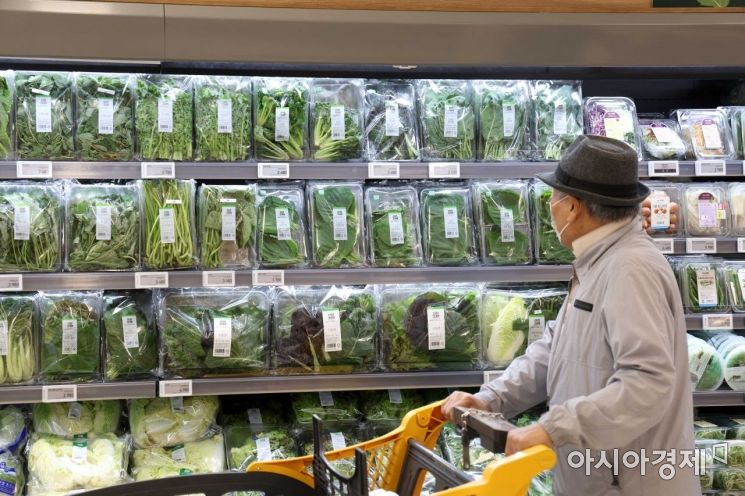 On the 23rd, a citizen is inspecting vegetables at a large supermarket in downtown Seoul. Photo by Mun Ho-nam munonam@
The main reason for the slowdown in the rate of increase last month was largely due to the decline in international oil prices. On the previous day (local time), West Texas Intermediate (WTI) crude oil futures on the New York Mercantile Exchange fell 1.11% from the previous trading day to $73.25 per barrel. Compared to the peak of $93.68 per barrel in September, this represents a 21.8% decrease in two months. The petroleum product index also fell 5.1% year-on-year last month, contributing to a 0.25 percentage point drop in overall inflation.
The inflation rate excluding food and energy, which are highly volatile, was 3.0%, showing a steady downward trend since November last year (4.3%). The living cost index, which tracks prices of 144 major items with high purchase frequency and expenditure share, rose only 4% compared to a year ago, slowing for the first time in four months. Although the Organization of the Petroleum Exporting Countries (OPEC) and the OPEC+ coalition of major non-OPEC oil producers agreed to cut oil production by about 900,000 barrels per day until the first quarter of next year, uncertainty remains over whether the production cuts will be maintained amid weakening international oil demand, leading to expectations that prices will remain stable until the end of the year. Kim Bo-kyung, Director of Economic Trend Statistics at Statistics Korea, stated, "The decline in international oil prices has expanded the drop in petroleum product prices, and the rate of increase in prices of agricultural and livestock products, durable goods, and textiles has slowed, curbing inflation and turning it into a downward trend."
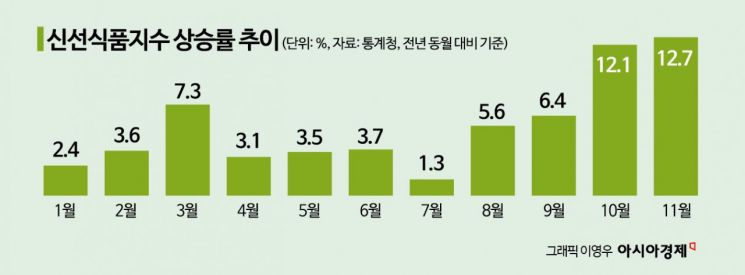
However, agricultural product prices rose sharply. Last month, agricultural product prices increased by 13.6% compared to a year earlier, marking the highest increase in two and a half years since May 2021 (14.9%). The fresh food index also rose 12.7% during the same period. Fresh fruits increased by 24.6%, and fresh vegetables by 9.5%. Prices of apples (55.5%), cucumbers (39.9%), green onions (39.3%), and tomatoes (31.6%) also rose significantly. This was due to reduced supply of agricultural and fresh food products caused by heatwaves and heavy rains this summer.
The problem is that fresh food prices are unlikely to stabilize in the short term, which may prolong the burden on ordinary citizens' grocery bills. Director Kim explained, "Vegetables generally have a short growing period, so prices tend to fall significantly when weather conditions improve, but fruits have a yearly cycle, making it difficult for prices to drop quickly. Agricultural product prices vary depending on weather conditions and supply-demand situations."
Persistent increases in processed food prices are also a burden. Last month, processed food prices rose 5.1% compared to a year earlier, increasing the rate of rise from the previous month (4.9%). Prices of ice cream (15.6%), milk (15.9%), and bread (4.9%) rose significantly. Although the government has recently requested food companies to refrain from raising prices to stabilize inflation, price increases are inevitable due to rising raw material costs. During this period, eating-out expenses rose 4.8% compared to a year ago, maintaining the same level as last month (4.8%).
The government plans to continuously operate a special price stabilization system to focus on price and livelihood stability. On the morning of the same day, at the Emergency Economic Ministers' Meeting and Price-Related Ministers' Meeting held at the Government Seoul Office, Deputy Prime Minister and Minister of Economy and Finance Choo Kyung-ho said, "We will strengthen support to stabilize prices of some agricultural, livestock, and fishery products that are still high. We will encourage the swift import of allocated tariff volumes for bananas, chicken, and green onions, which were implemented in November, and extend the discount support for agricultural, livestock, and fishery products and the refund event for fishery Onnuri gift certificates, which were scheduled to end in early to mid-December, until the end of the year using contingency funds."
© The Asia Business Daily(www.asiae.co.kr). All rights reserved.



















