Legislative Research Office Report 'Is the Loan Business Market Alright Amid Interest Rate Hikes?'
Funding Costs and Loan Loss Expenses Rise... Loan Business Operating Environment Worsens
"Illegal Private Loans Increase as Loan Business Loans and Users Rapidly Decline"
"If Adjusting the Legal Maximum Interest Rate Is Difficult, Consider a Linked Maximum Interest Rate System"
On the 4th, the National Assembly Legislative Research Office explained the side effects of the statutory maximum interest rate regulation in its report titled 'Is the Loan Market Okay as It Is During the Interest Rate Hike Period?'. It stated that despite the rise in market interest rates, loan companies are finding it difficult to raise loan interest rates further due to the statutory maximum interest rate regulation, leading them to shut their doors to lending because of deteriorating profitability.
The business environment for loan companies has rapidly worsened since the end of last year. The base interest rate, which had remained in the 0% range until the first half of 2021, sharply increased to 3.25% in November last year and 3.5% in January this year, causing loan companies' funding costs to soar accordingly. According to the Korea Financial Services Association, the new borrowing rates of the top 15 loan companies were 8.81% as of December last year, and 8.36% and 7.33% in June and September this year, respectively. Although a downward trend has been observed this year, these rates are still 1.56% to 3.04% points higher compared to June last year (5.77%).
With high interest rates and prolonged economic recession, delinquency rates in the loan industry have increased, pushing up bad debt costs. The delinquency rate of 25 major loan companies nearly doubled from the 7% range in the first half of 2022 to 13.4% in September 2023. The Legislative Research Office explained, "Although loan companies' funding and bad debt costs have sharply increased, the maximum loan interest rate they can charge is fixed at 20%. Therefore, lending to vulnerable borrowers with a high risk of default results in worsening profitability due to negative margins, further deteriorating the business environment for loan companies."
In fact, new loans from loan companies are sharply declining. According to NICE Information Service, the amount of new loans from 69 loan companies decreased by about 78%, from 384.6 billion KRW in January 2022 to 83.4 billion KRW in September 2023, and the number of new users also dropped by about 64%, from approximately 31,000 in January 2022 to 11,200 in September 2023.
The Legislative Research Office estimated that existing loan users are flowing into the illegal loan market, considering the recent increase in illegal loan damage cases. The number of illegal loan damage consultations and reports received by the Financial Supervisory Service's Illegal Loan Damage Reporting Center nearly doubled from 5,468 cases in 2019 to 10,913 cases in 2022, and recorded the highest half-year figure of 6,784 cases in the first half of 2023. This is based on the principle that as the illegal loan market expands, user damage caused by illegal loans also increases.
The Legislative Research Office suggested that raising the statutory maximum interest rate is necessary to protect vulnerable groups. They stated, "Considering that the statutory maximum interest rate has not been adjusted despite recent interest rate hikes, causing the loan market function to shrink, it is time to promptly discuss raising the statutory maximum interest rate to normalize the function." They added, "Since it is practically difficult to revise the law each time market conditions change to adjust the statutory maximum interest rate, the introduction of a 'linked maximum interest rate regulation' that ties the statutory maximum interest rate to market interest rates or the base rate can also be considered."
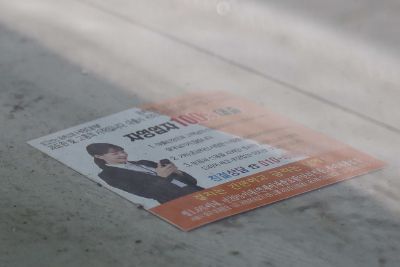 A flyer related to private loans is placed at a closed store in Myeongdong, Jung-gu, Seoul. Photo by Jinhyung Kang aymsdream@
© The Asia Business Daily(www.asiae.co.kr). All rights reserved.

















