First Nationwide 'Surveillance System' Installed on Wando Yeoseodo
Jeonnam Province has become the first in the nation to pilot the installation of a continuous seawater radiation monitoring system.
On the 4th, the province announced that it installed a 'real-time continuous radiation monitoring system' on Yeoseodo Island in Wando, the baseline of South Korea's territorial waters, to verify the safety of seawater radiation contamination following the discharge of contaminated water from the Fukushima nuclear power plant in Japan.
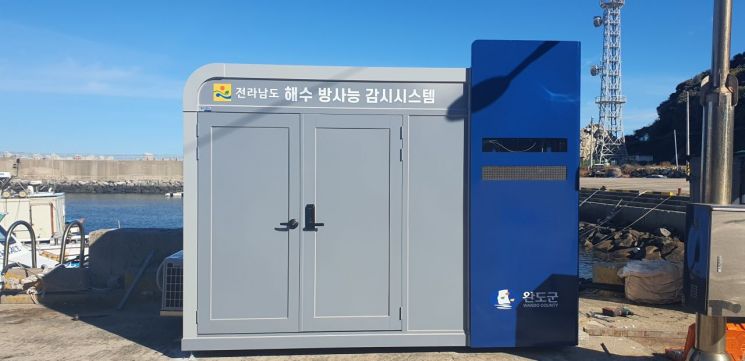
The system operates unmanned 24 hours a day and automatically measures the radiation concentration of gamma nuclides (cesium and iodine) and beta nuclides (tritium) in real time.
The test results are displayed in real time on a monitor installed on site for tourists and residents, and are also transmitted to Jeonnam Province and Wando County, enhancing the ability to respond immediately in case of any issues.
Currently, marine radiation inspections conducted at 59 locations in the Jeonnam area (48 coastal and 11 offshore) require an average of more than four days per test, including moving to fixed points for seawater sampling, collection, radiation testing, and result announcement, along with the necessary manpower and costs.
However, with the installation of the real-time continuous seawater radiation monitoring system, inspections can be conducted more efficiently and without being affected by weather conditions or the marine environment.
The real-time continuous seawater radiation monitoring equipment installed this time was developed through a government research support project. It has been tested and certified by the Korea Laboratory Accreditation Scheme (KOLAS) at the Korea Research Institute of Ships and Ocean Engineering, a non-profit organization, and its technology has been recognized through deliveries to the Republic of Korea Navy and others.
Choi Jeong-gi, Director of the Marine and Fisheries Bureau of Jeonnam Province, said, “The 'marine radiation continuous monitoring system,' installed for the first time nationwide, will be a good opportunity to inform the public about the safety of Jeonnam waters and the seafood produced there. We will continue to strengthen safety management related to contaminated water from the Japanese nuclear power plant and seafood to ensure that the public can consume seafood with confidence.”
Jeonnam Province has expanded seafood safety inspections to cover all species with more than 1,200 tests. Radiation inspections are also conducted at 19 wholesale markets before distribution. Additionally, a seafood safety management village system is operated for thorough management.
© The Asia Business Daily(www.asiae.co.kr). All rights reserved.

















