Increasing Youth Employment and Male Parental Leave Raises Birth Rate to 1.x
"Reduce Urban Population Concentration and Ensure Housing Stability"
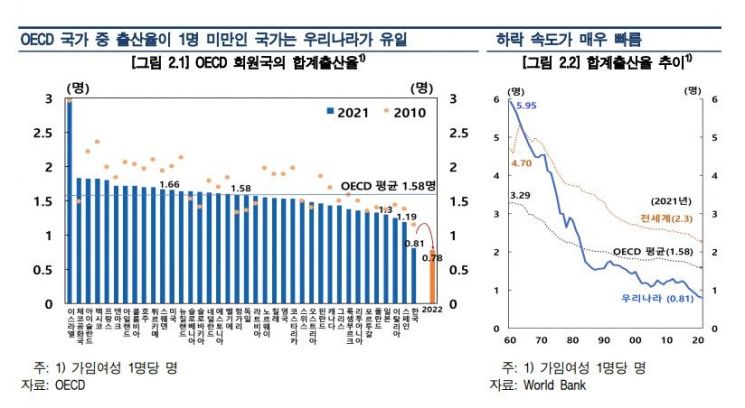
In 2021, South Korea's total fertility rate was 0.81, the lowest among the 38 member countries of the Organisation for Economic Co-operation and Development (OECD). An analysis has emerged warning that if the unprecedented global low birthrate and aging population are not effectively addressed, the country could experience negative growth in the 2050s. With the total fertility rate dropping further to 0.78 in 2022 and expected to decline even more this year, projections indicate that the total population could fall below 40 million by around 2070. Foreign media have also focused on South Korea's steep decline in birthrate, diagnosing that this rapid population decrease is more severe than the population collapse in 14th-century Europe during the Black Death.
On the 3rd, the Bank of Korea released an economic outlook report titled "Causes, Impacts, and Measures of Extreme Population Structure in Ultra-Low Fertility and Ultra-Aged Society," stating, "If low birthrate and aging are not properly addressed, significant difficulties are expected in both growth and distribution." The Bank warned that if South Korea does not respond to low birthrate and aging through policy measures, there is a 68% probability of zero or negative growth in the 2050s and a 90% probability that the population will fall below 40 million by 2070.
Foreign media have also expressed serious concerns about South Korea's rapid decline in birthrate. Ross Dowsett, a columnist for The New York Times (NYT), wrote on the 2nd (local time) in a column titled "Is South Korea Disappearing?" that the low birthrate could even lead to North Korea choosing to invade the South. He pointed out, "The inevitable neglect of the elderly generation, vast ghost cities and desolate high-rise buildings, and the emigration of young generations burdened by elder care with no future prospects will emerge," adding, "If South Korea struggles to maintain a competent field army, North Korea, with a total fertility rate of 1.8, might at some point consider invading the South."
According to the Bank of Korea, South Korea's aging population structure is progressing at the fastest rate in the world, with low birthrate contributing 70% and increased life expectancy 30%. As of last year, the proportion of the population aged 65 and over was 17.5%, and by 2025, it is expected to exceed 20%, entering an ultra-aged society. This is about seven years after entering an aged society in 2018, making South Korea the fastest among OECD countries that have already entered an ultra-aged society. According to United Nations (UN) population projections, South Korea's elderly population proportion will surpass Japan's from 2046, becoming the highest among OECD member countries, and by 2062, it will overtake Hong Kong to become the country with the highest elderly population proportion worldwide.
Youth Avoid Childbirth Due to High 'Competitive Pressure' and 'Anxiety'
The report analyzed the causes of ultra-low fertility, the fundamental cause of the aging population structure, across various layers and found that ultra-low fertility is linked to the high 'competitive pressure' felt by young people and 'anxiety' related to employment, housing, and child-rearing. The Bank of Korea commissioned Gallup to conduct a survey of 2,000 adults aged 25 to 39 nationwide. The results showed that the average desired number of children among groups feeling high competitive pressure was 0.73, which is 0.14 fewer than the 0.87 average among groups feeling low competitive pressure. Additionally, an experiment analyzing which economic costs (housing, education, medical expenses) particularly cause low fertility confirmed that the 'burden of housing costs' lowers the intention to marry and have children.
One of the main causes of South Korea's low birthrate is the low employment rate. The employment rate for those aged 15 to 29 was 46.6% last year, significantly lower than the OECD average of 54.6%. The quality of employment has also declined due to an increase in non-regular jobs. The proportion of non-regular workers among wage earners aged 15 to 29 rose from 31.8% in 2003 to 41.4% last year, an increase of 9.6 percentage points. Comparing temporary workers across countries, South Korea ranked second highest among 34 OECD countries at 27.3%, just behind the Netherlands. The average monthly wage ratio of regular to non-regular workers expanded from 1.5 times in 2004 to 1.9 times in 2023.
Gap Between Regular and Non-Regular Workers Deepens Low Birthrate in Metropolitan Areas
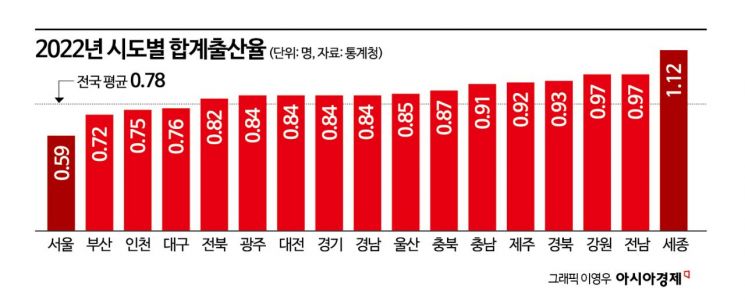
Furthermore, it was clear that the higher the population density and housing prices (jeonse prices), the lower the birthrate. Looking at the total fertility rate by city and province, Sejong City had a total fertility rate of 1.12 last year, while Seoul, with the lowest rate, was only 0.59, showing significant regional disparities. Hwang In-do, head of the Macroeconomic Research Division at the Bank of Korea Economic Research Institute, emphasized, "We need to alleviate the dual structure of the labor market to reduce competition for quality jobs and ease employment insecurity," adding, "Housing prices should be stabilized to reduce housing anxiety, and measures should be prepared to reduce competitive pressure by easing metropolitan concentration and moving away from entrance exam-focused education."
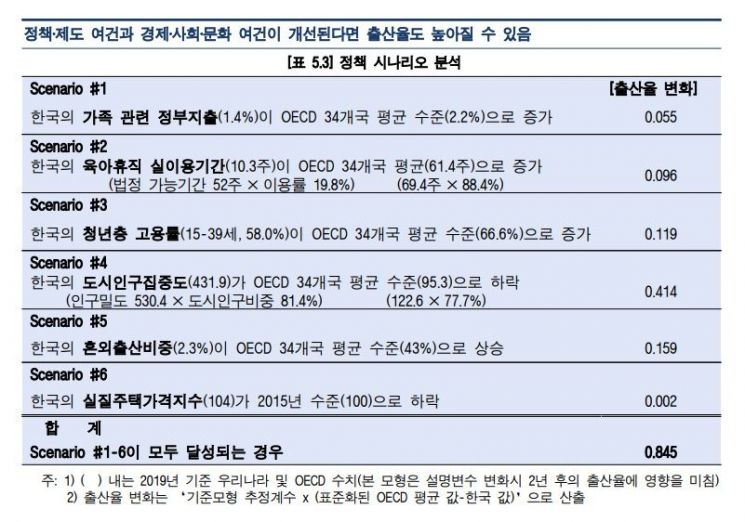
The Bank of Korea attracted attention by presenting a policy scenario analysis in this report, suggesting that if policy, institutional conditions, and economic, social, and cultural environments improve, the fertility rate could rise to the 1% range. First, if the employment rate of South Korean youth (aged 15 to 39, currently 58%) increases to the OECD average of 66.6%, the fertility rate would rise by 0.12. Particularly, if the actual usage period of parental leave in South Korea, currently only 10.3 weeks, increases to the OECD average of 61.4 weeks, the fertility rate would increase by 0.1, potentially rebounding the total fertility rate into the 1% range. If South Korea raises family-related government spending, currently only 1.4% of GDP, to the OECD average of 2.2%, the fertility rate would increase by 0.06. If the real housing price index (104) falls to the 2015 level (100), the fertility rate would increase by 0.002. Although difficult to change in the short term, if South Korea's urban population concentration (431.9) falls to the OECD average (95.3), and the proportion of out-of-wedlock births (2.3%) rises to the OECD average of 43%, the fertility rate would increase by 0.41 and 0.16 respectively. If all six scenarios mentioned above are achieved, the fertility rate could increase by 0.85 from the current level.
Researcher Hwang said, "Although there are policies for work-family balance, the serious problem is that they are 'practically unusable.' It is urgent to increase the use of parental leave among men and workers in small and medium-sized enterprises, and workplace culture must also change." He added, "If various policy efforts improve employment, housing, and child-rearing conditions to raise the fertility rate by about 0.2, South Korea's potential growth rate could increase by an average of 0.1 percentage points in the 2040s."
© The Asia Business Daily(www.asiae.co.kr). All rights reserved.
![Clutching a Stolen Dior Bag, Saying "I Hate Being Poor but Real"... The Grotesque Con of a "Human Knockoff" [Slate]](https://cwcontent.asiae.co.kr/asiaresize/183/2026021902243444107_1771435474.jpg)


















