April 4 '2023 Hanwha Battery Day' Held
World's Only Supplier of Complete Secondary Battery Process Equipment
Hanwha Corporation announced on the 4th that it aims to achieve sales of 1.4 trillion KRW in secondary battery process equipment by 2027, aspiring to become the world's number one secondary battery equipment company.
Hanwha Momentum held a secondary battery business briefing, "2023 Hanwha Battery Day," at the 63 Building in Yeongdeungpo-gu, Seoul, on the same day, and announced that it would achieve this goal based on four core strategies: ▲ the world's first unmanned coding technology ▲ the world's largest sintering furnace (950℃ high-temperature kiln) ▲ full-scale turnkey solution business for all processes ▲ commercialization of AI-based smart factories.
Yang Gi-won, CEO of Hanwha Momentum, said, "Today's event is a meaningful occasion to explain Hanwha Momentum's secondary battery manufacturing solution business and declare the company's vision," adding, "As a total solution provider covering all processes of the secondary battery industry, we will contribute to securing the competitiveness of Korea's secondary battery industry."
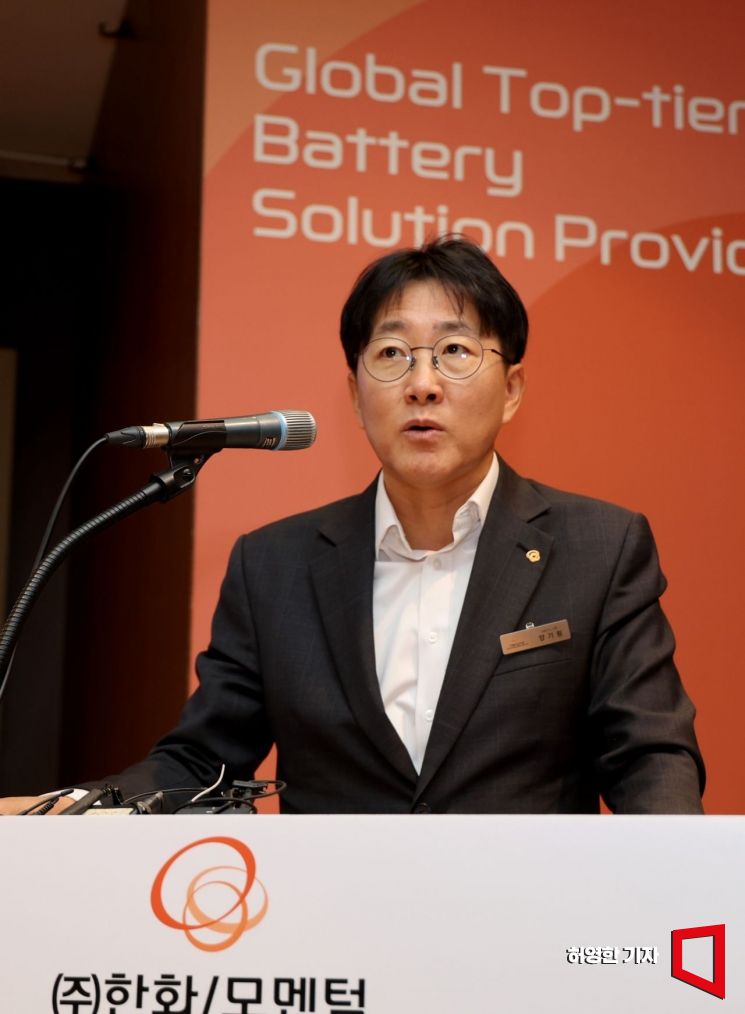 Hanwha's Momentum division's secondary battery business was introduced at the Hanwha Battery Day event held at the 63 Building in Seoul. Yang Gi-won, CEO of Hanwha/Momentum, is delivering the welcome speech. Photo by Younghan Heo younghan@
Momentum is responsible for eco-friendly industrial equipment businesses such as secondary battery equipment and solar power equipment among Hanwha Corporation's three business divisions (Global, Construction, Momentum). It officially entered the secondary battery business in 2009 by launching material and electrode process equipment.
It is the only company in the world that can supply equipment for all processes of secondary batteries, from cathode material production processes to cell processes (electrode, assembly, formation) and module pack processes. Momentum's cumulative order amount for the third quarter of this year reached 777.2 billion KRW, already surpassing last year's total of 594.2 billion KRW, and the total order backlog exceeded 1.5 trillion KRW.
Ryu Yang-sik, head of the secondary battery business division, said, "The biggest differentiating factor of Momentum compared to competitors is that it is technologically closest to the smartest solution." He added, "Except for some rapidly growing Chinese companies, global battery equipment companies have not yet reached the level of large corporations. Momentum, having secured the stability and economies of scale of a large corporation, can respond more advantageously to the significant changes ahead."
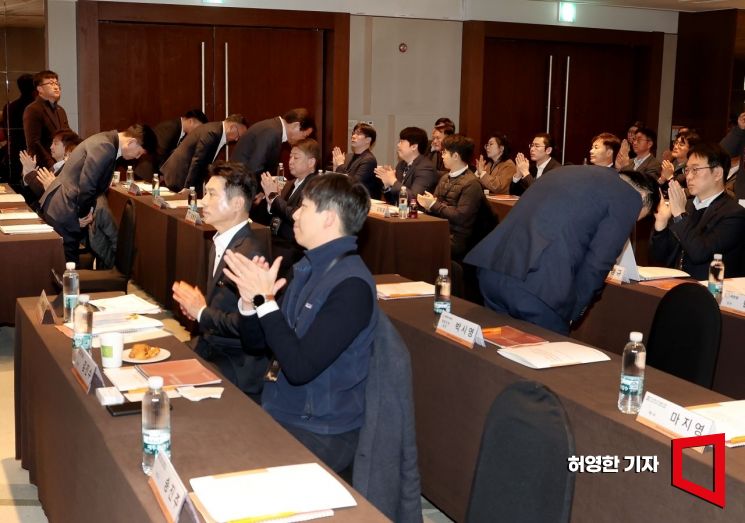 The Hanwha Battery Day event introducing Hanwha's Momentum division's secondary battery business was held at the 63 Building in Seoul. Hanwha Momentum executives are greeting the attendees. Photo by Huh Younghan younghan@
Technology development is also conducted in collaboration with group companies. Lee Hyung-seop, head of the R&D Center, said, "We are implementing a convergence development strategy by utilizing the group company network," and "We are jointly researching new processes in the material process field with group companies." He added, "With the emergence of new materials and new processes such as all-solid-state batteries, which are mentioned as next-generation batteries, and silicon-based anode process technology for improving energy density, securing related equipment performance is a matter of survival for equipment companies," emphasizing, "We are focusing on technology development centered on productivity and cost."
Momentum is developing next-generation cathode material process equipment, silicon anode process equipment, all-solid-state and dry electrode process equipment, and next-generation form factor assembly equipment. Lee said, "We plan to complete development such as autonomous coating next year," and "The commercialization timeline for future technologies like all-solid-state process equipment and dry electrode manufacturing technology is expected to be between 2028 and 2030."
Regarding new equipment demand for LFP batteries, Ryu said, "China produces and sells them 30% cheaper than us and has even attracted attention from global major OEMs, which is threatening to the battery industry," but added, "The process and equipment are similar to ternary batteries, so for equipment companies, it opens a new market, which is advantageous for us." He continued, "When battery companies build new lines, we will naturally participate as well."
© The Asia Business Daily(www.asiae.co.kr). All rights reserved.
![Clutching a Stolen Dior Bag, Saying "I Hate Being Poor but Real"... The Grotesque Con of a "Human Knockoff" [Slate]](https://cwcontent.asiae.co.kr/asiaresize/183/2026021902243444107_1771435474.jpg)












