IFRS17 Introduction 'Optical Illusion' for Life Insurers
Insurance Sales Down and Investment Losses -90%, but Net Profit 1.5 Times Higher Than Previous Year
Non-Life Insurers Steady... Gap in Net Profit with Life Insurers Widens to 3.6 Trillion Won
FSS "Uncertainty Remains... Caution Needed in Financial Soundness Management"
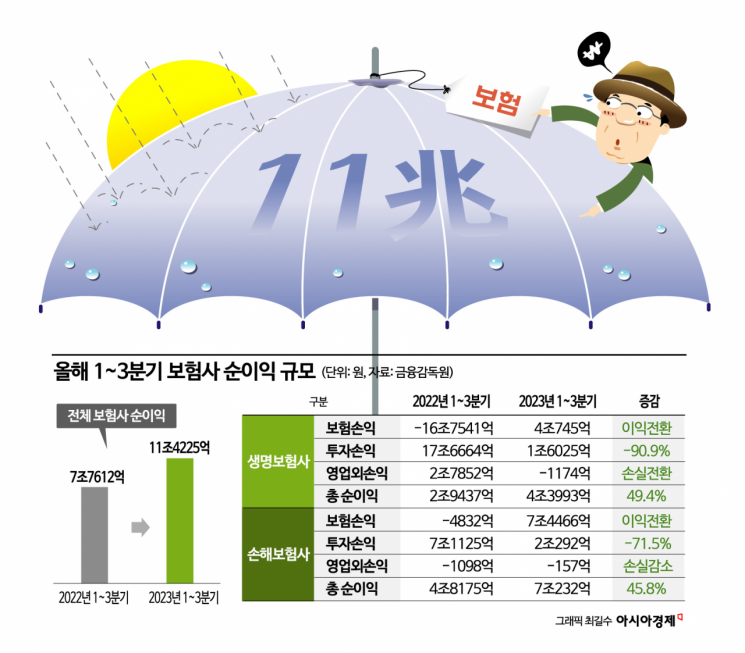
The cumulative net profit of domestic insurance companies for the third quarter of this year has surpassed 11 trillion won. This is interpreted not purely as an improvement in the business environment but largely as an effect of changes in accounting standards. By sector, both sales and net profits of non-life insurers overwhelmingly outpaced those of life insurers.
According to data compiled by the Financial Supervisory Service on the 3rd, the net profit of 53 insurance companies (22 life insurers and 31 non-life insurers) from January to September this year was 11.4225 trillion won, an increase of 47.2% (3.6613 trillion won) compared to the same period last year. Although operating performance improved, it is also evaluated that there was a significant optical illusion effect caused by the introduction of the new accounting standard IFRS17.
The net profit of life insurers was 4.3993 trillion won, up 49.4% (1.4556 trillion won) from the same period last year. Despite investment gains decreasing to 1.6025 trillion won, about one-tenth of last year's 17.6664 trillion won due to rising interest rates and other factors, net profit increased nearly 1.5 times. This is seen as benefiting from the 'optical illusion effect' due to changes in accounting standards. In fact, life insurers recorded a loss of 16.7541 trillion won in the insurance sector from the first to third quarters last year but turned to a net profit of 4.0745 trillion won in the same period this year. Although the insurance premium income, which is equivalent to sales for insurers, decreased by more than 1 trillion won, the sharp increase in net profit is analyzed to be due to the introduction of IFRS17 and IFRS9 this year, accounting standards that allow insurance liabilities to be measured at fair value and costs to be amortized over time.
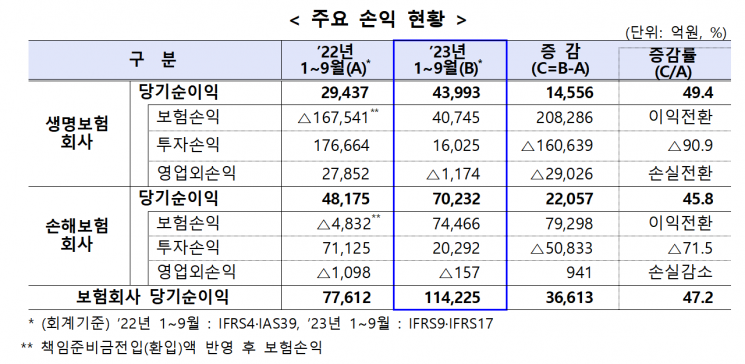
The net profit of non-life insurers was 7.0232 trillion won, up 45.8% (2.2057 trillion won) from the same period last year. The gap between the net profits of life and non-life insurers widened sharply from about 2 trillion won in the first to third quarters last year to about 3.6 trillion won this year. Even considering the impact of accounting standard changes, the difference in business conditions was significant. This is attributed to the steady performance of automobile insurance even after COVID-19. However, investment gains also fell sharply by 71.5% year-on-year to 2.0292 trillion won, similar to life insurers.
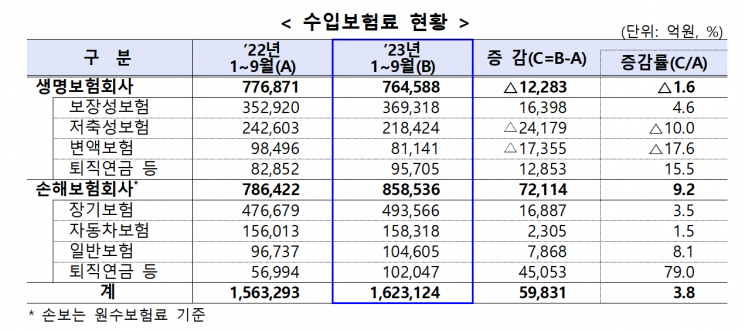
There was a mixed performance in the insurance sales sector as well. The premium income of life insurers was 76.4588 trillion won, down 1.6% (1.2283 trillion won) from the same period last year. While protection-type insurance (4.6%) and retirement pensions (15.5%) increased, sales of savings-type (-10.0%) and variable insurance (-17.6%) declined due to wider interest rate fluctuations and a weakened stock market.
On the other hand, the gross written premiums of non-life insurers reached 85.8536 trillion won, up 9.2% (7.2114 trillion won) during the same period. Each insurance type?long-term (3.5%), automobile (1.5%), and general (8.1%)?showed steady growth. The gross written premiums for retirement pensions increased by 79.0% year-on-year to 10.2047 trillion won due to business expansion.
Meanwhile, the return on assets (ROA) of insurance companies rose by 0.54 percentage points year-on-year to 1.32%, but the return on equity (ROE) fell by 0.49 percentage points to 9.06% during the same period. Although net profit increased, this was due to an increase in net assets following changes in accounting standards.
In fact, the total assets of insurance companies decreased by 12.0% from the end of last year to 1,153.4 trillion won. Both life and non-life insurers saw declines of 11.4% and 13.4%, respectively. Conversely, equity capital increased by 89.1% to 168.1 trillion won. The Financial Supervisory Service explained, "With the change in accounting standards, asset items such as insurance contract loans, unamortized new contract costs, and insurance receivables were reflected as insurance liabilities, and asset values decreased due to losses on investment assets. Nevertheless, liabilities decreased even more significantly due to the fair value measurement of insurance liabilities."
The Financial Supervisory Service emphasized that since this performance is largely influenced by accounting system changes and financial market uncertainties remain, proactive management of financial soundness is necessary. A representative from the Financial Supervisory Service stated, "Due to increases in fair value measurement financial assets and expanded volatility in interest rates and exchange rates, profits and financial fluctuations may be significant in the fourth quarter of this year. We plan to conduct thorough ongoing monitoring of key risk factors such as insurance operations, alternative investments, and real estate project financing (PF) loans, especially focusing on insurers with weak financial soundness."
© The Asia Business Daily(www.asiae.co.kr). All rights reserved.



















