Lee Proposes Construction of 'Buffer Zone' at Gaza Border
Post-War Gaza Strip Plan Takes Shape
Israel conducted airstrikes on 400 targets across the Gaza Strip on the 2nd (local time), the second day after the temporary ceasefire with the Palestinian militant group Hamas ended, according to foreign media reports.
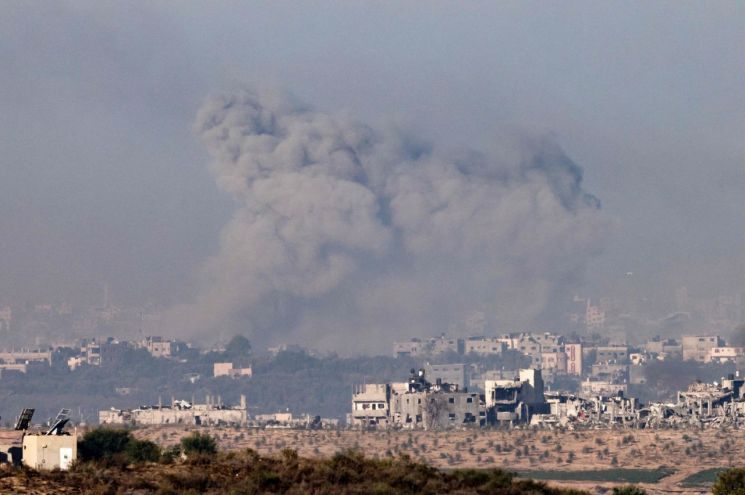
According to the Times of Israel, intense clashes are underway in the northern and southern Gaza Strip, with the army, navy, and air force attacking terrorist targets. In the southern region, including Khan Yunis where 50 targets were struck, extensive damage was inflicted. It is known that some Hamas leadership members are hiding in this area. Ground forces in northern Gaza also attacked Islamic sites used by another militant group, the Palestinian Islamic Jihad (PIJ).
Israeli military radio reported that Israeli forces are conducting operations in the northern Gaza cities of Gaza City and Beit Lahia. Israeli military spokesperson Jonathan Conricus stated, "We are currently striking Hamas military targets throughout the Gaza Strip."
Hamas is also reported to have ordered its members to engage in combat. A source close to Hamas said that Hamas militants have been instructed to resume fighting and defend the Gaza Strip. There are concerns that casualties on both sides will increase if clashes between Israel and Hamas intensify.
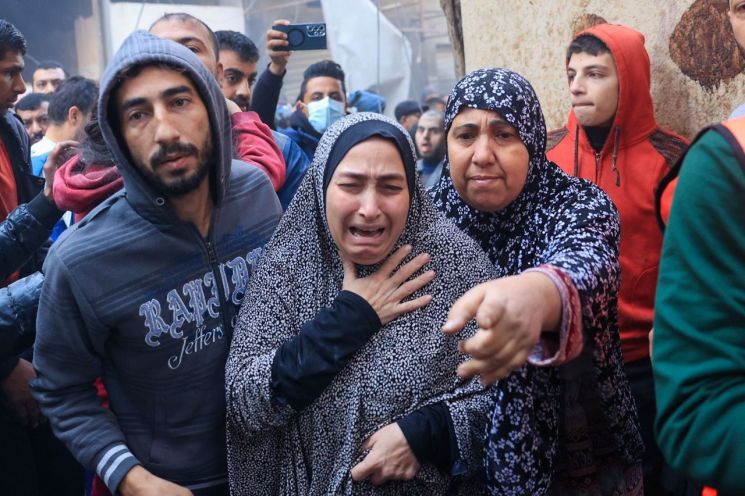 On the 1st (local time), in the Rafah refugee camp in southern Gaza Strip, a Palestinian woman is wailing as injured victims from an Israeli airstrike are being transported by ambulance.
 [Image source=AFP Yonhap News]
There are also concerns that the war between Israel and Hamas could expand to surrounding areas. The Syrian Ministry of Defense announced that Israeli forces attacked near Damascus, the capital of Syria, on the same day. The Syrian Ministry of Defense stated, "At 1:35 a.m. today, Israel conducted airstrikes from the occupied Golan Heights, targeting several locations near Damascus."
The Syrian Observatory for Human Rights, a civil war monitoring group, reported that two Hezbollah fighters were killed in Damascus on the same day. The previous day, Lebanon's pro-Iran militant group Hezbollah announced that one of its members was killed in an Israeli airstrike.
Meanwhile, Israel is reportedly considering establishing a buffer zone along the Gaza Strip border after the war with Hamas ends. The buffer zone is intended to prevent attacks by armed groups post-conflict and is planned to be set up on the Palestinian side of the Gaza border. Sources said Israel has communicated this plan to several neighboring Arab countries, including Egypt, Jordan, the United Arab Emirates (UAE), and Saudi Arabia.
This is interpreted as Israel concretizing its post-war Gaza Strip plans amid no Arab country expressing willingness to manage or maintain security in Gaza in the future. A source said, "Israel wants a buffer zone between Gaza and Israel to prevent Hamas and other armed groups from infiltrating or attacking the country."
Ofir Falk, foreign policy advisor to Israeli Prime Minister Benjamin Netanyahu, said, "The buffer zone plan is more detailed than that," adding that it is based on a three-stage process for the post-Hamas era. He explained that the three-stage process involves the destruction of Hamas, the demilitarization of the Gaza Strip, and the de-radicalization of Gaza, noting, "The buffer zone could be part of the demilitarization process."
The size of the buffer zone has not been disclosed. The entire Gaza Strip is approximately 40 km long and 5 to 12 km wide, with a population of 2.3 million, making it densely populated. If a buffer zone is established here, the Palestinian autonomous territory will effectively shrink.
© The Asia Business Daily(www.asiae.co.kr). All rights reserved.


















