Plenary Session Held Without Yeo's Attendance, Two Impeachment Proposals Passed
'Lee Jae-myung Investigation Command' Lee Jeong-seop and 'Accusation Leak' Son Jun-sung
Withdrawn and Resubmitted... Second Prosecutor Impeachment in Constitutional History
On the 1st, the National Assembly passed impeachment motions against Lee Jeong-seop, acting prosecutor at Daejeon High Prosecutors' Office who led the Lee Jae-myung Democratic Party representative's North Korea remittance case, and Son Jun-sung, deputy chief prosecutor at Daegu High Prosecutors' Office, who is suspected of the so-called 'report solicitation' scandal. This is the second impeachment of prosecutors following Andong-wan, deputy chief prosecutor at Busan District Prosecutors' Office, in September this year. The People Power Party criticized the plenary session, stating that it was convened solely to pass the impeachment motions despite no agreement between the ruling and opposition parties, and raised concerns about the neutrality of the Speaker of the National Assembly.
During the plenary session, the National Assembly voted on the impeachment motion against Prosecutor Son Jun-sung, passing it with 175 votes in favor, 2 against, 1 abstention, and 2 invalid votes out of 180 members present. The impeachment motion against Prosecutor Lee Jeong-seop was also passed with 174 votes in favor, 3 against, 1 abstention, and 2 invalid votes. The People Power Party did not participate in the vote.
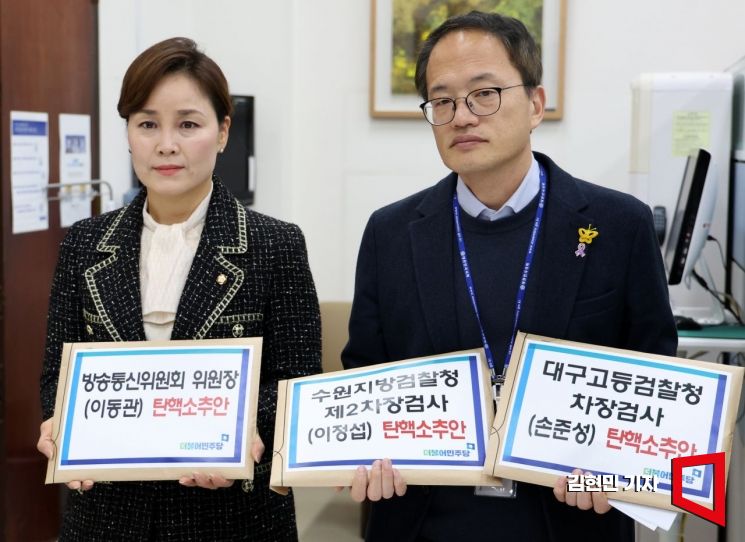 Park Jumin (right), Senior Deputy Floor Leader of the Democratic Party of Korea, and Im Okyung, Floor Spokesperson, submitted an impeachment proposal against Lee Donggwan, Chairman of the Korea Communications Commission, Lee Jeongseop, Second Deputy Chief Prosecutor of the Suwon District Prosecutors' Office, and Son Junseong, Deputy Chief Prosecutor of the Daegu High Prosecutors' Office, at the National Assembly's Legislative Affairs Office on the 28th. Photo by Kim Hyunmin kimhyun81@
This is the second time impeachment motions against two prosecutors have been reported to the National Assembly. Previously, the Democratic Party reported the impeachment motions to the plenary session on the 9th of last month. At that time, the People Power Party was expected to filibuster the Yellow Envelope Act and the three broadcasting laws, fulfilling the 24-hour waiting period required for impeachment motion processing. Impeachment motions must be voted on between 24 hours and 72 hours after being reported to the plenary session. However, after the People Power Party abandoned the filibuster, the Democratic Party voluntarily withdrew the impeachment motions and re-reported them on the 30th of last month. Initially, impeachment motions against Prosecutors were reported alongside an impeachment motion against Lee Dong-gwan, Chairman of the Korea Communications Commission, but since Chairman Lee resigned voluntarily before the plenary session and President Yoon Seok-yeol accepted the resignation, the impeachment motion lost its effect.
The main grounds for impeachment against Prosecutors Son and Lee are 'abuse of authority.' Democratic Party lawmaker Joo Cheol-hyun emphasized in his explanatory remarks that day, "Despite violating their responsibilities and duties as prosecutors, Prosecutors Son and Lee have continued to serve in key prosecutorial positions, maintaining an abnormal situation."
In Prosecutor Son's case, ahead of the 21st National Assembly general election, while serving as the head of the Investigation Information Policy Office at the Supreme Prosecutors' Office during then Prosecutor General Yoon Seok-yeol's tenure, he abused his authority by collecting information unrelated to investigations about the National Assembly election, directing the collection and review of real-name court rulings related to stock manipulation allegations involving Yoon's spouse and collusion suspicions involving Han Dong-hoon, then chief prosecutor and now Minister of Justice. Lawmaker Joo pointed out, "He provided the opposition party, then the United Future Party, with complaints naming reporters who had reported on the stock manipulation and collusion allegations, encouraging them to file complaints with the prosecution, thereby making these individuals subjects of investigation or using the complaints to quell public criticism of Prosecutor General Yoon, his family, and the prosecution organization. Furthermore, during this process, he illegally leaked investigation information obtained through his duties by photographing real-name court rulings containing personal information with his mobile phone camera and sending them via Telegram to opposition party National Assembly candidates."
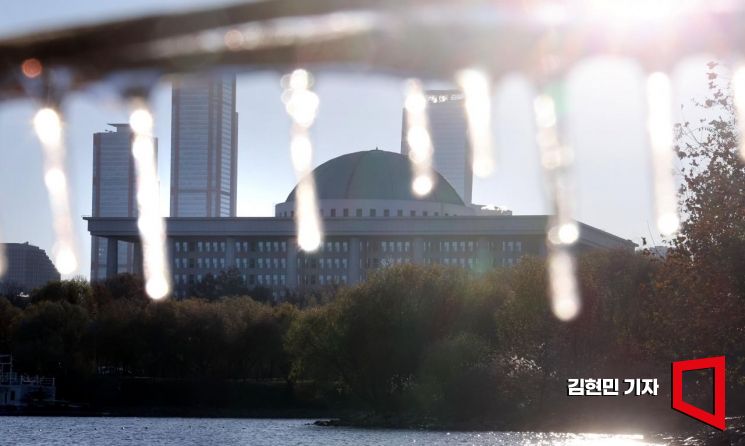 Icicles have formed on the Han River near the National Assembly ahead of the plenary session on the 30th, as the ruling and opposition parties continue their confrontation by reintroducing the impeachment motion against Lee Dong-gwan, Chairman of the Korea Communications Commission and prosecutor of the Democratic Party. Photo by Kim Hyun-min kimhyun81@
Regarding Prosecutor Lee, Lawmaker Joo pointed out that he illegally accessed crime records, investigation records, and criminal records of ordinary citizens unrelated to investigations and provided them to his relatives. He said, "He illegally used ski resorts and resort facilities that were closed due to COVID-19 gathering bans, violating quarantine laws and the Anti-Graft Act, and unlawfully facilitated reservations for seniors, colleagues, and prosecutors at a golf course operated by his wife, providing illegal convenience for golf course use. It has also been confirmed that he exerted undue influence in a drug case involving his brother-in-law to suppress the investigation."
However, the People Power Party criticized the impeachment as retaliatory, noting that Prosecutor Lee had experience leading investigations related to Democratic Party leader Lee Jae-myung. Kim Ki-hyun, leader of the People Power Party, said, "Does the Democratic Party see the National Assembly solely as a means to maintain its power and protect leader Lee Jae-myung? We ask the public to stop this evil act of using impeachment as an illegal tool to protect the Democratic Party leader."
To persuade the passage of the impeachment motions, Lawmaker Joo pointed out that Prosecutor Son was indicted last May by the High-ranking Officials' Crime Investigation Office (PCC) for serious crimes including violations of the Public Official Election Act and was undergoing a first trial, yet was promoted to chief prosecutor in September this year, and Prosecutor Lee was transferred to a key position. He said, "The only way to stop the reckless behavior of the Yoon Seok-yeol government and prosecution, which have lost self-regulation, is impeachment as granted to the National Assembly by the Constitution."
The People Power Party strongly opposed the process of passing the impeachment motions, accusing the Speaker of the National Assembly of violating the duty of neutrality. They argued that the plenary session was agreed upon for passing next year's budget and that holding a plenary session solely to pass impeachment motions was not allowed. The People Power Party also submitted a resolution urging the resignation of Speaker Kim Jin-pyo as a party stance, pointing out that the Speaker, who maintains an independent status and should mediate between ruling and opposition parties neutrally (Article 20-2 of the National Assembly Act), violated current law.
Meanwhile, this is the second time an impeachment motion against a prosecutor has passed the National Assembly, starting with Andong-wan, deputy chief prosecutor at Busan District Prosecutors' Office, who was suspected of retaliatory prosecution against victims of the 'Seoul city public official spy fabrication case' in September. That case, also led by the Democratic Party, was the first in constitutional history. The Constitutional Court is scheduled to hold the first hearing on the impeachment trial to decide on Andong-wan's dismissal on the 2nd of next month.
© The Asia Business Daily(www.asiae.co.kr). All rights reserved.
![Clutching a Stolen Dior Bag, Saying "I Hate Being Poor but Real"... The Grotesque Con of a "Human Knockoff" [Slate]](https://cwcontent.asiae.co.kr/asiaresize/183/2026021902243444107_1771435474.jpg)

















