Student Cafeteria Meal Ticket Sales Increase by 25%
"Due to Dining Out Price Burden, Frequent Visits to School Meals"
Nearby Commercial Area Sales Plummet... "Even Canceling Savings Accounts"
As high inflation continues, university students have tightened their belts by saving on food expenses by eating at school cafeterias and sharing rent with friends. The commercial districts near universities, hit by this wave, are seeing fewer customers and declining sales, leaving business owners distressed.
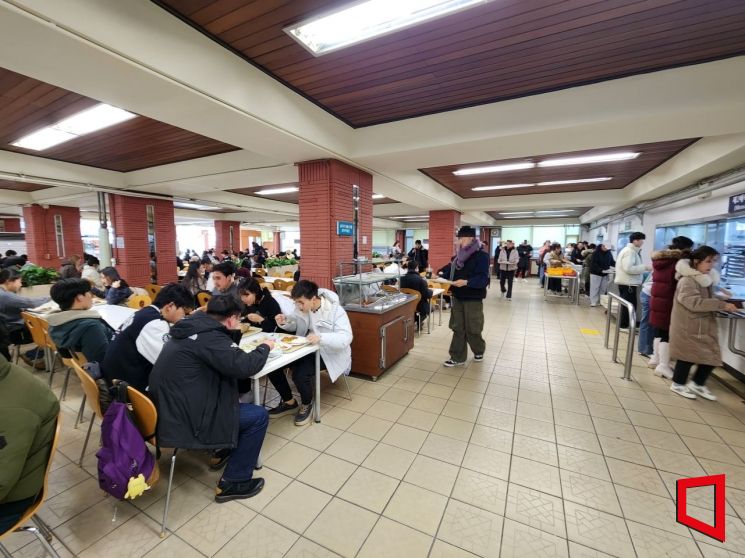 At around 11:50 a.m. on the 30th of last month, students at the Humanities and Sciences Building cafeteria of Hankuk University of Foreign Studies in Dongdaemun-gu, Seoul, are receiving meals and eating, having come in search of affordable school meals.
 Photo by Tae-won Choi skking@
At around 11:50 a.m. on the 30th of last month, the student cafeteria in the Humanities and Social Sciences Building at Hankuk University of Foreign Studies in Dongdaemun-gu, Seoul, was bustling with students coming out for lunch. The line of students waiting to receive food stretched all the way to the entrance. Due to a shortage of table seats, it was common to see students asking strangers for permission to share tables. The menu that day included gukbap (soup with rice) and hamburger steak. The prices were 3,500 won and 4,000 won respectively, about half the price of similar dishes sold at external restaurants. Ramen and gimbap were 2,100 won, and a bowl of rice was 700 won. Jeong (23, male), a third-year student at Hankuk University of Foreign Studies, said, "It's hard to get a full meal for 10,000 won outside the school, but even if I eat two dishes at the student cafeteria, it's cheaper than buying food outside, so I come here often." According to Hankuk University of Foreign Studies, the total number of meal tickets sold at the Humanities and Social Sciences Building student cafeteria reached 49,340 as of October this year, nearly a 25% increase from 39,517 during the same period last year.
The situation at Kyung Hee University's Cheongwoon Hall student cafeteria nearby was similar. Bulgogi bibimbap and spicy galbijjim were priced at 5,000 won and 5,200 won respectively. The student cafeteria was crowded with students trying to eat more affordably than at external restaurants. Kim (24, male), a third-year student at Kyung Hee University, said, "Due to cost concerns, I eat lunch at the student cafeteria about four times a week." Kang (25, male), who said he is preparing for employment, added, "There were restaurants I liked, but most raised their prices this year. It's burdensome to visit them every day like before, so I often use the student cafeteria."
According to the National Statistical Office's national statistics portal, the consumer price index for dining out rose by 5.4% in the third quarter of this year. Prices at Korean restaurants, snack bars, pork cutlet shops, and gukbap restaurants in Hoegi-dong and Imun-dong also increased by about 1,000 to 2,000 won during the second semester of this year. Newly opened pubs charged 6,000 won for soju and beer, even in university areas. Due to the steep price increases, university students have increasingly favored relatively inexpensive school meals.
Rising housing costs are also a burden for university students. On the 23rd of last month, Station3, which operates the real estate information platform 'Dabang,' analyzed the average monthly rent and maintenance fees for one-room apartments near 10 major universities in Seoul registered on Dabang. For a one-room apartment (exclusive area under 33㎡) with a deposit of 10 million won, the average monthly rent was 590,000 won, and the average maintenance fee was 80,000 won. This represents increases of 5.72% and 14.31%, respectively, compared to 560,000 won rent and 70,000 won maintenance fees during the same period last year. To reduce costs, some university students choose to live with friends. Gu (23, male) from Busan, who recently started living with a hometown friend, said, "We decided to live together in a two-room apartment with a monthly rent of 730,000 won. The friend I live with is a Hanyang University student, and even though he commutes by subway, he came to this area (Hoegi-dong) to reduce rent expenses." Shin (21, female), who is about to renew her one-room lease at the end of the year, is cutting living expenses to pay rent. She said, "The maintenance fee was raised from 60,000 won to 100,000 won. It's practically like the rent has increased. I used to have VIP status on delivery apps, but as I reduced the number of orders, I have now dropped to the lowest tier."
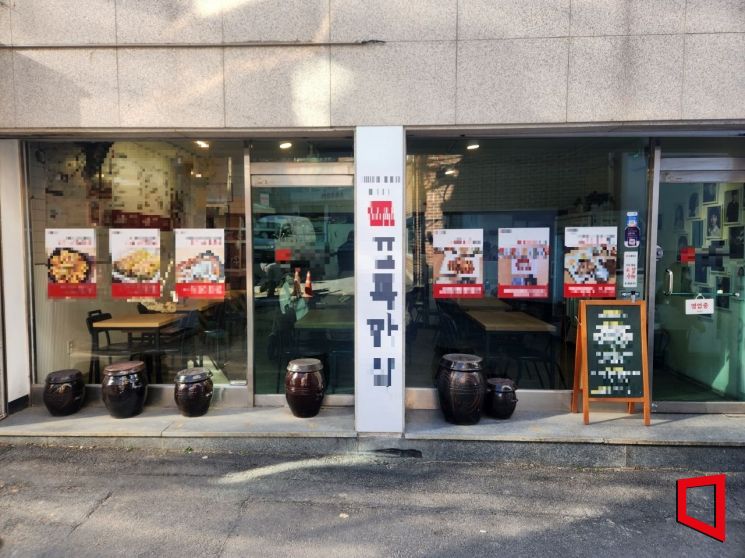 Around 12 PM on the 30th of last month, a restaurant near the main gate of Kyung Hee University in Dongdaemun-gu, Seoul. The restaurants in the dining area appeared relatively quiet despite it being lunchtime.
 Photo by Taewon Choi skking@
As students cut back on spending, the worries of merchants in university areas have deepened. Unlike the crowded student cafeterias that day, nearby restaurants appeared quiet even during lunchtime. A donburi restaurant near the main gate of Kyung Hee University, with prices ranging from 8,000 to 10,000 won, had customers at only 6 out of 10 tables during peak lunch hours. Another udon restaurant with similar prices had only half of its 18 tables occupied. Kim (61, female), who runs a naengmyeon (cold noodles) restaurant, said, "Last year, I used to make about 200,000 to 300,000 won during lunch, but these days, there are many days when I can't even make 100,000 won. With rising loan interest rates and falling sales, running the business itself is difficult. I even had to break a savings account I was using to pay rent." Kim (64, female), who runs a snack bar, sighed, "I only had two groups of customers for lunch today. Raw material costs have increased by more than 30%, but sales have dropped to less than half, which is a desperate situation." Kim (39, female), the owner of a budaejjigae (army stew) restaurant, said, "Prices had to be raised by 500 won due to inflation, but net profits have fallen by more than 20%."
© The Asia Business Daily(www.asiae.co.kr). All rights reserved.


















