Health Industry Promotion Agency Director Cha Sundo Takes on Healthcare Sales
"Focused only on Beauty So Far... Need for Large-scale and Specialized Development"
"Due to low birth rates and aging population, China's demographic structure is rapidly changing. Korea should seek opportunities to enter related markets by promoting advanced healthcare services such as health checkups, obstetrics and gynecology infertility treatments, and spinal treatments."
On the 29th of last month, Cha Sun-do, President of the Korea Health Industry Development Institute, reiterated his determination to enter the Chinese healthcare market during a meeting at the Weijing International Hotel in Beijing, China. He stated that now, as China's demographic structure rapidly changes, it is the right time to expand Korea's technological expertise, which has so far focused on the beauty sector, into large-scale and specialized markets. He had just begun a five-day business trip from November 28 to December 2, visiting Shanghai, Beijing, and Shenyang to sign memorandums of understanding with relevant Chinese institutions and large hospitals.
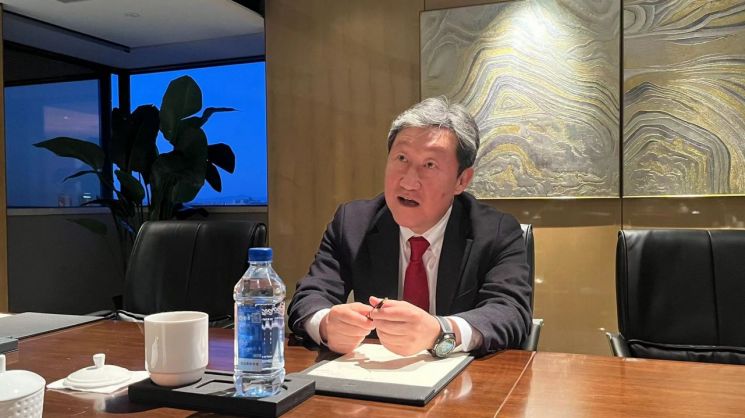 On the 29th of last month, Cha Sun-do, President of the Korea Health Industry Development Institute, held an interview with reporters at the Weijing International Hotel in Beijing, China. (Photo by Kim Hyun-jung)
He explained, "Korea needs to focus on China's demographic changes to devise an entry strategy. Although China introduced the three-child policy in 2021, the age of first marriage is rising, leading to many infertility cases. There are also endless opportunities in the silver market, such as rehabilitation hospitals tailored to the aging trend, and the angel market related to childbirth and postpartum care." He added, "It is difficult for China to meet demand on its own, so there are ongoing attempts to establish good overseas partnerships."
President Cha continued, "With rising income levels and increased health awareness after COVID-19, there is a growing demand for premium medical services. We are preparing a segmented strategy by understanding China's medical special zones policy and the characteristics of each of the 31 provinces and cities."
Expectations for growth in medical device exports are also high. As of last year, Korea's medical device exports to China amounted to approximately $660 million (about 858.4 billion KRW), ranking second after the United States ($1.38 billion). This represents a 16.8% increase compared to 2018. Major export items include dental implant fixtures ($217,000, 33.0%), tissue repair biomaterials ($62,600, 9.5%), dental implant superstructures ($42,191, 6.4%), and general-purpose ultrasound diagnostic devices ($37,000, 5.6%). China's medical device industry market is valued at $31.83 billion, ranking third worldwide after the United States and Germany.
He noted, "Due to China's economic slowdown and the recent acceleration of import restrictions on medical devices, companies already in China or planning to enter need strategies and responses to import regulations. The advanced equipment products and consumables market show low technological maturity and high import dependence."
One of the key tasks of this business trip is to reconnect the medical platforms between the two countries that were interrupted by the COVID-19 pandemic. The number of Korean medical institutions entering China has grown at an average annual rate of 83% over eight years from 2016 to this year. The number of cases, which was only two in 2016, has reached 72 cumulatively this year. Among them, 47 cases (65.2%) were projects promoted with government support. However, most are limited to opening beauty-related medical institutions such as plastic surgery and dermatology, as well as consulting and technical support. Plans are also underway to systematize the dispatch of Chinese patients to Korea. The number of Chinese patients visiting Korea reached 160,000 in 2019 but sharply dropped to the 30,000 range after COVID-19. Last year, it slightly recovered to 44,000.
President Cha explained, "Since we are in a recovery phase, we are attempting to sign MOUs with medical institution associations and build platforms connecting Korean hospitals to resume the interrupted flow." He emphasized, "To cooperate with the pro-Korean Northeast Three Provinces, we plan to discuss healthcare industry cooperation with the Shenyang city government. This is a new market development for international medical projects and a task to reconnect the previously interrupted cooperation." He added, "We will also restore cooperation systems established with major local governments such as Shandong, Jiangsu, and Hunan to discover new projects and continuously provide participation opportunities for domestic medical institutions."
The Development Institute manages about 900 billion KRW in research and development (R&D) budgets entrusted by the Ministry of Health and Welfare, and plans to invest part of this in healthcare industry R&D including pharmaceuticals, bio, medical devices, medical services, and cosmetics. This also includes projects to attract foreign patients to Korea and help Korean hospitals and healthcare services expand overseas.
© The Asia Business Daily(www.asiae.co.kr). All rights reserved.
![Clutching a Stolen Dior Bag, Saying "I Hate Being Poor but Real"... The Grotesque Con of a "Human Knockoff" [Slate]](https://cwcontent.asiae.co.kr/asiaresize/183/2026021902243444107_1771435474.jpg)
















