MSCI Index Up 8.1% MoM
All Three Major New York Stock Indexes Rise
Inflation and Employment Slowdown Signals Impact
Corporate Bond Market Also Attracts Funds
Global Asset Rally Expected
Global stock markets showed the largest increase in three years amid expectations of the end of tightening by major countries including the United States. As funds also flowed into the corporate bond market, voices are emerging that expect a rally across global assets.
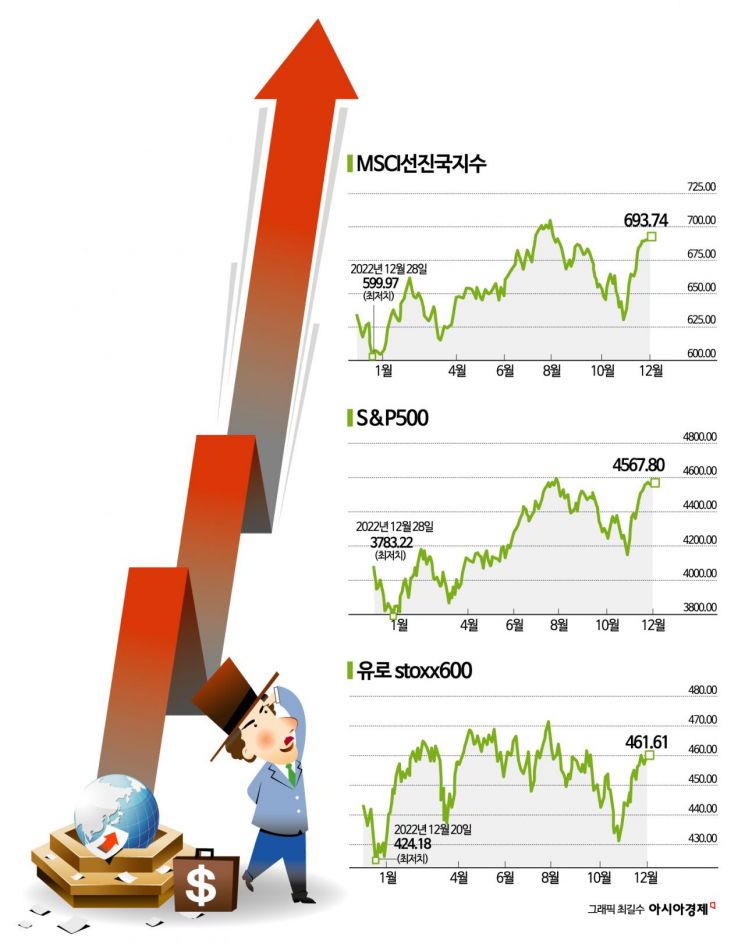
The MSCI Developed Markets Index recorded 694.74 at 10:30 a.m. local time on November 30, up 9% from the previous month. This is the largest increase since November 2020, when the stock market rebounded on hopes for a COVID-19 vaccine.
The three major indices of the New York Stock Exchange also recorded the largest monthly gains since July last year. The S&P 500, centered on large-cap stocks, the Nasdaq, focused on tech stocks, and the Dow Jones Industrial Average, composed of blue-chip stocks, rose 8.9%, 10.7%, and 9%, respectively, compared to the previous month. On that day, the Dow closed at 35,950.89, up 520.47 points (1.47%) from the previous trading day, marking the highest level this year.
This was largely influenced by signals that overheated inflation and employment are slowing down. On the same day, the U.S. core Personal Consumption Expenditures (PCE) price index for October, excluding energy and food, showed a slowdown in the rise compared to the previous month (0.2%) and the previous year (3.5%). The core PCE price index is one of the most important indicators the U.S. Federal Reserve (Fed) considers when deciding interest rates. The number of continuing unemployment claims, which counts those applying for unemployment benefits for more than two weeks, reached 1,927,000, an increase of 86,000 from the previous week, marking the highest level in two years and suggesting a cooling labor market.
The volatility (VIX) index, reflecting market investor sentiment, recorded its lowest level since the pandemic. A decline in the VIX index reflects investors' expectations that the stock market will proceed stably.
Expectations of the end of tightening are also reflected in the stock market in the Eurozone. The pan-European Stoxx 600 closed at 461.61, up 0.55% from the previous trading day. It rose 5.74% compared to the previous month. Last month, the core Consumer Price Index (CPI) rose 3.6% year-on-year, reviving investor sentiment. The core CPI was below the market expectation of 3.9%. The Eurozone's core CPI peaked at 10.6% in October last year and has been rapidly declining since. As a result, the market is observing that inflation is being controlled after the European Central Bank's (ECB) aggressive tightening, and that interest rate hikes have effectively come to an end.
As investor sentiment improves, funds are also flowing into the speculative-grade corporate bond market. According to market data research firm EPFR, $17 billion flowed into the corporate bond market last month alone. This is the largest monthly inflow since July 2020, when liquidity expanded as countries competed to loosen monetary policy due to COVID-19. The yield on speculative-grade corporate bonds, which was 9.5% at the end of October, fell to 8.56% on the 30th of last month, marking the largest monthly decline since July last year.
Some argue that this trend could be seen as a bubble forming in the asset market. If economic indicators continue to be stronger than the Fed's expectations or if the global economy next year experiences a deeper recession than expected, the stock market rally could quickly fade. Major foreign media reported, "Asset management firms Vanguard and Robeco are warning that current asset market valuations are excessively high." Thorsten Sløk, chief economist at U.S. asset management firm Apollo, also emphasized, "It is still premature for the asset market to rebound significantly," adding, "We have not yet come out of the (interest rate hike) forest."
© The Asia Business Daily(www.asiae.co.kr). All rights reserved.

















