SBI, Welcom, OK, Pepper, Korea Investment Q3 Disclosure Analysis
Average Delinquency Rate Rises from 2.9% to 6.1%
Non-Performing Loan Ratio Nearly Doubles
Net Profit Drops from 192 Billion KRW to 64.2 Billion KRW
Due to Increased Interest Expenses and Decreased Interest Income
The delinquency rate of major domestic savings banks has more than doubled in a year, increasing the need for soundness management. As interest expenses have surged significantly, net profits have also shrunk by nearly 70% compared to the previous year.
Analyzing the management disclosures of the top five domestic savings banks?SBI, Welcome, OK, Pepper, and Korea Investment?on the 1st, the average delinquency rate for these savings banks in the third quarter of this year was 6.1%. Pepper Savings Bank had the highest rate at 8.16%, followed by OK (7.29%), Welcome (5.7%), SBI (4.76%), and Korea Investment (4.73%).
The increase in delinquency rates was more than double compared to the same period last year (2.9%). Pepper Savings Bank worsened the most, rising 5.35 percentage points over one year, and SBI Savings Bank also increased by 3.32 percentage points compared to 1.44% in the third quarter of last year. Next were Welcome (2.7 percentage points), OK (2.67 percentage points), and Korea Investment (2.28 percentage points). Their average delinquency rate also rose by 1 percentage point compared to the previous quarter (5.1%).
Another soundness indicator, the ratio of non-performing loans classified as substandard or below, shows a similar trend. The average for the five savings banks in the third quarter of this year was 7.1%, up 2.9 percentage points from 4.2% last year. Pepper Savings Bank again showed the largest increase, rising 6.83 percentage points from 3.3% in the third quarter of last year to 10.13% this year. SBI rose by 3.54 percentage points, Korea Investment by 2.59 percentage points, Welcome by 2.44 percentage points, while OK slightly decreased from 7.98% to 7.11%.
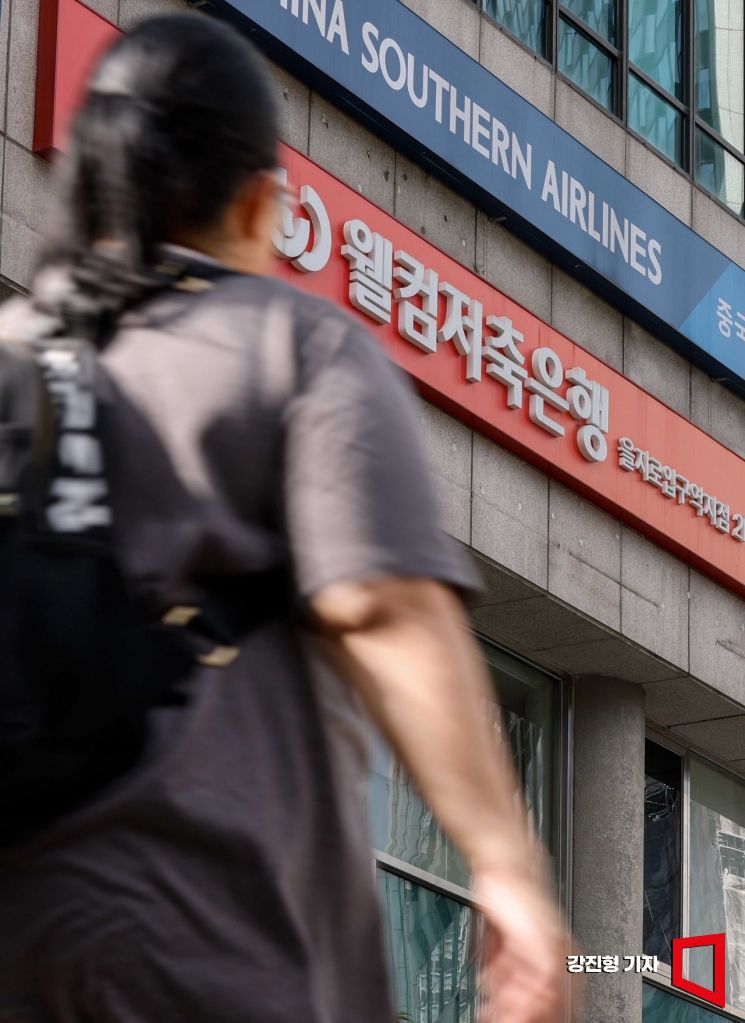 As deposit interest rates rise in the banking sector, the balance of savings and fixed deposits is increasing. The secondary financial sector is also consecutively raising interest rates on time deposits. The photo shows Welcome Savings Bank in Jung-gu, Seoul. Photo by Jinhyung Kang aymsdream@
Liquidity ratios also failed to avoid a decline. The average liquidity ratio of these savings banks dropped 4.8 percentage points from 126.4% in the third quarter of last year to 121.6% this year. The liquidity ratio is calculated by dividing liquid assets by liquid liabilities and is an indicator used to assess a financial institution’s ability to respond to sudden cash outflows. According to savings bank supervisory regulations, savings banks must maintain this ratio at 100% or higher.
Net profit decreased by 66.6% in one year. The combined net profit of the five savings banks shrank from 192 billion KRW in the third quarter of last year to 64.2 billion KRW this year. As of the third quarter this year, SBI recorded the highest net profit at 51.8 billion KRW, followed by OK with 16.9 billion KRW, Welcome with 12 billion KRW, and Korea Investment with 8.3 billion KRW. Pepper Savings Bank recorded a net loss of 24.8 billion KRW.
The sharp decline in net profit is due to increased interest expenses. The effects of high-interest special promotions on deposits and savings at the end of last year have continued until now. The combined interest expenses of these savings banks reached 532.9 billion KRW in the third quarter of this year, a 79% increase (235.3 billion KRW) compared to 297.6 billion KRW a year ago. A representative from a major savings bank forecasted, “The burden of interest expenses will continue through the fourth quarter of this year, affecting net profits.” The reduction in interest income due to narrowing loan-deposit interest rate spreads also had an impact.
Looking at the entire industry, the delinquency rate of 79 savings banks nationwide in the third quarter of this year was 6.15%, up 0.82 percentage points from 5.33% in the previous quarter, and the ratio of non-performing loans classified as substandard or below was 6.40%, up 0.79 percentage points from the previous quarter. In particular, the ratio of non-performing corporate loans classified as substandard or below rose 1.02 percentage points from 5.7% in the previous quarter to 6.72%. The BIS ratio was 14.14%, and the liquidity ratio was 139.26%.
An industry insider explained, “Although delinquency rates and the ratio of non-performing loans classified as substandard or below are generally rising, considering loss absorption capacity such as provisions for loan losses, the situation is manageable.”
© The Asia Business Daily(www.asiae.co.kr). All rights reserved.
![Clutching a Stolen Dior Bag, Saying "I Hate Being Poor but Real"... The Grotesque Con of a "Human Knockoff" [Slate]](https://cwcontent.asiae.co.kr/asiaresize/183/2026021902243444107_1771435474.jpg)











