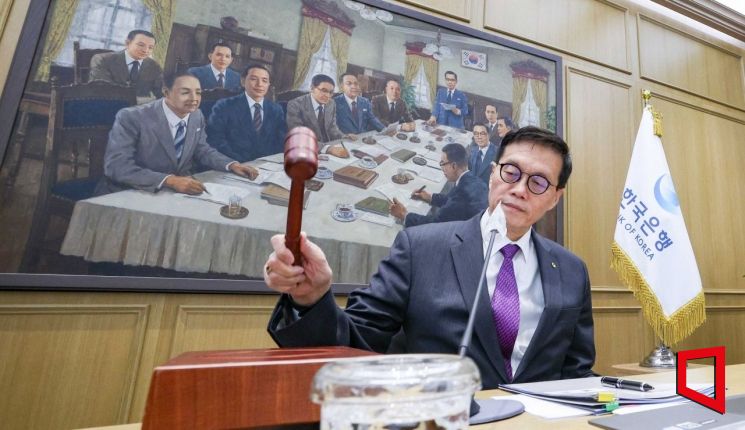
 Lee Chang-yong, Governor of the Bank of Korea, is striking the gavel at the Monetary Policy Direction Decision Meeting of the Monetary Policy Committee held on the 30th at the Bank of Korea in Jung-gu, Seoul. Photo by Joint Press Corps
On the 30th, the Monetary Policy Committee of the Bank of Korea kept the base interest rate unchanged at 3.5% for the seventh consecutive time, stating that "the inflation path is expected to be higher than initially projected" and that it "will maintain a sufficiently prolonged monetary tightening stance."
In the monetary policy direction statement released that day, the Bank of Korea's Monetary Policy Committee said, "Going forward, while monitoring the growth trend, we will operate monetary policy with attention to financial stability to ensure that the inflation rate stabilizes at the target level over the medium term."
The committee explained, "Although the inflation rate has risen higher than initially expected, it is forecasted that the underlying slowing trend will continue. Considering the increasing trend in household debt and the high uncertainty of external conditions, it is deemed appropriate to maintain the current tightening stance."
The domestic economy is expected to continue a moderate improvement trend as export sluggishness eases. However, due to the prolonged domestic and international monetary tightening stance and slow consumption recovery next year, the growth rate is expected to record 2.1%, slightly below the previous forecast of 2.2%.
The committee added, "There is high uncertainty regarding the future growth path due to the ripple effects of prolonged domestic and international monetary tightening and the development of geopolitical risks."
Domestic inflation is expected to continue a gradual slowing trend due to weakening demand pressures and declines in international oil and agricultural prices, but it is anticipated to exceed the August forecast path due to higher-than-expected cost pressures.
The committee explained, "The consumer price inflation rate will gradually decrease, reaching around 3% in the first half of next year," and "the annual inflation rate is projected to be 3.6% this year and 2.6% next year."
Furthermore, as the domestic economy continues its improving growth trend and the inflation path is expected to be higher than initially forecasted, the committee emphasized that it will maintain a sufficiently prolonged tightening stance.
The committee stated, "We will carefully monitor the inflation slowing trend, risks to financial stability, downside risks to growth, the trend of household debt increase, the monetary policy operations of major countries, and the development of geopolitical risks, and will determine the necessity of additional rate hikes accordingly."
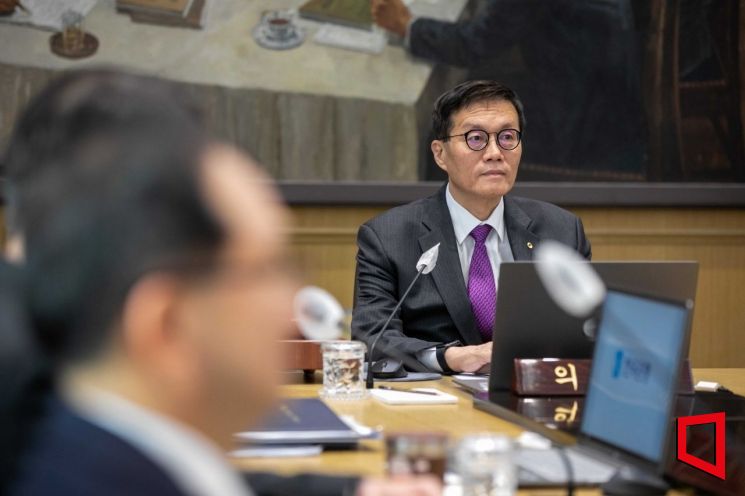 Lee Chang-yong, Governor of the Bank of Korea, is presiding over the Monetary Policy Committee meeting held on the 30th at the Bank of Korea in Jung-gu, Seoul. Photo by Joint Press Corps
Below is the full text of the monetary policy direction statement
The Monetary Policy Committee has decided to maintain the Bank of Korea's base interest rate at the current level (3.50%) until the next monetary policy direction decision. Although the inflation rate has risen higher than initially expected, it is forecasted that the underlying slowing trend will continue. Considering the increasing trend in household debt and the high uncertainty of external conditions, it is deemed appropriate to maintain the current tightening stance.
The global economy is expected to continue slowing growth due to the prolonged monetary tightening stance of major countries, despite eased concerns over additional tightening by the U.S. Federal Reserve and reduced geopolitical risks. Inflation in major countries is slowing but remains at a high level, and core inflation is decreasing slowly. In international financial markets, major country government bond yields have fallen sharply, and the U.S. dollar has weakened considerably. Going forward, the global economy and international financial markets are expected to be influenced by movements in international oil prices, the slowing trend of global inflation, monetary policy operations and ripple effects of major countries, and the development of the Israel-Hamas conflict.
The domestic economy has continued a moderate improvement trend as export sluggishness eases. Employment is generally favorable, with an increase in the number of employed persons and a sustained low unemployment rate. The domestic economy is expected to continue improving due to sustained export recovery. This year's growth rate is expected to be 1.4%, in line with the August forecast, and next year it is expected to rise to 2.1%, but slightly below the previous forecast of 2.2% due to prolonged domestic and international monetary tightening and slow consumption recovery. There is high uncertainty regarding the future growth path due to the ripple effects of prolonged domestic and international monetary tightening and the development of geopolitical risks.
The consumer price inflation rate rose to 3.8% in October due to increases in agricultural and energy prices, but the core inflation rate decreased to 3.2%. Short-term inflation expectations rose slightly to 3.4%. Going forward, domestic inflation is expected to continue a gradual slowing trend due to weakening demand pressures and declines in international oil and agricultural prices, but it is anticipated to exceed the August forecast path due to higher-than-expected cost pressures. The consumer price inflation rate is expected to gradually decrease, reaching around 3% in the first half of next year, with annual rates projected at 3.6% this year and 2.6% next year (August forecasts were 3.5% and 2.4%, respectively). Core inflation is expected to continue a moderate slowing trend, with projected increases of 3.5% this year and 2.3% next year (August forecasts were 3.4% and 2.1%, respectively). Future inflation paths are expected to be influenced by movements in international oil prices, exchange rates, and domestic and international economic trends.
In financial and foreign exchange markets, geopolitical risks have eased, and expectations for the end of the U.S. Federal Reserve's rate hikes have increased, easing risk aversion. Treasury bond yields and the KRW/USD exchange rate have fallen sharply, and stock prices have risen. Household loans have continued to increase, mainly in housing-related loans, while the rate of housing price increases has slowed.
The Monetary Policy Committee will operate monetary policy by monitoring the growth trend and ensuring that the inflation rate stabilizes at the target level over the medium term while paying attention to financial stability. As the domestic economy continues its improving growth trend and the inflation path is expected to be higher than initially forecasted, the committee will maintain the monetary tightening stance for a sufficiently prolonged period until it is confident that the inflation rate will converge to the target level. In this process, it will carefully monitor the inflation slowing trend, risks to financial stability, downside risks to growth, the trend of household debt increase, the monetary policy operations of major countries, and the development of geopolitical risks, and will determine the necessity of additional rate hikes accordingly.
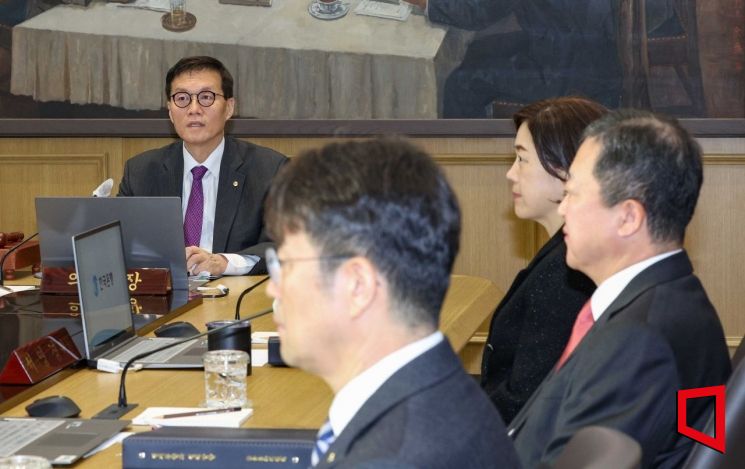 Lee Chang-yong, Governor of the Bank of Korea, is presiding over the Monetary Policy Direction Decision Meeting of the Monetary Policy Committee held on the 30th at the Bank of Korea in Jung-gu, Seoul. Photo by Joint Press Corps
© The Asia Business Daily(www.asiae.co.kr). All rights reserved.
![Clutching a Stolen Dior Bag, Saying "I Hate Being Poor but Real"... The Grotesque Con of a "Human Knockoff" [Slate]](https://cwcontent.asiae.co.kr/asiaresize/183/2026021902243444107_1771435474.jpg)













