First domestically produced endoscope
Main player is startup Medintech
Endoscope market dominated by Japanese and German companies
"Competitive in terms of control unit weight, system, and price"
A domestic startup has thrown its hat into the endoscope market dominated by Japanese and German companies. The protagonist is Medintech, a startup established in 2020. The endoscope developed by Medintech received Class 2 medical device approval from the Ministry of Food and Drug Safety in August. They are currently awaiting approval for an endoscope product for experienced medical professionals, targeting final productization by the end of this year or early next year.
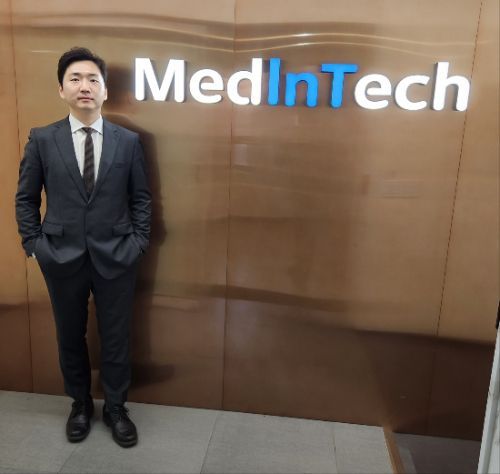
Lee Chi-won, CEO of Medintech (34), said in an interview on the 30th, "We expect that domestically produced endoscope products will be supplied to hospitals in Korea as early as the first half of next year, or at the latest in the second half." He added, "We will start full-scale competition with overseas companies in terms of price and quality." Currently, the price of Japanese endoscope products exceeds 100 million KRW, and new products are known to be twice as expensive. CEO Lee said, "As a startup, early market entry is important, so we plan to set the price at around 90 million KRW."
An endoscope is a highly precise medical device that allows checking for abnormalities in the stomach, colon, etc., by inserting a scope with a camera through the mouth or anus. Among the endoscopes introduced in Korean hospitals, 7 out of 10 are products from the Japanese medical device company Olympus. The rest of the market has been led by Japanese and German companies such as Fujifilm, Pentax, and Karl Storz.
The domestically produced endoscope developed by Medintech is characterized by motorizing the control section, which is the hardware of the endoscope. Existing products require medical staff to hold a handle weighing up to 750g and manually control the scope’s up, down, left, and right movements. Medintech reduced the handle weight to about half and installed motors inside the system to control the scope’s movements using only electrical signals.
Additionally, the company stated that they significantly reduced the misdiagnosis rate by integrating artificial intelligence (AI) into the endoscope system. The AI alerts the doctor if any areas are missed during observation of the stomach or colon and accurately informs the size of lesions. When there is foreign matter on the camera, the AI algorithm automatically judges and executes the air-water section control, which medical staff previously operated in real-time using their left middle or index finger.
CEO Lee said, "The misdiagnosis rate of existing endoscopes reaches 30%. This indicates a significant skill gap between experienced and inexperienced doctors." He predicted, "If the domestically produced endoscope being released this time takes hold, it will be very positive in terms of patient safety."
Medintech aims to enter overseas markets by 2025. CEO Lee said, "We expect to obtain U.S. Food and Drug Administration (FDA) approval within two years." In the mid to long term, they plan to combine surgical robot technology with endoscopes to create a robotic medical device platform company that performs natural orifice surgeries.
CEO Lee graduated from the Department of Mechanical and Aerospace Engineering at Seoul National University and completed an integrated master's and doctoral program in biomedical engineering at Dong-A University Graduate School. He founded Medintech with researchers while working at the Korea Electrotechnology Research Institute. Within one year of its founding, Medintech was selected for a 9.5 billion KRW government-led pan-ministerial full-cycle medical device R&D project. Separate from the five-year endoscope development project, they received customized consulting including patent analysis, medical staff feedback, and one-on-one matching with the Ministry of Food and Drug Safety.
CEO Lee said, "Many startups face setbacks during the product development stage, but it is not easy to get such opportunities. Thanks to the government’s will to nurture startups and localize core technologies, we were able to receive support appropriately and timely."
© The Asia Business Daily(www.asiae.co.kr). All rights reserved.

















