Remove School Bell or Change Melody
Reflecting Educational Trends Emphasizing Diversity and Autonomy
In Japan, the number of schools eliminating the bell that signals the start and end of classes is increasing. The idea is to cultivate students' ability to manage their time independently rather than imposing uniform rules. Various attempts are underway, ranging from completely removing the bell with a 'No Chime' system to significantly reducing the number of rings or creating unique melodies for students.
According to the Hokoku Newspaper on the 29th, schools across Japan, including Ishikawa Prefecture and Tokyo, are increasingly not using the 'Kin Kon Kan Kon' chime bell. Kin Kon Kan Kon is the Japanese expression for the 'Ding Dong Deng Dong' sound, referring to the Westminster Abbey chime melody used as a school bell in Korea as well.
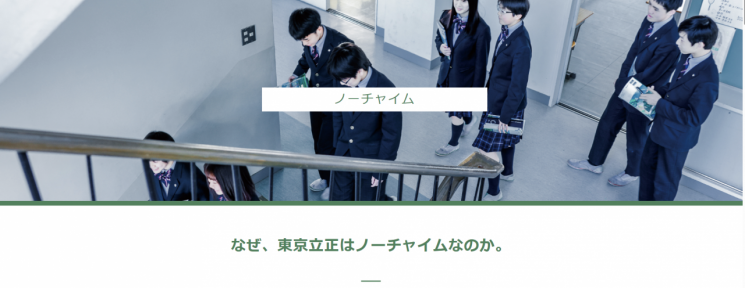 Tokyo Ritsumei High School advertising 'No Chime' on the school website. (Photo by Tokyo Ritsumei High School website)
At Kanazawa High School in Kanazawa City, a 'No Chime' system that completely eliminates the class bell has been in place since 2019. Students check their watches individually and move accordingly, sitting down autonomously even without the bell ringing. Students say, "At first, we were confused, but we got used to it." The school stated, "This fosters students' autonomy, which soon leads to growth. We hope many other schools adopt this as well."
Ritsumei High School in Tokyo, which actively promotes the No Chime system, states on its website, "If you want to know the value of a week, ask a weekly magazine editor. If you want to know the value of an hour, ask lovers eagerly awaiting a meeting," and adds, "Time does not start with a signal like a chime bell. Classes should begin by one's own will."
Nomishi Hamacho Elementary School has set the bell to ring only three times a day since last September. The bell rings five minutes before morning classes start, during the long break, and five minutes before lunch ends?only three times in total. A representative from the Nomishi Board of Education said, "This is to help children internalize the importance of keeping time themselves," adding, "No students are late for class. Rather, it has become an opportunity for staff to recognize the importance of how to use time during lessons."
Some schools have changed the 'Ding Dong Deng Dong' melody used by most schools. Kanazawa Municipal Koshomachi Junior High School, which opened this year, has been using a modified version of the school song melody as the bell sound since the second semester. The principal personally commissioned a music professor to create it, and students have given positive feedback, saying it "makes them feel good about attending class."
Kashima Elementary School in Nakanoto Town created two different bell sounds for the start and end of classes. The bell signaling the start of class uses a melody that relaxes the mind to boost study motivation, while the bell signaling the end of class is a short tune considerate of students waiting for break time.
In fact, there are no regulations regarding class bells in Japan. Fifty years ago, teachers or staff carried bells themselves to signal the start and end of classes. Later, with the introduction of broadcasting equipment, the chime bell naturally replaced this practice, and the melody used at that time seems to have become fixed.
The Hokoku Newspaper reported, "In today's education, which values diversity and autonomy, the movement to entrust time management to students is spreading," adding, "Because students manage their time responsibly, this trend is receiving positive evaluations."
© The Asia Business Daily(www.asiae.co.kr). All rights reserved.

















