November OECD Economic Outlook
The Organisation for Economic Co-operation and Development (OECD) has lowered South Korea's economic growth rate for this year to 1.4% and raised the growth rate for next year to 2.3%.
On the 29th (local time), the OECD released its "Economic Outlook" containing these details. The OECD publishes economic outlooks for all member countries every June and November, and interim economic outlooks for the Group of Twenty (G20) in March and September.
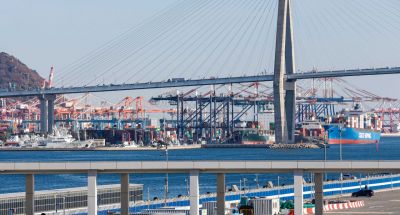 Export containers are being loaded onto a ship at Busan North Port. Photo by Kang Jin-hyung aymsdream@
South Korea's growth forecast for this year was downgraded by 0.1 percentage points compared to last September. At that time, the OECD had projected South Korea's economic growth rate at 1.5%, the same as in June. The 1.4% growth rate matches the forecasts presented by the International Monetary Fund (IMF), the government, the Bank of Korea, and the Korea Development Institute (KDI).
The growth forecast for next year was revised upward by 0.2 percentage points from 2.1% in September. The OECD assessed that domestic demand is improving in the second half of next year, and the semiconductor sector is showing signs of recovery as it passes the bottom supported by demand recovery.
The global growth forecast for 2023 was lowered from 3.0% to 2.9%, while the forecast for next year remains unchanged at 2.7%.
South Korea's inflation rate for this year is predicted to be 3.6%, 0.2 percentage points higher than the previous 3.4%. Next year is also expected to see inflation at 2.7%, 0.1 percentage points higher than the previous 2.6%. However, the inflation rates for the G20 countries are higher than South Korea's, at 6.2% this year and 5.8% next year.
The OECD suggested that, given South Korea's rapidly aging population and the resulting increase in pension and healthcare expenditures, it is necessary to enhance fiscal soundness through the implementation of fiscal rules. It also advised regulatory innovation, reducing the productivity gap between large corporations and small and medium-sized enterprises, and resolving the dual structure of the labor market.
© The Asia Business Daily(www.asiae.co.kr). All rights reserved.
![Clutching a Stolen Dior Bag, Saying "I Hate Being Poor but Real"... The Grotesque Con of a "Human Knockoff" [Slate]](https://cwcontent.asiae.co.kr/asiaresize/183/2026021902243444107_1771435474.jpg)
















