5 Major Banks + IBK Temporarily Waive Early Repayment Fees Until Year-End
Prepayment penalties in the banking sector, which amount to 300 billion KRW annually, will be improved to reflect only the essential costs actually incurred according to loan handling. In addition, major banks will temporarily waive prepayment penalties on all household loans until the end of the year.
The Financial Services Commission announced on the 29th that it had prepared the "Prepayment Penalty System Improvement and Consumer Burden Reduction Plan" after two months of consultations with the banking sector since October.
According to the current Financial Consumer Protection Act, prepayment penalties are generally prohibited, but an exception allows fees to be charged if the borrower repays the loan within three years from the loan date.
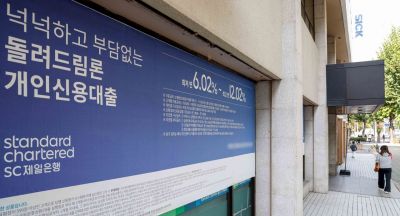 On the 23rd, as domestic market interest rates and bank loan interest rates rapidly rise, a banner displaying loan interest rates is hung on the exterior wall of a commercial bank in Seoul. Photo by Jinhyung Kang aymsdream@
Accordingly, banks impose prepayment penalties to cover losses caused by disruptions in fund management due to early repayment, as well as administrative and recruitment costs related to loans. The amount collected annually by banks from these prepayment penalties is approximately 300 billion KRW.
However, the authorities believe that the current prepayment penalties in the banking sector do not reflect the actual costs incurred and are imposed uniformly without considering the characteristics of each bank's business practices, lacking reasonable standards. For example, the prepayment penalty for mortgage loans at the five major commercial banks is uniformly set at 1.2% for variable interest rates and 1.4% for mixed (fixed) interest rates, and many banks charge the same fees for mobile sign-ups as for branch sign-ups.
In contrast, various countries operate prepayment penalty systems that reflect operational costs and the characteristics of banks. In Australia, for instance, variable interest rate loans only reflect administrative costs related to loan execution, while fixed interest rate loans may also include interest costs.
Accordingly, the authorities plan to improve the system by enhancing the transparency and rationality of prepayment penalties through revisions to supervisory regulations and model guidelines, as well as strengthening comparison and disclosure. First, guidelines will be established to ensure that prepayment penalties reflect only the essential costs actually incurred according to loan handling.
In this case, prepayment penalties will reflect only actual costs such as losses from disruptions in fund management and administrative and recruitment costs related to loans. For example, differences in actual recruitment costs between face-to-face and non-face-to-face channels will be reflected in the fees, and interest cost inclusion will be restricted for variable interest rate and short-term loan products beyond actual costs incurred.
Furthermore, charging additional items beyond those specified in the guidelines for prepayment penalties will be defined as unfair business practices and prohibited. Additionally, detailed matters such as the target and rates of prepayment penalties will be determined by banks based on customer characteristics and product types, and disclosure of fee imposition, exemption status, and calculation criteria will be required to encourage healthy competition among banks.
The authorities will proceed with legislative notice of supervisory regulations and revisions to model guidelines after collecting opinions from the banking sector regarding this prepayment penalty system reform.
Meanwhile, the five major commercial banks (KB Kookmin, Shinhan, Hana, Woori, NH Nonghyup) and Industrial Bank of Korea will temporarily waive prepayment penalties for one month until the end of this year to encourage early repayment of household loans. Additionally, the temporary prepayment penalty waiver program for vulnerable borrowers will be extended for one year and operated until early 2025.
© The Asia Business Daily(www.asiae.co.kr). All rights reserved.

















