Plans for Subordinate Legislation of the Maritime Port Function Maintenance Act
Current Law Allows Only Up to 6 Foreign Crew Members
Must Be Filled with Koreans, but Manpower Shortage Widespread
If Carrying 11 Koreans, No Limit on Foreign Crew Members
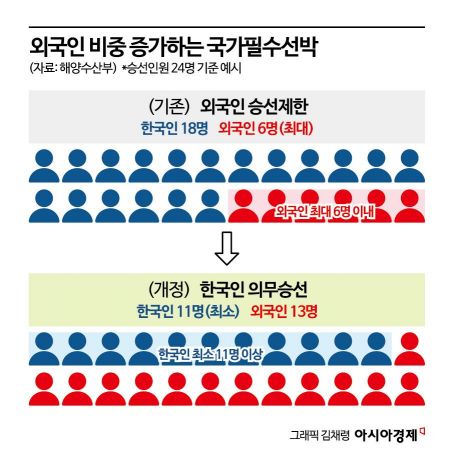
The government will ease foreign recruitment regulations for nationally essential vessels struggling with manpower shortages. Previously, the number of foreign crew members was limited to six per ship, but from now on, only 11 Korean crew members need to be hired. Arithmetically, this makes it possible to operate nationally essential vessels primarily staffed by foreigners.
According to a comprehensive report by Asia Economy on the 29th, the government plans to submit the “Plan for Revising Subordinate Legislation of the Maritime Port Function Maintenance Act” containing these details to the Cabinet meeting in February. This plan is a follow-up measure to the “Seafarer Job Innovation Plan” announced last July. Since it concerns manpower, it underwent a tripartite agreement among labor, management, and government in June.
Nationally essential vessels are ships designated and operated to ensure stable transportation of goods during emergencies such as wartime or when maritime port functions face significant disruptions. Ships with an international gross tonnage of 10,000 tons or more and a vessel age under 20 years are selected annually based on shipping company applications. Currently, 88 vessels including bulk carriers, oil tankers, and container ships are designated across 17 shipping companies.
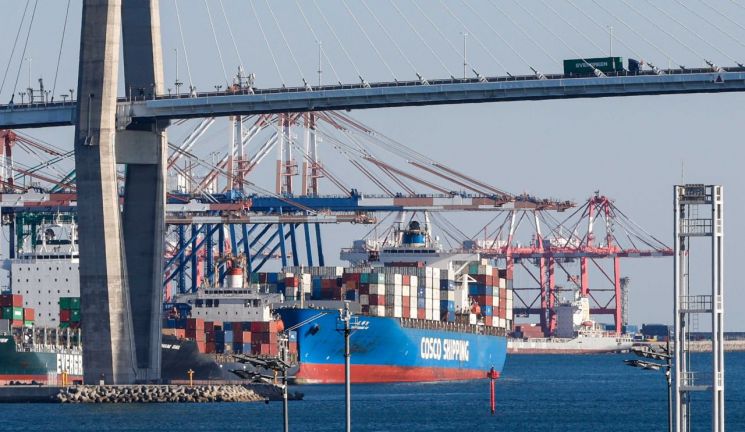 Export containers are being loaded onto a ship at Busan North Port. Photo by Kang Jin-hyung aymsdream@
The plan’s core is to change the seafarer criteria for nationally essential vessels from “foreign crew restrictions” to “mandatory Korean crew boarding.” Currently, up to six foreigners can board each nationally essential vessel. This measure ensures stable navigation and vessel safety since these ships operate during emergencies. When the nationally essential vessel system began in 2006, there were many maritime workers, and it also aimed to protect domestic jobs.
Starting next year, only 11 Koreans need to be onboard, and the remaining crew can be foreigners. Assuming a nationally essential vessel with 24 crew members, currently, only six foreigners can board, and the remaining 18 must be Koreans. After the law is amended, only the minimum 11 Koreans need to be hired, and the remaining 13 can be foreigners. From 2025, the mandatory Korean crew requirement will be further relaxed to 10.
27,000 Decrease in Korean Seafarers... "Vacation Expansion" Amid Manpower Shortage
The change in crew composition standards aims to solve the maritime industry’s manpower shortage. The number of Korean seafarers sharply declined from 58,818 in 2000 to 38,758 in 2010, and 31,867 last year. Due to aging, the proportion of those aged 60 or older reaches 44%. About 80% of maritime specialist seafarers employed through maritime universities or maritime high schools switch to land-based jobs within five years. Shipping companies must fill the departing Korean seafarers with foreigners, but regulations made this impossible.
The labor union accepted the change decisively to improve working conditions despite the reduction in domestic jobs. According to the Korea Shipping Association, about 200 Korean seafarer jobs will decrease due to the measure. Instead, labor, management, and government agreed to reduce the paid leave claim condition for seafarers from six months to four months and to uniformly extend paid leave by two days per shipping company. In the future, assuming sufficient replacements are secured, they plan to gradually consider a “4 months onboard, 2 months leave” system.
Strict exceptions will also be relaxed. Current law temporarily allows foreign seafarer restrictions to be lifted only in special circumstances such as “ship repairs.” However, under the amendment, exceptions will be recognized if a seafarer is injured or ill and the ship is in a foreign port, making it difficult to board Korean seafarers.
The government emphasized that even if the number of foreigners on nationally essential vessels increases, there will be no disruption in vessel operation during emergencies. A Ministry of Oceans and Fisheries official explained, “Through meetings with related agencies, we confirmed that the standard change will not cause problems,” adding, “Shipping companies also judged that the amendment is fully feasible based on their past vessel operation experience.”
© The Asia Business Daily(www.asiae.co.kr). All rights reserved.
![Clutching a Stolen Dior Bag, Saying "I Hate Being Poor but Real"... The Grotesque Con of a "Human Knockoff" [Slate]](https://cwcontent.asiae.co.kr/asiaresize/183/2026021902243444107_1771435474.jpg)

















