Manufacturers Withdraw Price Hike Plans After Review
'Struggling' with One-Sided Policy That Requires Bearing Losses
Shrinkflation and Other 'Tricks' Only Result
"Even if price increases are immediately suppressed, the effect on stabilizing inflation will inevitably be limited. It will become a boomerang that increases the burden on both manufacturers and consumers in the future." A food industry official pointed out this in a phone interview with Asia Economy on the 30th, regarding the confusion occurring in the industry over product price hikes. The concern arose as manufacturers have repeatedly planned price increases due to soaring overall costs since early this year, only to postpone or cancel them. The government, citing price management as a justification, has begun closely monitoring the prices of 28 items with high consumer sensitivity such as bread, milk, and snacks on a daily basis, and is pressuring related companies through consumer groups to refrain from raising prices.
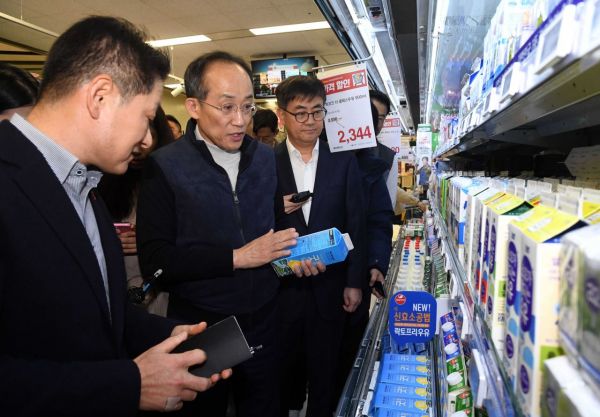 Deputy Prime Minister and Minister of Economy and Finance Choo Kyung-ho (center) visited the Emart Yongsan store in Yongsan-gu, Seoul, on the afternoon of the 14th to check prices. Photo by Kang Jin-hyung aymsdream@
History Repeats Itself from Over a Decade Ago... "Just a Stopgap Measure"
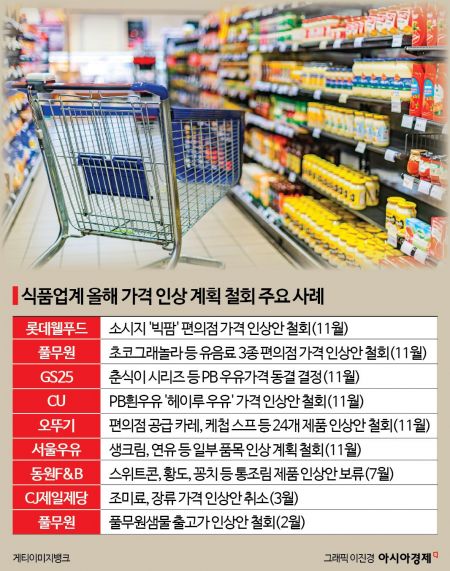
As the government takes a tough stance, cases of food companies withdrawing their price increase plans have become frequent this year. On the 28th, Pulmuone and Lotte Wellfood withdrew plans to raise convenience store prices of some products by about 10%. On the 27th, Ottogi decided to raise prices by around 10% on 24 company products sold in convenience stores, including curry and ketchup, starting from the 1st of next month, but canceled the plan within half a day. The company explained, "Due to the accumulated burden of raw material prices since last year continuing into this year, we planned to raise prices, but decided to participate in stabilizing livelihoods amid the difficult economic situation under the government's price stabilization policy." Industry insiders believe Ottogi felt pressured by the government and public opinion.
Earlier this month, Seoul Milk Cooperative abandoned plans to raise prices on some items such as fresh cream and condensed milk, and in July, Dongwon F&B postponed canned food price hikes. In March, CJ CheilJedang canceled plans to raise prices on seasonings and sauces, and in February, Pulmuone halted plans to raise Pulmuone Spring Water's ex-factory price by about 5%.
This movement resembles the price management policy implemented during the Lee Myung-bak administration over a decade ago. At that time, ahead of the 19th general election in 2012, the government mentioned introducing a 'Price Management Real-Name System' from the New Year and closely monitored price increases in the food industry. Accordingly, manufacturers handling ramen, bread, alcoholic beverages, etc., postponed price hikes and entered a 'wait-and-see' mode. An industry official pointed out, "With raw materials and incidental costs trending upward, manufacturers had limits to enduring losses," adding, "Pressuring only companies sensitive to consumer opinion is unlikely to be effective in the long term."
"Side Effects Worsen... Support Measures Must Be Presented Together"
As monitoring to suppress price increases intensifies, side effects are emerging in the food industry. Representative examples include 'shrinkflation,' where product volume is reduced while prices remain the same or increase, and 'skimflation,' where ingredients are used less or replaced with cheaper ones, lowering product quality. Meanwhile, while prices of B2C (business-to-consumer) products chosen by consumers are frozen or manufacturers withdraw price hike plans, B2B (business-to-business) suppliers providing food raw materials to companies are gradually raising product prices, causing fairness controversies.
A food industry official lamented, "People are sensitive to a 100 won increase in ramen, bread, or fruit prices, but show no interest in how much the prices of raw materials supplied to companies increase." Another official said, "If prices cannot be raised, companies inevitably minimize losses by reducing product volume," adding, "If guidelines are issued to clearly notify consumers of product changes, we plan to follow them and reduce volume."
There is also criticism that enforcing price control by squeezing only companies is a 'showy administration.' One official said, "With rising interest rates, energy costs, and loan interest, how much help would lowering food prices by a few hundred won be to household income?" He advised, "Rather than applying pressure across the board, it is desirable to more clearly distinguish essential items closely related to consumers' lives and manage prices focusing on them." He added, "Overall costs for purchasing raw materials and production have risen, and labor costs have significantly increased due to minimum wage hikes," emphasizing, "The government should consider manufacturers' difficulties, present support measures, and request cooperation in suppressing price increases."
© The Asia Business Daily(www.asiae.co.kr). All rights reserved.
![Clutching a Stolen Dior Bag, Saying "I Hate Being Poor but Real"... The Grotesque Con of a "Human Knockoff" [Slate]](https://cwcontent.asiae.co.kr/asiaresize/183/2026021902243444107_1771435474.jpg)












