"I am confident that hiring retired private-sector experts as specialized examiners will become a powerful government tool to support the industry. The Korean Intellectual Property Office (KIPO) will pave the way for specialized examiners to be widely employed and active in patent examination in the national advanced strategic industry sectors."
KIPO Commissioner Lee In-sil said this in an interview with Asia Economy on the 29th.
Last November, KIPO included semiconductor patents in the priority examination category, followed by hiring retired semiconductor personnel as examiners in March this year and launching the Semiconductor Examination Task Force in April, thereby completing a package patent examination support system for the semiconductor sector.
As semiconductors are both a core industry of Korea and a national security asset, the government’s direct support for securing a super-gap in the domestic semiconductor industry is the background for establishing this package patent examination support system.
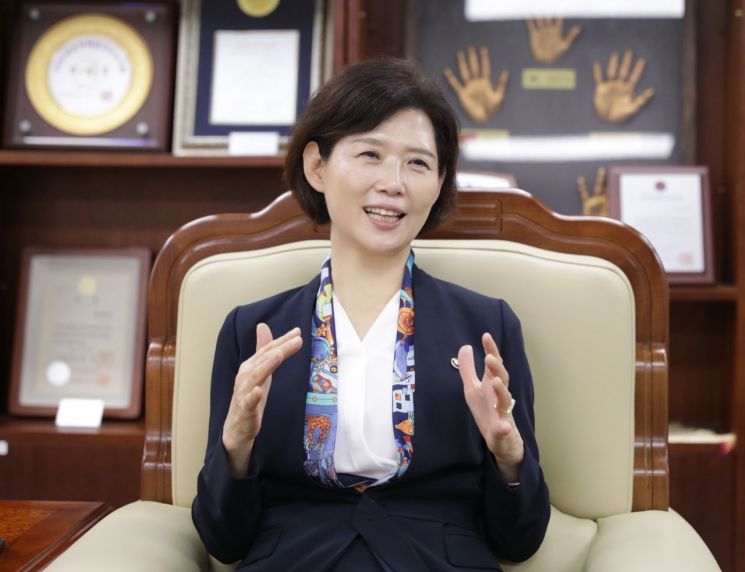 Patent Office Commissioner Lee In-sil is explaining the plan to expand the recruitment of expert examiners from private retirees in a future interview with Asia Economy on the 27th. Provided by the Patent Office
Among these efforts, hiring retired personnel in the semiconductor field as examiners is considered a major achievement during Commissioner Lee’s tenure. Additionally, the notable increase in semiconductor patent examination cases in the first half of this year and the prevention of core personnel and technology outflow abroad are recognized as representative positive effects of hiring retired semiconductor personnel.
For example, from January to June this year, KIPO processed 11,163 semiconductor patent examination cases, a 15.4% increase from 9,676 cases in the same period last year. This series of achievements was made possible by retired personnel deployed on-site during the first half of the year handling examinations.
Since priority examination became available, the average patent examination period for the semiconductor sector has shortened to 1.9 months. Considering that the typical patent examination period is around 12.7 months, this means the examination period was advanced by 10.8 months, enabling rapid patent rights acquisition for core semiconductor technologies.
Most importantly, in a KIPO internal survey, 22 out of 30 specialized examiners (hired retired personnel) responded that before entering public service through KIPO, they had received job offers from overseas companies or had considered changing jobs abroad.
In other words, if these individuals had not been hired as specialized examiners, there was a risk that Korea’s core human resources in the semiconductor industry could have been lost overseas.
Regarding this, Commissioner Lee emphasized, "Hiring retired personnel as specialized examiners is a system welcomed by the industry. Thanks to their field experience and technical expertise, examinations can be conducted quickly and accurately, enabling rapid patent rights acquisition for companies’ core technologies."
He also explained, "The industry’s positive view of hiring specialized examiners is also due to alleviating concerns about personnel and technology outflow that occurs when retired personnel look abroad for job changes."
KIPO plans to continue steadily hiring retired personnel as specialized examiners. Currently, the second recruitment process for the semiconductor (including display) sector is underway, with 37 specialized examiners scheduled to be appointed in January next year.
In particular, earlier this month, KIPO completed consultations with the Ministry of the Interior and Safety regarding increasing 38 specialized examiners in the secondary battery sector and is currently negotiating budget allocation with the Ministry of Economy and Finance and others.
Secondary batteries are being classified as a national advanced strategic industry sector alongside semiconductors, laying the groundwork for the government to provide additional support for securing super-gap technological capabilities in the domestic industry.
Commissioner Lee said, "Secondary batteries are considered one of the two pillars of national core strategic technologies along with semiconductors. By supplementing examiners with retired personnel in these fields, we will support seamless examination and rapid patent rights acquisition, enabling domestic companies to secure super-gap technologies."
He added, "KIPO is also focusing its institutional capabilities on blocking overseas technology leakage, which has recently become a national issue, by strengthening the capabilities of technology police and closely cooperating with the National Intelligence Service, prosecution, and police to eliminate blind spots in investigations of technology leakage crimes."
Commissioner Lee has also been actively promoting the spread of 'K-IP' overseas and expanding administrative service exports.
During the presidential state visit last month to Middle Eastern countries, Commissioner Lee held government and high-level meetings with the United Arab Emirates (UAE), Saudi Arabia, Qatar, and others, mutually agreeing to closely cooperate on exporting intellectual property administrative services and establishing country-specific intellectual property strategies.
Additionally, last month, he invited senior intellectual property enforcement officials from Indonesia for a joint seminar, which laid the foundation for remedying and resolving intellectual property infringement damages suffered by Korean companies operating in Indonesia. The seminar was held as a follow-up to the Korea-Indonesia summit and the KIPO Commissioner’s meeting.
© The Asia Business Daily(www.asiae.co.kr). All rights reserved.

















