Life Story of Yi Wan-yong Condensed to 425 Characters at Birthplace
Seongnam Cultural Center: "The Purpose Was to Raise Awareness"
A monument installed at the birthplace of Lee Wan-yong (1858?1926), one of the 'Eulsa Five Traitors (乙巳五賊),' will be removed after controversy, just one week after its erection.
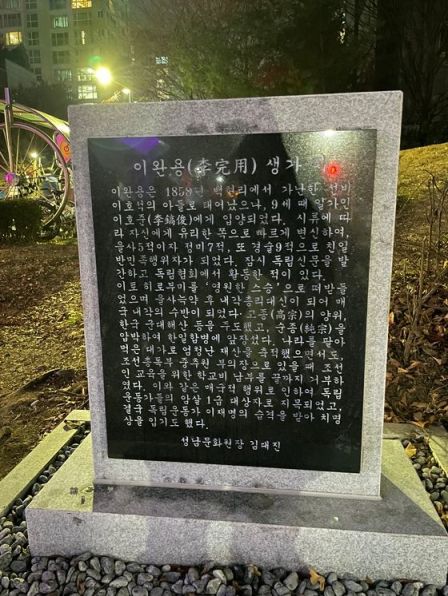 The marker stone for the birthplace of Lee Wan-yong, erected in front of an apartment complex in Baekhyeon-dong, Bundang.
 Photo by JTBC news footage capture
On the 28th, the Seongnam Cultural Center in Gyeonggi Province announced that it would dismantle the marker stone (75 cm wide, 112.5 cm tall) at Lee Wan-yong's birthplace near a kindergarten in Baekhyeon-dong, Bundang-gu, Seongnam City, which had been erected on the 22nd at a cost of 2.5 million won.
The Seongnam Cultural Center erected 10 monuments at historical sites around Seongnam City with a budget of 30 million won, including the monument marking Lee Wan-yong's birthplace.
The 'Lee Wan-yong Monument' was installed in front of an apartment complex in Baekhyeon-dong, Seongnam City, Gyeonggi Province. The monument contains 425 characters detailing Lee Wan-yong's pro-Japanese activities.
The marker stone records early information such as "Lee Wan-yong was born in 1858 in Baekhyeon-ri as the son of a poor scholar, Lee Hoseok, but was adopted at age nine by a relative, Lee Hojun," along with descriptions of his pro-Japanese and anti-national acts, labeling him as one of the Eulsa Five Traitors, the Jeongmi Seven Traitors, and the Gyeongsuk Nine Traitors. It also states that "after the Eulsa Treaty, he became the Prime Minister and head of the pro-Japanese cabinet."
The Seongnam Cultural Center explained that the monument was erected to ensure that historical lessons are not forgotten. Kim Dae-jin, director of the Seongnam Cultural Center, said, "The purpose is to inform future generations about Lee Wan-yong's actions to prevent the emergence of traitors again. We wanted to erect not only monuments commemorating positive history but also the Lee Wan-yong monument to raise awareness. The Cultural Center must play a role in presenting history as it is."
However, among residents, criticism arose questioning the necessity of spending public funds to erect a monument marking the birthplace of a pro-Japanese collaborator like Lee Wan-yong. Some pointed out that the monument's appearance was not significantly different from a typical commemorative stone, deeming it inappropriate.
As public opposition grew and sentiment worsened, the Seongnam Cultural Center ultimately decided to remove the monument.
© The Asia Business Daily(www.asiae.co.kr). All rights reserved.

















