Delay in G90·EV9 Level 3 Autonomous Driving Technology Installation
Technical Challenges Including Maximum Speed 80km/h and Night Autonomous Driving
Increased Manufacturer Liability for Level 3 Autonomous Vehicle Accidents
Risk of Lawsuits and Recalls if Technology Maturity Is Low
International Consortium Proposes Legislation for Level 2.9 Autonomous Vehicles
Hyundai Motor Company and Kia's launch of Level 3 autonomous driving mass-production vehicles continues to be delayed. As consumers grow weary of repeated postponements, voices are rising to address the fundamental issues across the domestic autonomous driving industry. The core controversy lies in the responsibility for accidents involving Level 3 autonomous vehicles, where driving is alternated between the autonomous system and the human driver. Industry experts argue that a social consensus is needed that maintains the safety of drivers and pedestrians while not hindering technological advancement.
According to comprehensive reporting on the 28th, Kia recently removed the Level 3 autonomous driving option 'HDP (Highway Driving Pilot)' from the EV9 catalog. HDP is an autonomous driving feature that allows drivers to take their hands off the steering wheel at speeds up to 80 km/h on highways. Kia had announced the release of the EV9 GT Line trim with Level 3 autonomous driving options within the year when launching the EV9 in June. However, the release schedule was indefinitely postponed due to technical limitations.
This is not the first delay in the launch of Level 3 mass-production vehicles by Hyundai Motor Company and Kia. Last year, Hyundai planned to apply Level 3 autonomous driving for the first time on the Genesis flagship sedan G90. However, the release was postponed to the first half of this year to secure technology and safety. Although the updated G90 model was released in March this year, the Level 3 autonomous driving technology was ultimately excluded.
The global autonomous driving industry is fiercely competing in technology at Level 3 in mass-production vehicles and at Level 4 in mobility services such as robotaxis. The Society of Automotive Engineers (SAE) defines the advancement of autonomous driving technology in six levels from Level 0 to Level 5. The higher the level, the closer it is to full autonomy. Level 3 involves shared driving between humans and systems depending on region and situation. From Level 4 onwards, no human is required in the driver's seat. The system drives entirely but autonomous driving is only possible in specific areas and situations.
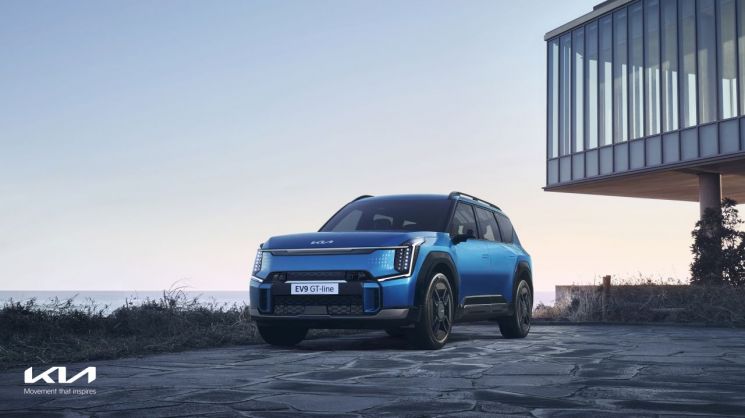
The World's First 80 km/h Level 3 Mass-Production Vehicle: Issues with Marketability and Technology
The industry analyzes various reasons for Hyundai Motor Company and Kia's delay in launching Level 3 mass-production vehicles. First, it is due to the dilemma between symbolism, technical limitations, and marketability. Criticism has been raised that the development schedule was set aggressively to claim the title of 'the world's first 80 km/h Level 3 autonomous driving mass-production vehicle.'
Currently, only two companies have succeeded in mass-producing Level 3 autonomous vehicles: Honda (2021) and Mercedes-Benz (2022). Honda's Legend was sold in a limited run of 100 units, making it difficult to consider it a true Level 3 mass-production vehicle. Mercedes-Benz's Level 3 autonomous driving technology applied to the new S-Class is currently only operable in Germany and the U.S. states of California and Nevada. It also only works during clear daytime weather. The maximum speed is limited to 60 km/h.
Hyundai Motor Company and Kia aimed to raise the maximum speed to 80 km/h. Their strategy was to release a Level 3 mass-production vehicle with practical marketability capable of high-speed driving on highways. They also set a goal for limited operation during rainy weather or nighttime. By expanding the operational design domain (ODD) compared to competitors, they sought to secure competitiveness. For this reason, the option price was set at a record high of 7.5 million KRW. The option price alone is equivalent to 10% of the base price of the EV9 all-wheel-drive model.
However, the industry believes that this ODD expansion strategy may have hindered Hyundai Motor Company and Kia. As driving speed increases, the amount of data that must be analyzed per second grows exponentially. Faster data processing speeds require supporting processor and communication specifications. Consequently, verification time also increases. According to industry research, a single autonomous vehicle generates 4000GB of data during one hour of operation. This is equivalent to downloading 8,000 copies of a 90-minute movie.
An industry insider said, "If the ODD is narrowed, marketability declines; if expanded, technical limitations are encountered. They likely faced a situation where rushing to meet schedules would result in a product with lower completeness, exposing them to various lawsuits and recall risks."
Level 3 Autonomous Vehicles: Increased Manufacturer Liability in Accidents
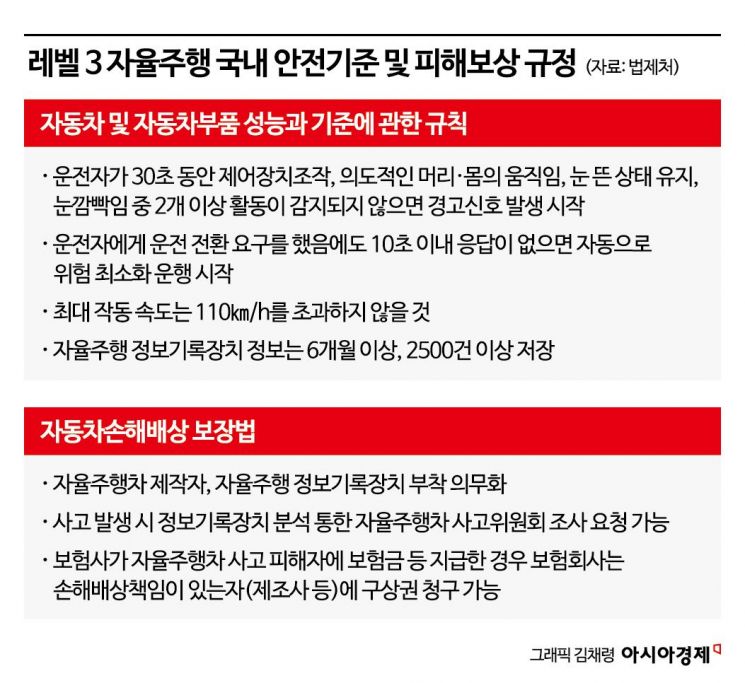
There is also analysis that the responsibility for accidents involving autonomous vehicles is a main cause of the launch delays. From Level 3 autonomous vehicles onward, the driving responsibility is divided between the human and the vehicle. Normally, the human drives, but in specific locations and situations where autonomous driving is permitted, the vehicle takes over driving. Therefore, up to Level 2 autonomous vehicles, the human driver is responsible for all accidents, but from Level 3, responsibility is divided between the driver and the manufacturer depending on who was driving at the time. To distinguish this, installation of an autonomous driving information recording device, similar to a black box, has been made mandatory.
In the event of an accident, the driver's insurance is used first, and then the fault of the manufacturer and driver is determined. If the manufacturer's fault is recognized, the insurer can claim subrogation rights against the manufacturer. If there is disagreement between parties, the Autonomous Vehicle Accident Investigation Committee can review the case to determine fault. Therefore, releasing a Level 3 autonomous vehicle with low technological completeness could expose manufacturers not only to a loss of consumer trust but also to enormous recall and litigation risks.
For this reason, Tesla claims that its Full Self-Driving (FSD) beta version is at Level 2. However, in various advertisements and marketing, it is portrayed as having Level 3 or higher capabilities. This is a kind of trick to avoid manufacturer liability while securing extensive data for advancing autonomous driving technology. In fact, the industry regards Tesla's autonomous driving technology as Level 3 or higher. FSD can operate at night or in rainy conditions and recognizes traffic lights on general roads, not just highways, to pass intersections. The maximum operating speed is 150 km/h.
However, as Tesla has recently been embroiled in various lawsuits, traffic authorities in many countries are closely monitoring Tesla's actions. In this situation, it is difficult for Hyundai Motor Company and Kia to adopt a strategy like Tesla's. Nevertheless, the United Nations World Forum for Harmonization of Vehicle Regulations (UN WP29), which creates global autonomous driving regulations, is pushing legislation to reduce manufacturer liability for Level 3 autonomous vehicles. The scope of commercialization of autonomous driving technology will be expanded to Level 2.9, emphasizing driver responsibility more. This is a process of finding a social consensus to protect the safety of drivers and pedestrians while not delaying technological development. With discussions on revising such laws scheduled for January next year, there is speculation that Hyundai Motor Company and Kia have no urgent reason to accelerate the launch of Level 3 mass-production vehicles.
© The Asia Business Daily(www.asiae.co.kr). All rights reserved.
![Clutching a Stolen Dior Bag, Saying "I Hate Being Poor but Real"... The Grotesque Con of a "Human Knockoff" [Slate]](https://cwcontent.asiae.co.kr/asiaresize/183/2026021902243444107_1771435474.jpg)












