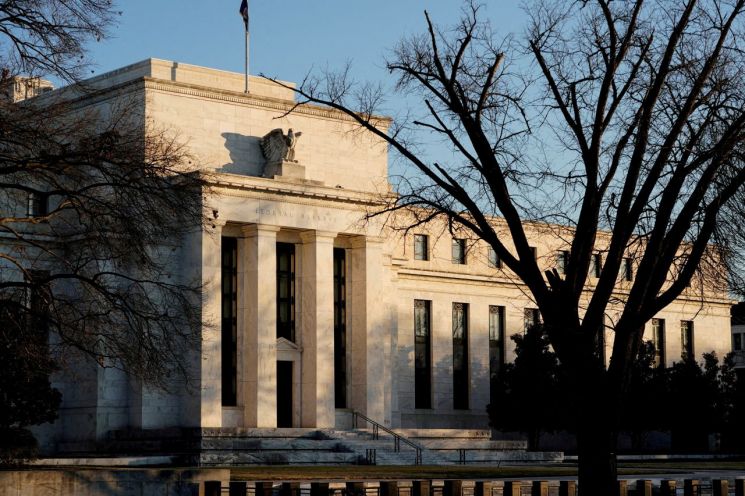
On Wall Street in the United States, forecasts of a Federal Reserve (Fed) pivot in the first half of next year are emerging one after another. Bank of America (BoA) predicted that the first interest rate cut will be implemented in June next year based on a soft landing scenario. The market also predominantly expects a total of four rate cuts from as early as May through the end of the year.
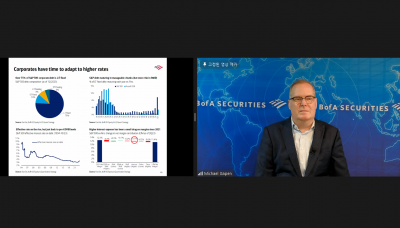
BoA announced in its '2024 Economic Outlook' released on the 27th (local time) that the Fed will begin cutting the benchmark interest rate starting in June next year, lowering it by 0.25 percentage points per quarter. Michael Gapen, BoA's Chief U.S. Economist, explained during an afternoon video briefing, "We believe the rate hikes that began in March last year have ended," adding, "Interest rate cuts will be made at a pace of 0.25 percentage points per quarter starting in June 2024." This is later than UBS's scenario of a rate cut in March next year but earlier than the forecasts of Vanguard and Goldman Sachs, which expect cuts in the second half of the year.
BoA assessed that although the cumulative rate hikes will ultimately weaken growth and raise unemployment, a 'soft landing' of the U.S. economy is more likely than a recession. This is because consumer spending, which accounts for more than two-thirds of U.S. economic activity, is maintaining resilience supported by a strong labor market and balance sheets, while recent inflation indicators have shown a clear deceleration trend. Gapen emphasized, "The labor market is the key driver of consumption," and predicted, "Consumer spending will slow but not plunge."
The forecast for the U.S. real Gross Domestic Product (GDP) growth rate next year is 0.5% in Q1, 0.5% in Q2, 0.5% in Q3, and 1.0% in Q4. The core Personal Consumption Expenditures (PCE) price index, an inflation gauge closely watched by the Fed, is estimated to fall to the high 2% range starting in Q2. However, Gapen added that the path to achieving the 2% inflation target without a recession could be longer and more challenging than expected.
Alongside this, downside risks weighing on the economy were also pointed out. In addition to movements in government bond yields, credit tightening, student loan repayments, and geopolitical risks, BoA noted that policy uncertainty could increase significantly due to the U.S. presidential election next year. This policy uncertainty is expected to be observed not only in the U.S. but also in other countries holding elections. Candice Browning, Head of BoA Global Research, stated, "We expect 2024 to be a year in which central banks successfully coordinate a soft landing," but also noted, "However, there are more downside risks than upside risks."
The market also confirms expectations for rate cuts next year. According to the FedWatch tool of the Chicago Mercantile Exchange (CME), federal funds futures markets are pricing in nearly a 60% chance that the Fed will cut rates by at least 0.25 percentage points in May next year. This is a significant increase from about 29% at the end of October. Currently, futures markets expect a total of four rate cuts by the end of the year.
The Wall Street Journal (WSJ), citing these figures, reported, "Investors expect rate cuts soon regardless of a recession," and "Government bond yields are also quickly pricing in these Fed rate cut expectations." The outlet also pointed out that these rate cut expectations are driven by economic indicators such as lower-than-expected inflation data and weak Purchasing Managers' Index (PMI). Furthermore, while Fed officials including Chair Powell consistently say that discussions about rate cuts are premature, they are also signaling that if there is confidence inflation will reach the 2% target, rates will be lowered regardless of whether a recession occurs.
This week, the release of the PCE price index, which can confirm the inflation slowdown trend, the Fed's Beige Book containing economic outlooks, and discussions by Chair Powell are scheduled. The U.S. core PCE for October, to be released on the 30th, is expected to rise 3.5% year-over-year and 0.2% month-over-month, continuing the deceleration trend. If the slowdown trend is reconfirmed in the PCE following the previously released Consumer Price Index (CPI), expectations for rate cuts next year are likely to increase further.
Meanwhile, BoA predicted in its 2024 economic outlook that the S&P 500 index, centered on large-cap stocks, will close next year at a record high of 5,000. The international oil price benchmarks Brent crude and West Texas Intermediate (WTI) are forecasted to average $90 and $86 per barrel, respectively.
© The Asia Business Daily(www.asiae.co.kr). All rights reserved.
![From Bar Hostess to Organ Seller to High Society... The Grotesque Con of a "Human Counterfeit" [Slate]](https://cwcontent.asiae.co.kr/asiaresize/183/2026021902243444107_1771435474.jpg)

















