7,824 Cases Reported from January to October This Year
Increase in Bullying, Discrimination, and Ignoring
Difficulty in Securing Clear Evidence
Supplementary Legislation Needed for Perpetrator Punishment and More
The amendment to the Labor Standards Act prohibiting workplace harassment, known as the 'Workplace Harassment Prevention Act,' has entered its fifth year of enforcement, with the number of reported cases steadily increasing each year. In particular, as cases of harassment involving subtle tactics such as ostracism, discrimination, and ignoring?types that are difficult to prove?are gradually rising, there are concerns that the current law, which lacks punishment provisions for perpetrators, has limitations in responding effectively. Experts advise that regular education on workplace harassment and strengthening of penalties should be implemented.
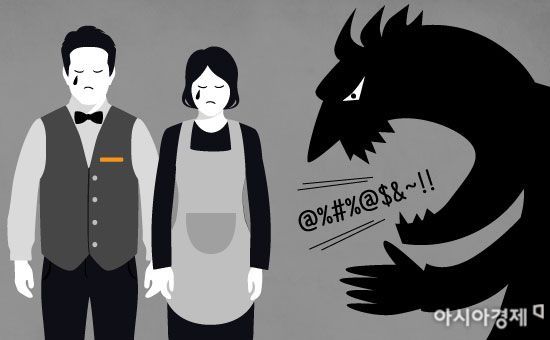
Even When 'Workplace Harassment' Is Recognized... Followed by Secret Ostracism
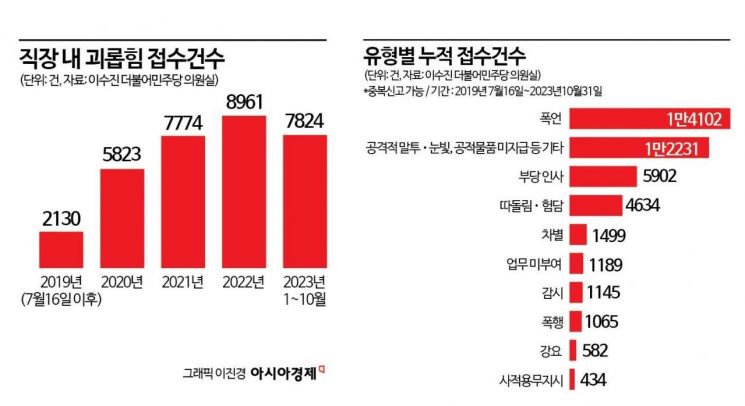
According to data obtained by Asia Economy on the 29th through the office of Lee Su-jin, a member of the National Assembly's Environment and Labor Committee from the Democratic Party of Korea, a total of 7,824 workplace harassment reports were filed from January to October this year. The number of reports by year has steadily increased: 2,130 cases in 2019 (after the law took effect on July 16), 5,823 in 2020, 7,774 in 2021, and 8,961 in 2022.
The cumulative number of cases by type (duplicate reports possible) were verbal abuse (14,102 cases), others (12,231 cases), unfair personnel decisions (5,902 cases), ostracism and slander (4,634 cases), discrimination (1,499 cases), denial of work assignment (1,189 cases), surveillance (1,145 cases), assault (1,065 cases), coercion (582 cases), and orders for personal errands (434 cases). The 'others' category includes aggressive tone or glances, non-provision of official supplies, and failure to hand over duties. Looking at the proportion of reports by type, verbal abuse (45%) and unfair personnel decisions (25%) were high in 2019, but dropped to 31% and 13%, respectively, this year. Conversely, 'others' rose from 5.9% to 30%, and discrimination increased from 2.2% to 4.2%. In the early days of the law's enforcement, verbal abuse accounted for about half of workplace power abuse cases, but now there are more types of harassment that are difficult to secure clear evidence for.
Workplace harassment has become more secretive and meticulous than before. Even when recognized as workplace harassment by government agencies, there have been many cases where the reporter became cautious or resigned. According to reports filed with the civic group 'Workplace Gapjil 119,' office worker A, who works at a small or medium-sized enterprise, reported to the Anti-Corruption and Civil Rights Commission that their supervisor B made them run personal errands such as buying cigarettes and coffee every day, which was recognized as workplace harassment. However, afterwards, B was ostracized by others and eventually resigned. Office worker C also reported supervisor D, who repeatedly verbally abused and ostracized them, to the HR and General Affairs team, but the company took no action for over a month. When C tried to report again, they were pressured with the words, "If this becomes an issue, you won't be able to work here." C eventually reported directly to the Ministry of Employment and Labor and was recognized as a victim of workplace harassment, but rumors circulated within the company that C "ruined someone's life by reporting over a trivial matter."
Certified labor attorney Jang Joo-hyun said, "Recently, there has been a significant increase in reports that are very ambiguous to judge, such as ostracism, backbiting, and spreading anonymous malicious rumors, rather than workplace harassment that can be confirmed at a glance," adding, "The most important thing is to collect objective evidence that can prove one's victimization." He further explained, "You need to prove that you are being harassed through recordings, messenger chats, phone calls, etc., and even if it is not a direct conversation with the perpetrator, you can prove harassment by collecting conversations or contacts from surrounding colleagues."
Widespread Futility Due to Legal Limits... "Effectiveness Must Be Supplemented"
Under current law, even if workplace harassment occurs, there are no punishment provisions for perpetrators. The criminal penalty clause only prohibits dismissal or other unfavorable treatment of workers who report workplace harassment or victims. Violators are subject to imprisonment of up to three years or a fine of up to 30 million won. For other legal violations, only corrective orders or fines can be imposed. Looking at the processing results of reports from January to October this year, there were 509 cases of improvement guidance, 111 cases sent to prosecution (43 indicted), 1,368 withdrawn cases, 5,456 cases categorized as others (fines, legal exemptions, duplicate complaints, no-shows, complaints filed, etc.), and 380 cases still under processing. Businesses with fewer than five employees, special types of workers, and freelancers are not protected by the law at all. Although a total of 25 amendments to the Labor Standards Act, including expanding the scope of investigations, strengthening victim protection, and establishing penalties for perpetrators, have been proposed in the National Assembly, proper discussions have not been held.
As the futility of the Workplace Harassment Prevention Act spreads, victims are reluctant to report. According to an online survey conducted by the civic group Workplace Gapjil 119 through the public opinion research firm Embrain Public from the 4th to the 11th of last month targeting 1,000 workers aged 19 and older nationwide about organizational culture, the lowest scoring item was "I think the identity of the reporter will be exposed when reporting workplace harassment" (51.7 points), down 12.5 points from 64.2 points last year. This was followed by "It will be difficult to return and live normally after reporting workplace harassment" (54.6 points), "I think appropriate punishment will not be imposed on the perpetrator when workplace harassment is recognized" (54.7 points), and "I think I will suffer disadvantages such as disciplinary action, ostracism, or rumors when reporting workplace harassment" (55.7 points). The survey was conducted by scoring 25 items across seven areas including rest, evaluation, hierarchy, communication, harassment prevention, response, and follow-up measures on a scale of 0 to 100 points.

Experts emphasized the need to find ways to enhance the effectiveness of the Workplace Harassment Prevention Act. Professor Kim Sung-hee of Korea University's Labor Issues Research Institute said, "There is a social aspect where the seriousness of workplace harassment is not fully recognized. Mandatory education should be conducted annually, and the responsibility of employers should be further strengthened," adding, "Measures to reduce the number of workers outside the scope of the law are also required." Professor Emeritus Lee Byung-hoon of Chung-Ang University's Department of Sociology said, "Since the current law is not functioning properly right now, legal amendments are necessary," and "If workplace harassment problems are becoming serious and many people are suffering, strengthening penalties is needed."
© The Asia Business Daily(www.asiae.co.kr). All rights reserved.
![Clutching a Stolen Dior Bag, Saying "I Hate Being Poor but Real"... The Grotesque Con of a "Human Knockoff" [Slate]](https://cwcontent.asiae.co.kr/asiaresize/183/2026021902243444107_1771435474.jpg)

















