When Buying Clothes, Design Comes First... Followed by Price and Comfort
Preference for Comfortable and Easy-to-Coordinate Basic Designs
Men in their 20s to 50s in Korea consider ‘design’ the most important factor when purchasing clothing, with a particular preference for designs that are comfortable to wear.
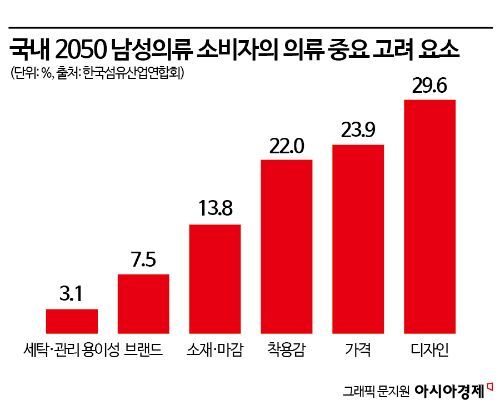
According to a clothing consumption survey conducted on domestic male clothing consumers aged 20 to 50 by the Korea Federation of Textile Industries on the 28th, 29.6% of respondents cited ‘design’ as the most important factor when purchasing clothing, the highest percentage overall. Following design were ‘price (23.9%)’ and ‘comfort (22.0%)’ in order.
On the other hand, relatively fewer respondents valued ‘brand (7.5%)’ and ‘ease of washing and care (3.1%)’. However, since the percentages of those who considered design, price, and comfort important all exceeded 20%, it is analyzed that male clothing consumers tend to consider multiple factors rather than focusing on a single specific element.
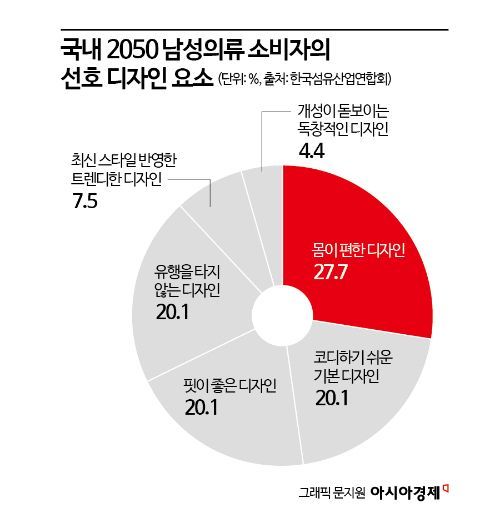
Among the detailed preferred design elements, 27.7% of respondents said that ‘a design that is comfortable to wear’ was the most important. Following comfortable design were ‘basic designs that are easy to coordinate anywhere,’ ‘designs that do not follow trends and can be worn for a long time,’ and ‘designs with a good fit,’ each accounting for 20.1% equally.
In contrast, preferences for ‘unique designs that highlight my individuality (4.4%)’ or ‘trendy designs reflecting the latest styles (7.5%)’ were relatively low, suggesting that male consumers generally prioritize practical elements such as activity and functionality.
Regarding purchase channels, more than 4 out of 10 respondents (43.3%) said they mainly use ‘offline stores’ as their primary purchase channel, showing a somewhat conservative tendency. This is interpreted as a relatively strong desire among male consumers to check not only design but also size and material before purchasing products compared to other groups. Beyond offline channels, ‘mobile shopping malls’ followed at 31.8%, then ‘PC internet shopping malls (21.0%)’, and ‘TV home shopping (3.9%)’ in order.
Meanwhile, 4 out of 10 male clothing consumers (39.0%) reported purchasing clothing once per quarter. In terms of expenditure, 19.5% of respondents said they spent ‘between 150,000 and less than 200,000 won,’ the highest percentage, and 17.0% said they spent ‘more than 200,000 won.’ Compared to all clothing buyers, these figures are 6.2 percentage points and 2.8 percentage points higher, respectively, indicating that although male clothing consumers purchase clothing less frequently, their average spending per purchase is relatively high.
© The Asia Business Daily(www.asiae.co.kr). All rights reserved.
![Clutching a Stolen Dior Bag, Saying "I Hate Being Poor but Real"... The Grotesque Con of a "Human Knockoff" [Slate]](https://cwcontent.asiae.co.kr/asiaresize/183/2026021902243444107_1771435474.jpg)

















