Domestic Pharmaceutical Industry Previously Less Interested in Environmental Response
Growing ESG Interest for Global Supply Chain Security
"Pharmaceutical Companies Need Proactive Strategy Development"

Pharmaceutical and bio companies are consecutively publishing ESG (Environmental, Social, and Governance) reports to address climate change and achieve sustainable growth.
On the 27th, the Korea Health Industry Development Institute analyzed the current status of ESG in the domestic pharmaceutical and bio sectors and found that 12 companies are currently publishing ESG reports. These include Samsung Biologics, Celltrion, SK Biopharm, SK Bioscience, Yuhan Corporation, Hanmi Pharmaceutical, Chong Kun Dang, Daewoong Pharmaceutical, HK Inno.N, GC Green Cross, Boryung, and Dong-A Socio Holdings.
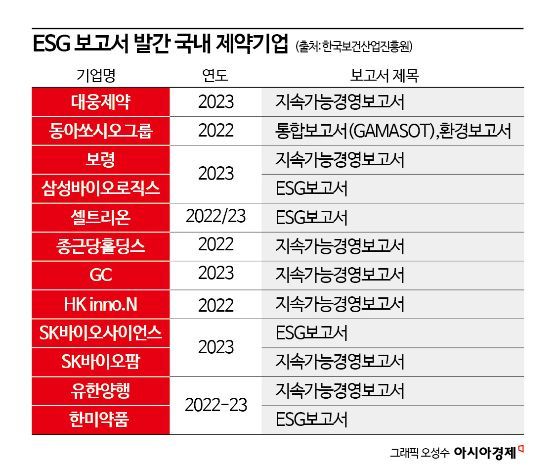
The institute analyzed, "Compared to industries like automotive and electronics, the pharmaceutical industry has not shown significant interest in environmental responses. However, as global companies adopt ESG as a corporate risk management and investment attraction strategy, many domestic pharmaceutical companies are aligning with global trends to secure supply chains."
Most companies have set goals to achieve carbon neutrality (net zero) by 2050. Hanmi Pharmaceutical plans to achieve net zero by 2040. Daewoong Pharmaceutical and HK Inno.N have committed to reducing energy consumption and water reuse rates by 5% annually, while Chong Kun Dang aims to reduce greenhouse gas emissions by 40% and achieve a 40% water reuse rate by 2030. The institute noted that Boryung, Dong-A Socio Group, and Yuhan Corporation have shown significant environmental activity achievements but have not presented specific targets.
The average greenhouse gas intensity (emissions relative to sales) of the 12 domestic pharmaceutical companies last year was 3.41. The lowest was SK Biopharm at 0.71. Compared to 2020, greenhouse gas emissions increased last year for all except Hanmi Pharmaceutical. The institute evaluated that "domestic companies have yet to show significant greenhouse gas reduction achievements."
However, the 12 pharmaceutical companies are implementing concrete measures to reduce energy consumption. Boryung reduced energy use at its Yesan plant by adjusting chilled water supply temperatures during non-dehumidification periods and developing an energy-saving mode for the building management system (BMS) of air conditioning units. HK Inno.N enhanced equipment efficiency by installing an integrated controller for air compressor operation and replacing with high-efficiency inverters. As a result, except for SK Biopharm, the energy use intensity (energy consumption relative to sales) of the pharmaceutical companies decreased compared to the previous year. Despite increased pharmaceutical production and sales, energy-saving efforts led to reduced intensity.
Some companies applied eco-friendly designs to improve energy efficiency. Samsung Biologics adopted green construction methods for its 5th plant to be built in Songdo, Incheon. SK Bioscience received the U.S. Green Building Certification (LEED) for its factory and R&D center and was awarded the highest energy efficiency grade. Daewoong Pharmaceutical, Dong-A ST, Samsung Biologics, Chong Kun Dang, GC Green Cross, and HK Inno.N secured renewable energy sources such as solar power. Samsung Biologics, SK Bioscience, and Celltrion disclosed specific renewable energy transition rates of 8.7%, 38%, and 53%, respectively.
Waste landfill rates for the 12 companies were recorded at 0%. Incineration rates ranged from 20% to 50%, with many pharmaceutical companies recovering energy through incineration. Recycling rates ranged from 40% to 70%, with Boryung having the highest recycling rate at 78.6%.
Forty-six percent of domestic pharmaceutical and bio exports are to Europe and the United States, where ESG regulations are legislated. Compliance with the laws and norms of these countries is inevitable for exports. In South Korea, from 2026 onward, companies listed on the stock market with assets exceeding 2 trillion won will be required to publish ESG reports, highlighting the need for pharmaceutical companies to establish proactive strategies.
Jung Soon-gyu, senior researcher at the Health Industry Policy Research Center of the Korea Health Industry Development Institute, stated, "To enhance ESG environmental responses in the domestic pharmaceutical and bio industry, it is necessary to establish a public-private cooperation consultative body, build a support platform for greenhouse gas measurement, and shift the awareness of pharmaceutical and bio executives."
© The Asia Business Daily(www.asiae.co.kr). All rights reserved.


















