Review of Large Corporations' Participation in Projects Over 100 Billion Won
Few Projects Meet the Standard Scale
Low-Bid Orders and Additional Tasks Also Pointed Out as Areas for Improvement
The government is pushing to lift restrictions on large companies' participation in public software (SW) projects following a series of administrative network failures. However, there are concerns that the criteria allowing large companies to participate in these projects remain too stringent. Additionally, the industry points out the need for improvements in low-price bidding, cessation of frequent task changes, and a comprehensive review of public SW projects themselves.
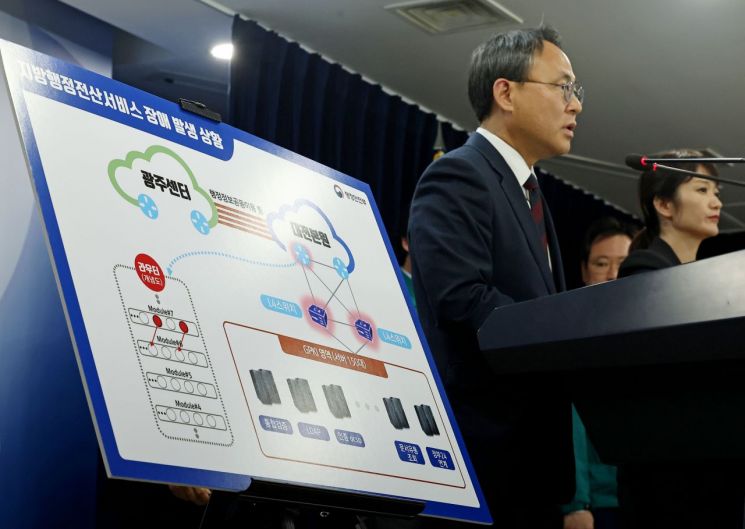 Gogi-dong Deputy Minister of the Ministry of the Interior and Safety is giving a presentation at the briefing on the causes of the local administrative computer service failure and future measures held at the Government Seoul Office Building on the 25th. Photo by Yonhap News
According to the Ministry of Science and ICT and related industries on the 27th, the government is working on revising the Software Promotion Act to ease restrictions on large companies' participation in public SW projects, which were introduced in 2013. The Ministry of Science and ICT and the Regulatory Innovation Promotion Team under the Office for Government Policy Coordination revealed this plan in June and are considering allowing large companies to participate in projects with a scale of 100 billion KRW or more.
However, even if large companies participate in public SW projects, it is uncertain whether the government's digital service trust, which has declined due to recent consecutive administrative network failures, will recover. The government’s stance is to consider large company participation only in public SW projects exceeding 100 billion KRW, but such large-scale projects are rare. According to the Ministry of Science and ICT, over the past five years (2018?2022), 293 exception reviews were conducted for large company participation in public SW projects, of which only 19 cases (6.5%) were for projects over 100 billion KRW. Among these, 16 cases were approved as exceptions and carried out by large companies.
Currently, related laws restrict large companies from bidding on public SW projects to enhance the competitiveness of small and medium-sized system integration (SI) companies. However, large companies can participate in areas related to national security or new technologies such as artificial intelligence (AI) and big data, provided that more than half of the consortium is allocated to small companies.
There are precedents where large companies caused major service failures shortly after launch, such as SK C&C’s consortium for the Korea Post’s next-generation financial system construction project and LG CNS’s consortium for the next-generation social security information system development, leading to arguments that restricting large company participation is not the fundamental cause of the current incident.
Ahn Hong-jun, Director of Industrial Policy at the Korea Software Industry Association, said, "The government announced that the recent administrative network failure was due to hardware issues. Hardware problems are fundamental and unrelated to the size of the company conducting the project, so restricting large companies is not the root cause of the administrative network failure."
Currently, the public SW project bidding system evaluates 80% on technical aspects and 20% on price, but since technical differentiation is difficult, bidding price effectively determines the outcome. This leads to competition below appropriate compensation, resulting in quality degradation. Frequent task changes are also problematic, as clients often request changes during public SW construction projects.
Rep. Byeon Jae-il of the Democratic Party pointed out during this year’s national audit, "Although the law mandates holding a task review committee, contract changes or budget adjustments requested by contractors during task changes are not accepted, and budgets are rather cut." Director Ahn said, "Fundamentally, the budget for public SW projects should be increased, and the issue of quality degradation caused by frequent task changes must be resolved."
© The Asia Business Daily(www.asiae.co.kr). All rights reserved.
![Clutching a Stolen Dior Bag, Saying "I Hate Being Poor but Real"... The Grotesque Con of a "Human Knockoff" [Slate]](https://cwcontent.asiae.co.kr/asiaresize/183/2026021902243444107_1771435474.jpg)
















