Among OECD countries, only South Korea and some US states lack paid sick leave
South Korea's number of paid sick leave days is also among the lowest in the OECD
Possibility of cooperation between private insurers and public-private sectors
 Photo by Getty Images Bank
There are calls for the 'sangbyeong sudang' (sickness benefit), which guarantees income when workers are unable to engage in economic activities due to illness or injury unrelated to work, to be established domestically. Most other OECD countries have introduced it, and it is considered essential given the situation in South Korea, where sick leave is not properly utilized. A public-private partnership plan involving some private insurance participation was also proposed to address coverage blind spots.
On the 26th, the Korea Insurance Research Institute released a report titled "The Necessity of Introducing the Sangbyeong Sudang System and the Role of Private Insurance," which contains these points. The report points out that South Korea has a wide income security blind spot compared to other OECD countries, and a social safety net is needed to prevent income loss risks due to sickness. The sangbyeong sudang system was identified as an alternative.
In fact, among the 36 OECD member countries, all except South Korea and some U.S. states (California, New York, etc.) have introduced the sangbyeong sudang system. Although South Korea's National Health Insurance Act Article 50 specifies sangbyeong sudang, it is not functioning properly due to the lack of related subordinate legislation. Paid sick leave that guarantees income during sickness is also effectively meaningless since companies can introduce it at their discretion.
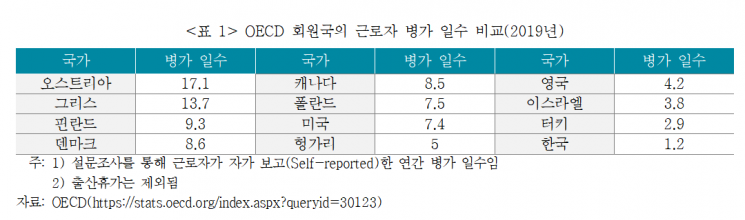
In South Korea, it is difficult to freely use both paid and unpaid sick leave. As of 2019, Korean workers used an average of only 1.2 days of sick leave, both paid and unpaid combined. This is significantly less compared to Austria (17.1 days), Canada (8.5 days), Finland (9.3 days), as well as Turkey (2.9 days), Poland (7.5 days), and Israel (3.8 days).
The Ministry of Health and Welfare also recognizes the necessity of the sangbyeong sudang system and announced plans to introduce it in 2025 after conducting phased pilot projects since July last year. Since the pilot project is still underway, currently, in the private insurance sector, fixed-amount health insurance such as cancer insurance, income compensation-type insurance such as automobile insurance loss of income, and workers' compensation income protection insurance are fulfilling the role of sangbyeong sudang.
The report proposed a public-private cooperation plan in which private insurance partially covers income loss risks to minimize coverage gaps and ensure the government's system is established. For example, if the sangbyeong sudang system operates only for specific groups such as low-income or vulnerable workers, private insurance should cover income loss risks for the remaining groups. Conversely, if the system operates for all groups, the report explained that the public and private sectors could share the benefit payments (income replacement rate).
There is also an analysis that the introduction of the system itself could be an opportunity for private insurers. Kim Kyung-sun, a research fellow at the Korea Insurance Research Institute, explained, "With the introduction of the sangbyeong sudang system, procedures such as eligibility management, income verification, and benefit qualification confirmation will be conducted, allowing private insurers to utilize this to expand income protection insurance, which has not been active so far."
Along with public-private cooperation, measures to prevent system abuse are also necessary. Researcher Kim pointed out, "Private health insurance subscribers may extend hospitalization unnecessarily to receive sangbyeong sudang, increasing unnecessary medical use, which could ultimately raise National Health Insurance benefit expenditures and worsen the finances of both public and private health insurance." He emphasized, "It is necessary to control moral hazard through a three-step medical certification process at the system design stage, including issuance of medical certificates, review by operating institutions, re-certification, and setting waiting periods."
© The Asia Business Daily(www.asiae.co.kr). All rights reserved.

















