Agustin Carstens BIS Secretary General Meeting
Central Bank Rate Hikes Ended but Rate Cuts Expected to Be Premature
Korean Monetary and Fiscal Policies Appropriate... Within Stability Range
Possibility of Rate Cuts Before US Has "Capacity"
 Agustin Carstens, General Manager of the Bank for International Settlements (BIS), is answering questions at a press conference held on the 24th at the Bank of Korea headquarters in Jung-gu, Seoul. (Photo by Bank of Korea)
Agustin Carstens, General Manager of the Bank for International Settlements (BIS), assessed that the major central banks' interest rate hikes in the past two years during the 'war against inflation' have effectively come to an end, but he explained that it is still too early to expect rate cuts next year. The reason is that it is difficult to see inflation as sufficiently stabilized. In particular, he pointed out that the massive fiscal spending by countries, which increased significantly before and after COVID-19, could have a negative impact on inflation going forward.
Regarding the possibility of South Korea cutting interest rates before the United States, he evaluated that "there is room" for this. Although many believe that South Korea's monetary policy is not independent of the U.S., and the interest rate gap between Korea and the U.S. has currently widened up to 2 percentage points, he explained that "the Bank of Korea can operate monetary policy independently of the U.S. situation."
General Manager Carstens made these remarks about the monetary policies and inflation situations of major central banks at a press briefing held on the 24th at the Bank of Korea headquarters in Jung-gu, Seoul. The BIS is an international organization that facilitates cooperation among central banks and is commonly called the "central bank of central banks." Carstens, who took office in 2017, visited the Bank of Korea for the first time in five years since November 2018.
"Rate hikes are over... but it's too early to expect rate cuts next year"
Carstens said, "Although it cannot be concluded definitively, most central banks have almost finished raising interest rates," adding, "Many countries are feeling the impact of higher costs due to high interest rates, and costs may increase further in the future."
He continued, "Fortunately, in many countries, these shocks have been more moderate than expected," and "Several countries are achieving a soft landing, so financial instability is not significantly affecting economic growth."
Regarding the possibility of capital outflows and other damages in emerging markets due to the sharp rate hikes in the U.S., he said, "In the past, many emerging countries had macroeconomic imbalances that made them very vulnerable to external interest rate changes, but now they have healthier macroeconomic policies," and predicted that there would be no major problems.
When asked about the timing of rate cuts, Carstens replied, "It is too early to say it will be next year," and "Interest rates should be maintained until there is confidence that inflation has sufficiently stabilized."
He explained that although inflation is slowing down, it takes more time for monetary policy to have a full impact on the economy, so central banks should not turn to rate cuts too soon.
"Fiscal tightening needed for price stability... South Korea is in the 'region of stability'"
In particular, he pointed out that massive fiscal spending by major governments such as the U.S. could negatively affect inflation. In the U.S., the fiscal deficit for the 2023 fiscal year expanded significantly by 23% compared to the previous year, reaching $1.695 trillion. Other major countries are also increasing spending on growth, welfare, and defense due to geopolitical risks and aging populations.
Carstens emphasized, "Over the past decade, governments have implemented fiscal stimulus policies, which expanded further due to COVID-19," and "If (tight) monetary and fiscal policies work together in the same direction, it is more efficient in lowering inflation and interest rates."
He explained that since the limits of promoting growth through expansionary fiscal and monetary policies have been reached, both monetary and fiscal policies should enter the 'region of stability,' and productivity should be increased through structural reforms.
Shin Hyun-song, BIS Economic Advisor and Head of the Research Department, who attended the press briefing, described such 'structural reforms' as "not just short-term policies but aimed at fundamentally strengthening the economic structure," and said, "South Korea faces an aging population issue, which is directly linked to fiscal sustainability and pension problems." He stressed, "The private and public sectors need to work together and think deeply about this."
Carstens added, "Fiscal expansion makes price stability somewhat more difficult, so fiscal tightening is necessary," but said that there are no major problems in the U.S. or South Korea.
He said, "The U.S. is a special case, so increased fiscal spending is unlikely to cause significant problems," and "South Korea is conducting both monetary and fiscal policies appropriately, and the national debt-to-GDP ratio is at an acceptable level, so South Korea is truly within the 'region of stability.'"
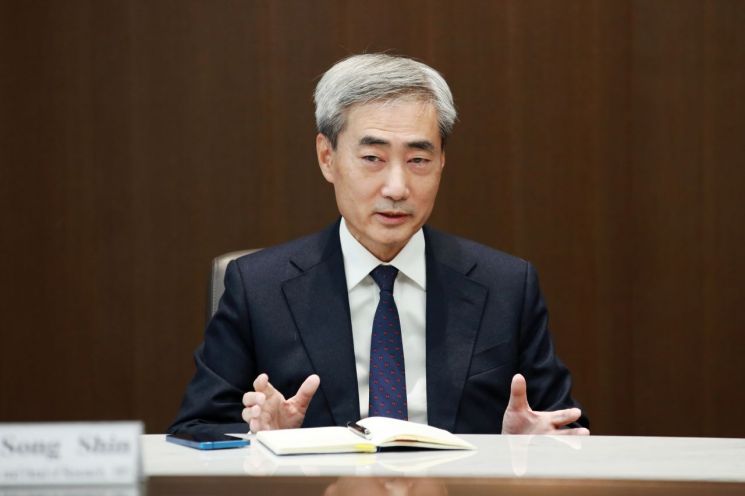 Shin Hyun-song, Economic Advisor and Director of the Research Department at the Bank for International Settlements (BIS), is answering questions at a press briefing held on the 24th at the Bank of Korea headquarters in Jung-gu, Seoul. (Photo by Bank of Korea)
South Korea has room to cut rates before the U.S.
When asked whether South Korea could cut interest rates before the U.S. once inflationary pressures ease, Carstens replied that "there is room" for this.
He said, "Not only South Korea but many countries are influenced by U.S. monetary policy, but the Bank of Korea uses reliable policies and is an institution guaranteed autonomy," adding, "It has sufficient capacity to operate monetary policy independently of external policy environments or the U.S. situation."
Carstens gave an overall positive assessment of South Korea's economic situation but noted that household debt, which has increased significantly through mortgage loans, needs to be managed. According to the BIS, South Korea's household debt-to-GDP ratio stood at 101.7% as of the second quarter of this year, ranking among the highest globally.
He said, "(Household debt) is related to South Korea's housing development and limited land area, so it is not an easy problem to solve," but emphasized, "Local governments, project developers, and banks all need to cooperate to lower housing prices and reduce household burdens."
He added, "South Korea's household debt exceeds 100% of GDP, which requires continuous monitoring," and "Financial authorities need to take a more cautious stance."
© The Asia Business Daily(www.asiae.co.kr). All rights reserved.
![Clutching a Stolen Dior Bag, Saying "I Hate Being Poor but Real"... The Grotesque Con of a "Human Knockoff" [Slate]](https://cwcontent.asiae.co.kr/asiaresize/183/2026021902243444107_1771435474.jpg)

















