Starting July, 'KakaoT' Pilots 'Gratuity Tips'
Concerns Over Consumer Burden and Establishing Tip Culture Continue
As so-called 'tipflation' has become a headache in the United States, 'tip culture' is being introduced in various places in Korea, sparking controversy. Tipflation is a portmanteau of tip and inflation, referring to the phenomenon where the tip rates requested at restaurants, bars, and other places have increased compared to before due to the surge in global prices after COVID-19.
"If passengers continue to complain about KakaoT tips, Kakao must take responsibility"
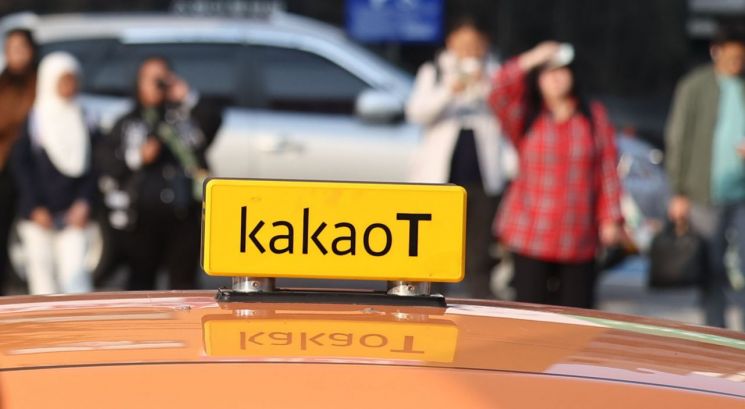
On the 24th, the Consumer Sovereignty Citizens' Meeting issued a statement saying, "Although Kakao has implemented measures to prevent problems related to the tip service in advance, if complaints from passengers using taxis continue due to the gratitude tip service, and this leads to a qualitative decline in taxi service, Kakao must take full responsibility for all of this."
They added, "While (tips) have the advantage of potentially improving service quality and are not mandatory, consumers' views are not entirely favorable when they encounter a service encouraging tips amid increased consumer burdens due to recent taxi fare hikes." They continued, "In Korea, where tip culture is not well developed, it is necessary to fully consider during the pilot period that this service could entrench tip culture, making it like an additional fee, and create a structure that shifts the cost of quality service onto consumers."
Earlier in July, KakaoT introduced a pilot gratitude tip service. After using a taxi, when giving a 5-star rating for the service, a tip payment window is activated. Tips are divided into three amounts: 1,000 won, 1,500 won, and 2,000 won, which users can select directly, and there is also a 'Do not pay' option. KakaoT's tip feature applies only to Kakao Black, Model Taxi, Venti, Kakao Blue, and not to general calls.
KakaoT is not the first domestic taxi-hailing company to introduce tips. Small and medium-sized companies such as I’m and Tada, as well as special-purpose vehicle companies, have already introduced tips. However, considering that KakaoT holds a 95% market share in the domestic taxi-hailing platform market, it is pointed out that the tip culture starting in the taxi industry could have a significant impact on Korean society.
Especially as consumer burdens have increased due to recent taxi fare hikes, the emergence of services encouraging tips has not been well received by consumers. In fact, in August, a consumer data platform Open Survey conducted a survey of 1,000 consumers aged 20 to 50 on their perception of the 'introduction of tip functions in taxi-hailing platforms,' and 36.7% of respondents answered 'very negative.'
Even in the US, where tip culture is developed, there is 'fatigue'
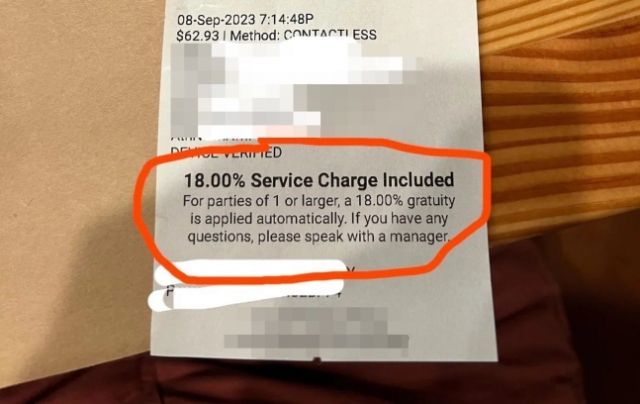 A Vietnamese restaurant in the United States sparked controversy by automatically adding an 18% tip to the total food bill. [Image source=Reddit]
Even in the United States, where tip culture is well established, people are expressing fatigue over tipping. In the past, it was common to pay about 10-15% of the food price as a tip. However, recently, especially in large cities like New York, tip rates have soared to as high as 25%.
In September, a Vietnamese restaurant in the US automatically applied an 18% tip to the total food price, which drew strong criticism from American netizens. The reason was that tips, which should be voluntarily given based on service satisfaction, were forced. Additionally, in the US, since COVID-19, even fast-food restaurants and kiosk-only stores have started requesting tips, leading to growing dissatisfaction.
Meanwhile, in Korea, restaurants and cafes demanding tips are also emerging one after another. On online communities, there have been eyewitness accounts such as "I saw a 'tip box' at the counter of a famous bakery cafe that even had a '5-hour wait'."
However, demanding tips from consumers at restaurants or cafes may violate the law. According to the Enforcement Rules of the Food Sanitation Act, price tags must display the final price, including service charges such as tips and value-added tax, and restaurants must charge according to the price tag.
© The Asia Business Daily(www.asiae.co.kr). All rights reserved.


















