Opposition Debates Maintaining Semi-Linked System vs. Parallel System
Compromise Proposal 'Regional Parallel System' Gains Consensus
With less than a month remaining until the registration of preliminary candidates for next year's general election (December 12), the ruling and opposition parties remain at an impasse over the method of selecting proportional representatives. The Democratic Party of Korea officially advocates maintaining the current semi-proportional representation system. However, concerns are growing that the 'satellite party' issue that arose in the 21st general election could recur, leading to internal deliberations on whether to stick with the semi-proportional system or not.
The People Power Party insists on returning to a parallel proportional representation system, which allocates proportional seats based on party vote share regardless of constituency seats. However, a 'return to the parallel system' faces strong internal opposition within the Democratic Party, which has championed the semi-proportional system, as it would mean reversing their stance.
As a compromise, both parties are also discussing a 'regional parallel proportional representation' system. This system would return to the parallel model but divide the country into three regions (the Seoul metropolitan area, central, and southern regions), electing proportional representatives based on party vote share within each region. It is expected to help ease regional political divides.
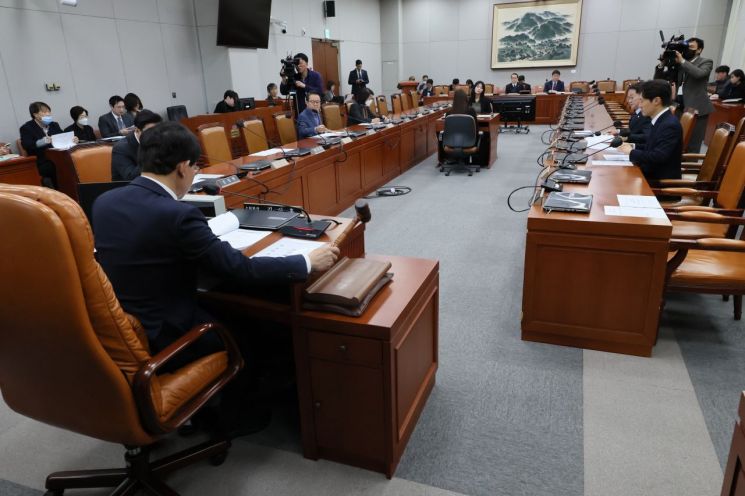 On the 21st, the 2nd Subcommittee on Bill Review of the Special Committee on Political Reform is being held at the National Assembly.
 [Image source=Yonhap News]
Kim Young-bae, the opposition party floor leader of the National Assembly's Special Committee on Political Reform and a Democratic Party lawmaker, said in a 21 MBC radio interview, "There is a de facto agreement to maintain the single-member district system for constituencies. Regarding proportional representation, while there is broad agreement to divide the country into regions such as southern, northern, and central areas instead of a nationwide system, there is no consensus yet on how many proportional representatives to elect or whether to use the parallel or proportional system."
Regarding criticism of returning to the parallel system, Kim explained, "If the current election law proceeds as is, the satellite party controversy is bound to resurface." When asked if the Democratic Party is pushing for legislation to prevent satellite parties, Kim said, "Even if that law passes, it will be practically difficult to prevent satellite parties."
He added, "Even if we adopt the parallel system, we are considering a compromise that can guarantee diversity." He explained, "In the last election, out of 47 proportional seats, 17 were allocated under the parallel system and 30 under the semi-proportional system. For this election, the cap on the number of semi-proportional seats will be lifted, making all 47 seats semi-proportional. If we impose a cap as before to limit the percentage of proportional seats that the two major parties can occupy, it will create opportunities for minor and extraparliamentary parties to enter."
However, the People Power Party argues that the Democratic Party's compromise proposal is essentially not much different from the current semi-proportional system. On the 23rd, People Power Party lawmaker Choi Hyung-doo said in an MBC radio interview, "The proposal is to do some seats under the proportional system and some under the parallel system, but it's the same story," adding, "It is not very realistic."
Both parties seem to have reached some consensus on the regional parallel system. Lawmaker Choi said, "Speaker Kim Jin-pyo proposed a mediation plan suggesting that 'the proportional system does not fit our reality, so we should go with the parallel system but divide it regionally, which could somewhat resolve the issues between proportional representation and single-member districts, as well as the gap between metropolitan and non-metropolitan areas.'" He added, "There was a general agreement in the party caucus, and many in the Democratic Party also see it as an unavoidable aspect."
© The Asia Business Daily(www.asiae.co.kr). All rights reserved.
![Clutching a Stolen Dior Bag, Saying "I Hate Being Poor but Real"... The Grotesque Con of a "Human Knockoff" [Slate]](https://cwcontent.asiae.co.kr/asiaresize/183/2026021902243444107_1771435474.jpg)
















