'2050 Tanso Jungnip Noksaeng Seongjangwi' Plenary Meeting
Global Environmental Regulations Emerging as Trade Barriers
Concerns Over Competitiveness of Key Industries... "Urgent Need for Eco-Friendly Measures"
Advancing Digital Carbon Neutrality with Environmental Data
The government plans to produce 500,000 tons of clean methanol by 2030. This decision comes from the urgent need to switch to eco-friendly fuels as environmental regulations in major countries emerge as trade barriers. Methane emissions, previously identified as a major cause of environmental pollution, will be reduced by more than 30%. Through this, the strategy aims to foster green industries and secure new growth engines.
On the 23rd, the 2050 Carbon Neutral Green Growth Committee held its 5th plenary meeting at Nurikum Square in Mapo-gu, Seoul, chaired by Prime Minister Han Duck-soo, where it reviewed and approved the government’s plan containing these details. The plan focuses on promoting carbon neutrality achievement, securing competitiveness of key industries, and responding to eco-friendly energy transitions.
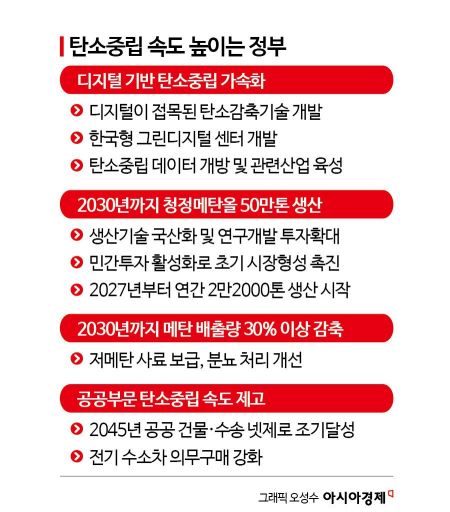
According to the ‘Clean Methanol New Industry Creation Promotion Strategy’ passed that day, the government will produce 500,000 tons of clean methanol by 2030 and foster related green new industries. Clean methanol refers to fuel made using biomass, bioenergy, renewable energy, carbon capture and utilization (CCUS), clean hydrogen, and other sources, recognized as a low-carbon fuel with almost no carbon emissions.
The background for starting clean methanol production lies in strengthened global environmental regulations. The International Maritime Organization (IMO) adopted the ‘2023 Greenhouse Gas Reduction Strategy’ last July and declared its goal to achieve carbon neutrality (net zero) in the international shipping sector by 2050. The U.S. Inflation Reduction Act (IRA) and the European Union’s (EU) Carbon Border Adjustment Mechanism (CBAM) also act as trade barriers. There is growing concern that failure to accelerate the shift to eco-friendly energy will undermine the competitiveness of key industries such as shipbuilding, shipping, and automobiles.
A representative from the Carbon Neutral Green Growth Committee explained, “Currently, the shipbuilding industry is enjoying a boom by receiving orders for LNG vessels, but due to environmental regulations, demand for clean methanol ships is increasing.” He added, “Although Korea was the first in the world to build clean methanol ships, the actual production volume of clean methanol is zero, making it difficult to conduct test operations.” He emphasized, “(Clean methanol production) is a very urgent and critical matter.”
First, to improve production conditions, raw materials such as hydrogen and carbon sources will be secured, and investment in research and development (R&D) to acquire technology and localize equipment will be expanded. Green hydrogen will be produced by water electrolysis using surplus renewable energy, and economically viable hydrogen will be secured by improving the utilization methods of bioresources. Facilities that convert food waste and livestock manure into biogas will be increased, and carbon dioxide capture and utilization from the steel and cement industries will also be promoted.
Additionally, to secure demand for clean methanol, quality standards will be established and low-carbon product certification will be supported. In the shipping sector, where change is urgent, subsidies to induce the transition to eco-friendly ships will also be provided. Clean methanol will be included in the Korean Green Taxonomy to encourage private investment, and initial economic feasibility will be unlocked through regional revitalization investment funds. Actual production will begin in 2027 with a pilot project producing 22,000 tons annually at the Taebaek Jangseong Mining Site.
Advancing Digital Carbon Neutrality... Public Sector Sets an Example
Meanwhile, existing methane emissions will be reduced by more than 30% by 2030 compared to 2020 levels. Although methane has a short atmospheric lifetime, its greenhouse effect is 28 times that of carbon dioxide, requiring intensive reduction efforts to curb global temperature rise. In 2020, Korea’s methane emissions were 27.4 million tons CO2eq, accounting for 4.2% of the country’s total greenhouse gas emissions.
Reductions will be concentrated in industries with high methane emissions. To reduce methane from the agriculture and livestock sectors, systematic paddy water management methods will be disseminated, low-methane feed will be distributed, and the purification treatment rate of livestock manure will be expanded. For waste, efforts will be made to reduce food waste and recover methane from landfills and convert it into biogas. Methane reduction R&D and international cooperation projects will also be expanded beyond previous levels.
The meeting also approved the ‘Promotion Plan for Carbon Neutrality through Digital Transformation.’ The core is to integrate essential digital technologies for energy efficiency and carbon emission tracking and monitoring into industry and daily life. The government will build a ‘Green Digital Ecosystem’ to enable the public and private sectors to easily engage in carbon reduction. Data related to carbon neutrality will be collected and opened to the private sector, and a support platform for carbon emission measurement, reporting, and verification will be developed. Platforms such as the greenhouse gas spatial information map and building energy integrated management system will also be upgraded.
However, considering that carbon emissions may increase during the digital transformation process, high-efficiency and low-power methods have been adopted. The targets are data centers and networks. To reduce energy consumption in data centers, computing materials, components, and equipment will be made more efficient, and infrastructure such as cooling, air conditioning, and power facilities will be made low-power. Networks will also develop technologies to reduce power consumption.
The public sector will also set an example in advancing carbon neutrality. Greenhouse gas emissions from buildings and vehicles will be reduced by 37% by 2030 compared to 2018, and carbon neutrality will be achieved by 2045 in the long term. The Carbon Neutral Green Growth Committee explained that this is a “challenging goal,” 5 percentage points higher than the previous target.
Public buildings will enhance energy performance through green remodeling, and idle spaces owned by the government or local governments will be used to attract private capital for renewable energy production. Each institution will establish reduction plans, and the incentive system will be restructured during government performance evaluations. Additionally, efforts will be made to expand electric vehicle charging facilities, convert public ships to eco-friendly vessels, and broaden the scope of institutions required to purchase green products.
© The Asia Business Daily(www.asiae.co.kr). All rights reserved.

















