Request to Block Historical Entry and Provide Police Protection
Seoul Metro announced the highest level of response regarding the protests by the National Solidarity for the Elimination of Discrimination against Persons with Disabilities (Jeonjangyeon), stating that "entry will be completely blocked to make protests impossible in the subway."
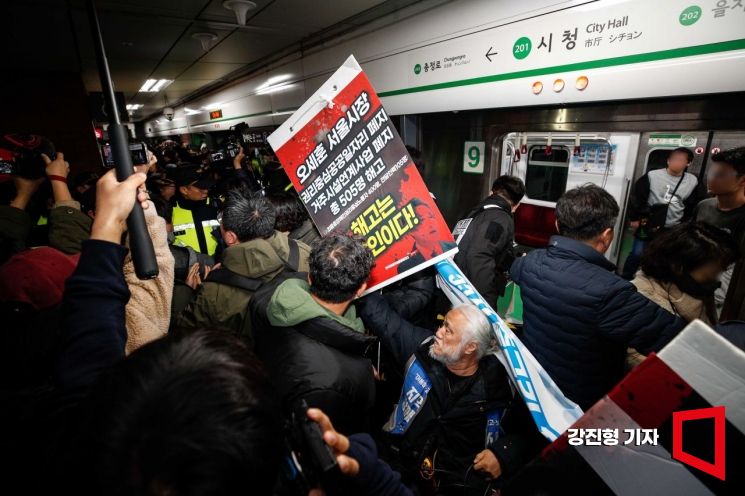 On the 20th, at the Seoul Subway Line 2 City Hall Station platform heading toward Dangsan Station, members of the National Solidarity for the Elimination of Discrimination against Persons with Disabilities resumed a subway boarding protest, urging the inclusion of a budget for the mobility rights of persons with disabilities in the 2024 budget allocation. Photo by Jinhyung Kang aymsdream@
Seoul Metro stated on the 23rd that starting from the 20th, as Jeonjangyeon resumed protests in the Seoul subway, it will implement a three-step tough response plan including blocking station entry, restricting boarding by suspending the opening and closing of platform screen doors upon entry, and taking legal action against all illegal activities. Jeonjangyeon resumed protests after about two months since their last demonstration at City Hall Station on Line 2 on September 25.
Jeonjangyeon conducted protests disrupting subway operations at City Hall Station on Line 2 during rush hours over two days starting from the 20th, demanding "rights-centered public job security struggles," among other things. Due to this, Line 2 trains were delayed by up to 47 minutes. The Metro reported that a total of 139 complaints related to the protests were received at the customer center on the 20th and 21st, and stated, "Since 2021, Jeonjangyeon has held a total of 471 publicity campaigns, of which 92 involved protests disrupting train operations." The resulting train delay time amounted to 86 hours and 33 minutes, and the losses incurred by the Metro totaled 780 million KRW. The Metro held an emergency countermeasure meeting on the 21st to devise a response plan.
First, the Metro requested police protection of facilities to prohibit and restrict assemblies and protests in all subway stations and trains. According to the Assembly and Demonstration Act, if residents or managers request protection of facilities or places, prohibition or restriction of assemblies or protests can be notified. Additionally, if Jeonjangyeon attempts to board with the intent to delay subway operations, the Metro plans to cooperate with the police to block boarding. If protests do not cease despite repeated deterrence, trains will pass through the affected stations without stopping. To ensure smooth on-site response, all subway security officers will be deployed, and numerous support personnel including station staff and headquarters employees will also be assigned.
Furthermore, if protesters block some train doors, the Metro will suspend the opening and closing of platform screen doors at the affected platforms. The Metro also plans to strictly respond to all illegal acts, including disruptions to train operations and violations of the Railroad Safety Act, and will record video evidence from the start to the end of the protests.
Baek Ho, President of Seoul Metro, said, "This measure will have a significantly stronger effect than before as it completely blocks entry to prevent protests in the subway," and added, "During my term, I will definitely protect citizens' safety from protests, villains, and other disorderly conduct occurring in the subway."
© The Asia Business Daily(www.asiae.co.kr). All rights reserved.

















