The three major indices of the U.S. New York stock market showed an upward trend in the early session on the 22nd (local time), a day before the Thanksgiving holiday. International oil prices are falling by around 4% as the scheduled regular meeting of oil-producing countries was postponed.
As of 10:58 a.m. at the New York Stock Exchange (NYSE) on the day, the Dow Jones Industrial Average was trading at around 35,178, up 0.26% from the previous close. The S&P 500 index rose 0.28% to 4,551, and the Nasdaq index was up 0.4% at 14,256. The stock market will be closed on the 23rd due to the Thanksgiving holiday and will close early on the 24th.
Currently, among the 11 sectors within the S&P 500 index, nine sectors excluding energy and materials are all rising. Nvidia fell more than 3% from the previous close despite its earnings released after the market closed the day before exceeding expectations, amid concerns that additional export restrictions to China could affect fourth-quarter sales. HP rose nearly 4% on expectations of launching AI PCs in the second half of next year despite weak earnings. Microsoft (MS), the largest shareholder expected to join the board in the future while showing influence during Sam Altman's return to OpenAI, is up more than 1%.
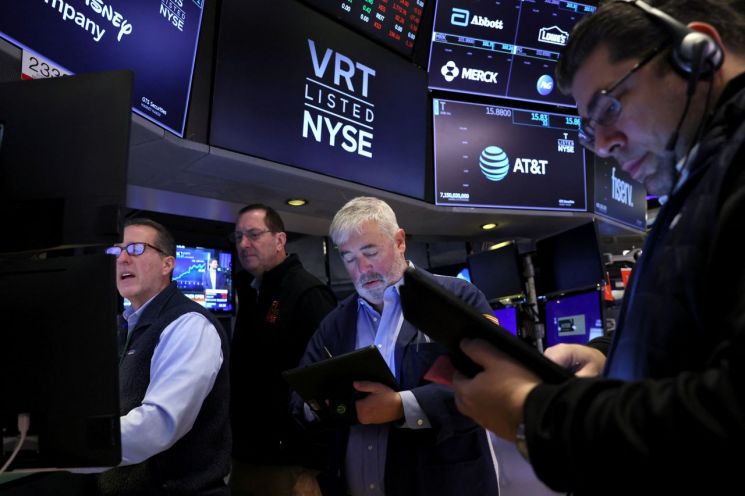
Investors are closely watching stock price movements following earnings announcements from major companies including Nvidia, along with economic indicators, government bond yields, and oil price movements.
The unemployment data released on the day indicated that the labor market remains robust. Weekly initial jobless claims last week fell by 24,000 from the previous week to 209,000, marking the lowest level in five weeks. This also beat the expert forecast of 229,000. However, durable goods orders released on the same day suggested an economic slowdown. U.S. durable goods orders (products expected to last three years or more) in October decreased by $16 billion (5.4%) from the previous month to $279.4 billion. This reversed the previous month's 4% increase to a decline. The drop was larger than Wall Street's forecast of a 3.4% decrease.
Following the economic data release, government bond yields showed a slight rise. In the New York bond market, the benchmark 10-year U.S. Treasury yield was trading around 4.43%. The 2-year yield, which is sensitive to monetary policy, stood at 4.92%. The dollar index, which measures the value of the U.S. dollar against the currencies of six major countries, rose more than 0.5% from the previous close to 104.1.
Oil prices showed a sharp decline of around 4% during the session. The OPEC Plus (OPEC+) group, consisting of OPEC oil-producing countries and non-OPEC oil producers, announced that the regular ministerial meeting originally scheduled for the 26th has been postponed to the 30th. This suggests that negotiations on whether to extend additional production cuts are not proceeding smoothly. The January West Texas Intermediate (WTI) crude oil price fell 4.08% from the previous close to around $74.6 per barrel, while the January Brent crude price dropped 3.94% to about $79.2 per barrel.
The decline in oil prices is somewhat easing concerns about inflation. Charlie Ripley, a strategist at Allianz Investment Management, said, "As inflation continues to fall, the possibility of a soft landing by the Federal Reserve (Fed) is increasing," adding, "In this environment, the stock market is likely to continue performing well next year." Since the beginning of this month, the Nasdaq index has risen nearly 11%. The Dow and S&P 500 indices have also increased by more than 6% and 8%, respectively.
European stock markets are mixed. Germany's DAX index and France's CAC index are up 0.43% and 0.56%, respectively. The UK's FTSE index is down 0.19%.
© The Asia Business Daily(www.asiae.co.kr). All rights reserved.
![Clutching a Stolen Dior Bag, Saying "I Hate Being Poor but Real"... The Grotesque Con of a "Human Knockoff" [Slate]](https://cwcontent.asiae.co.kr/asiaresize/183/2026021902243444107_1771435474.jpg)
















