Sam Altman, CEO of OpenAI, known as the 'Father of ChatGPT,' was reinstated after a series of twists and turns over five days following his dismissal. The incident, which shook the global tech industry, is interpreted as a reflection of the war between the ‘Boomers’ (boomer·development advocates) who want to slow down AI development speed and the ‘Doomers’ (doomer·doomsayers) who prioritize safety. The victory of 'Sam the Unsackable' Altman ultimately signals an acceleration of AI commercialization projects. Besides Altman, major shareholders like Microsoft (MS), who showed behind-the-scenes influence by supporting Altman throughout the incident, are also considered big winners.
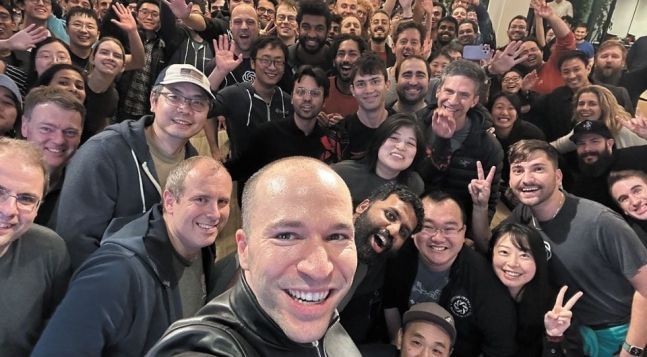 On the 21st (local time), immediately after the decision for CEO Sam Altman's return was made, employees who supported Altman gathered at OpenAI headquarters in the United States to hold a party and take a group selfie. [Source=X (formerly Twitter)]
Altman Returns as CEO Five Days After Ouster...An Industry-Shaking "Plot Twist"
On the 22nd (local time), OpenAI announced via X (formerly Twitter) that it had agreed to reinstate Altman as CEO and partially restructure the board of directors that had ousted him. The restructured board includes Brett Taylor, former co-CEO of Salesforce, joining as the new chairperson. Larry Summers, former U.S. Treasury Secretary, was also added. Adam D'Angelo, CEO of Quora, remained on the board. D'Angelo, who was one of the board members involved in Altman's ouster, led the negotiations for Altman's return.
MS, the largest shareholder, immediately welcomed the board restructuring. Satya Nadella, CEO of MS, said, "I am encouraged by the changes to the OpenAI board," calling it "the first essential step toward more stable, informed, and effective governance." OpenAI referred to this as an 'initial' board and hinted at potential expansion. Bloomberg reported that the final board would include nine members. The New York Times (NYT), citing sources, said, "Existing board members also felt a new start was necessary," but "(existing board members) D'Angelo, Tasha McCauley, and Helen Toner demanded certain concessions from Altman, including an independent investigation into OpenAI leadership. The outgoing board focused on curbing Altman's power," reflecting the atmosphere.
The incident, which began with the sudden announcement of Altman's dismissal on the 17th, saw multiple reversals over five days. Immediately after, strong backlash from investors including MS led to speculation over Altman's return during the weekend, but it did not materialize. However, when MS, the major shareholder, announced plans to recruit Altman, and over 700 of OpenAI's 770 employees collectively resigned, threatening to move to MS if Altman was not reinstated, the board had no choice but to surrender. Had the board not backed down, the existence of OpenAI, the industry leader that sparked the AI boom with ChatGPT, would have been at risk.
NYT reported, "The sudden dismissal of Altman triggered a plot twist drama, culminating in the decision to reinstate the OpenAI CEO." Bloomberg described the incident as "a shocking plot twist that shook Silicon Valley and the global AI industry, with Altman returning to OpenAI just five days after being ousted."
MS is considered the primary winner. Despite holding 49% of OpenAI shares as the largest shareholder, MS had no voting rights in the company, where a nonprofit board held major decision-making power. This was why Altman’s dismissal was possible. However, MS also controlled the flow throughout the incident and achieved its desired outcome. Local media evaluate that as the powerful investor with capital and data centers (MS) began to exert its influence, the OpenAI board inevitably collapsed.
Bloomberg analyzed, "The simplest interpretation is a big win for MS and CEO Nadella," adding, "MS successfully protected its investment without employing the 700 OpenAI employees who are partners in the AI revolution." The outlet noted, "It is undeniable that the power of capital overcame the board's authority," pointing out that OpenAI, which started as a nonprofit, is ultimately a capitalist enterprise. Axios described MS as OpenAI’s sugar daddy (a middle-aged financial supporter in exchange for companionship). Wall Street also widely analyzed that MS led the OpenAI coup.
Having gained the upper hand in this incident, MS is expected to further strengthen its influence by improving OpenAI’s governance structure. Local media, citing sources, reported that MS is pursuing securing seats on OpenAI’s board. Altman, supported by CEO Nadella, also returned to OpenAI on the same day and expressed, "I look forward to building a strong partnership with MS."
Altman, who was ousted from the company he founded and then reinstated, is clearly a winner. Having aimed to accelerate AI tool development and commercialization, Altman can now push his vision more strongly with the support of the restructured board. Before his dismissal, Altman was raising funds in the Middle East to create an AI semiconductor company to compete with Nvidia and was also working with former Apple personnel to develop AI devices. Accordingly, it is expected that the various projects he envisioned will now accelerate under OpenAI’s leadership.
Since the new board chair, Taylor, also supports AI service commercialization, he is expected to actively back Altman’s initiatives. The recruitment of former Treasury Secretary Summers, who wields influence in politics, business, and academia, is also seen as a move to respond to regulatory challenges AI faces worldwide.
Bloomberg stated, "Altman is now the undisputed decision-maker of the AI revolution," adding, "No one can block the path of 'Sam the Unsackable.'" CNN assessed, "This incident put an end to the AI industry’s confusion over who will lead and operate OpenAI and, more broadly, how fast AI technology development should proceed."
However, the industry debate over AI development speed and commercialization, which was the background to Altman’s sudden dismissal, has not ended. This incident essentially brought to the surface the division between Boomers, who want to maximize AI’s potential, and Doomers, who see AI as an existential threat to humanity. As a result, the conflict between the two sides is expected to spread throughout the industry.
Unlike Altman, who has advocated for AI development and commercial use, most of the existing OpenAI board members have expressed concerns that rushing AI development could pose existential risks to humanity. Ilya Sutskever, a leading gradualist and chief scientist, reportedly expressed worries that Altman was not paying enough attention to these potential risks. Former board member Helen Toner also criticized OpenAI on AI safety issues in a paper co-authored by researchers at the Georgetown Center for Security and Emerging Technology. Emmett Shear, former Twitch CEO and interim CEO after Altman’s ouster, also belongs to the Doomer camp, advocating slowing down AI development.
This conflict is not limited to OpenAI. Similar situations have been reported at Meta, Anthropic, and others, where opinions between Boomers and Doomers diverge. The Economist described this incident as "the most dramatic revelation of the division occurring in Silicon Valley."
National concerns over AI regulation are also expected to deepen. Time noted, "This incident leaves AI startups, which have been trying to balance rapid AI advancement with ethical responsibility, questioning their future direction." Politico analyzed, "Washington policymakers, struggling to keep up with rapidly evolving AI technology, were caught off guard. This turmoil is likely to influence how the U.S. Congress and the Biden administration approach AI regulation."
© The Asia Business Daily(www.asiae.co.kr). All rights reserved.



















