Ithanhee and 53 Others Demand Party Resolution to Prevent Satellite Parties
Hong Ikpyo "Satellite Party Practice... Concerns Over Proportional Representation Intent"
With the registration for preliminary candidates for next year's general election starting from the 12th of next month, discussions on electoral system reform between the ruling and opposition parties are at a standstill. The ruling People Power Party has solidified its position in favor of returning to the 'parallel proportional representation system,' while the Democratic Party, which holds the key to election law amendments, is facing difficulties in reaching a party consensus as some members insist on maintaining the mixed-member proportional representation system and are demanding the introduction of satellite party prevention laws.
Hong Ik-pyo, the floor leader of the Democratic Party, said in an interview with BBS Radio on the 22nd, "It is true that the Democratic Party has not decided on (the election law amendment and stance)," adding, "There are divided opinions within the party regarding the election law." In fact, within the Democratic Party, there is debate over whether to adopt the mixed-member proportional system, which links proportional representation seats elected by party vote share to constituency seats, or the parallel system, which elects constituency seats and proportional representation seats separately, for next year's general election.
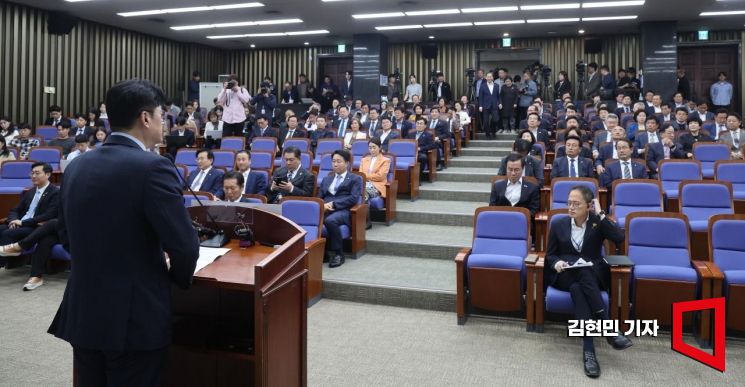 Hong Ik-pyo, the floor leader of the Democratic Party of Korea, is speaking at the party meeting held at the National Assembly on the 30th. Photo by Hyunmin Kim kimhyun81@
During the last presidential election, the Democratic Party adopted the mixed-member proportional system as its party stance. This system was first introduced in the last general election and was favored because it allows for proportionality and consideration of minor parties. It was also praised for its advantage in expanding the role of small parties in Korea's polarized politics, thereby enabling compromise politics.
However, there is criticism that the mixed-member proportional system caused political regression because both major parties created satellite parties in the last general election. If the People Power Party forms a satellite party in next year's election, the Democratic Party could be at a significant disadvantage if it does not also create a satellite party.
There is also a forecast that the mixed-member proportional representation system could benefit third-party new parties such as the new party promoted by former People Power Party leader Lee Jun-seok, Hope of Korea by lawmaker Yang Hyang-ja, and New Choice by former lawmaker Geum Tae-seop, which poses an obstacle. In particular, controversies such as the 'sister party' issue involving former Justice Minister Cho Kuk and former Democratic Party leader Song Young-gil are also burdensome.
For these reasons, a pragmatic view advocating a return to the parallel system has gained traction within some factions of the Democratic Party. However, with lawmakers like Lee Tan-hee expressing a commitment to preserving the mixed-member proportional system, the party has yet to reach a consensus. Lawmaker Lee stated, "The spirit of the Democratic Party is political reform and coalition politics," and argued, "Let's maintain the mixed-member proportional electoral system promised to the people."
At the same time, Lee is urging legislation to address the satellite party issue, which is considered the biggest weakness of the mixed-member proportional system. Along with Lee, 53 Democratic Party lawmakers demanded that the satellite party prevention law be adopted as party policy on the same day.
The satellite party prevention laws include the 'Public Official Election Act' proposed by Democratic Party lawmaker Kim Sang-hee and the 'Political Funds Act' submitted by Lee. Kim's bill requires parties that nominate constituency candidates to also nominate proportional representation candidates amounting to 20% of their constituency candidate nominations, aiming to prevent major parties from not nominating proportional candidates for satellite parties.
Lee's bill stipulates that if a satellite party merges with another party within two years of the election date, the party's regular subsidies will be reduced by 50%. It is argued that if these two laws are processed as a package, they can prevent satellite parties formed by the two major parties.
Earlier, Justice Party lawmaker Shim Sang-jung proposed a Political Funds Act that only provides election subsidies to parties that nominate at least five candidates each for constituency and proportional representation elections. This means that satellite parties nominating only proportional candidates should not receive any election subsidies.
Democratic Party lawmakers Kang Min-jung and Shim also proposed amendments to the Public Official Election Act to separate constituency and party ballots, requiring that all parties' symbols and names be displayed on the party ballot regardless of whether they have nominated candidates. Lawmaker Park Sung-joon also proposed a Public Official Election Act amendment mandating that parties nominating at least 30% of constituency seats must also nominate at least 30% of proportional representation candidates within the proportional representation seat range.
However, it is uncertain whether such legislation will be a solution. Floor leader Hong said regarding the satellite party prevention law, "If it can be fundamentally blocked, I am 100% in favor of eliminating satellite parties," but added, "It is not easy to fundamentally block them." The satellite party prevention law presupposes maintaining the mixed-member proportional system, but the People Power Party opposes the legislation. As a result, the satellite party prevention law has not yet even been submitted to the National Assembly's Political Reform Special Committee.
Some suggest that a compromise between the mixed-member proportional and parallel systems may ultimately be the solution. Kim Young-bae, a Democratic Party lawmaker and secretary of the party's Political Reform Special Committee, said in an interview with MBC Radio the day before, "In the last election, out of 47 proportional seats, 17 were parallel and 30 were mixed-member proportional. This time, the cap has been lifted, so all 47 seats will be mixed-member proportional," adding, "If we cap the percentage of proportional seats that the two major parties can occupy as before, small parties and parties outside the National Assembly will have opportunities to advance." This suggests that a compromise within the framework of maintaining both systems could be sought.
© The Asia Business Daily(www.asiae.co.kr). All rights reserved.

















