"We do not have time to wait for the next pandemic. We must apply the lessons learned during the COVID-19 pandemic right now."
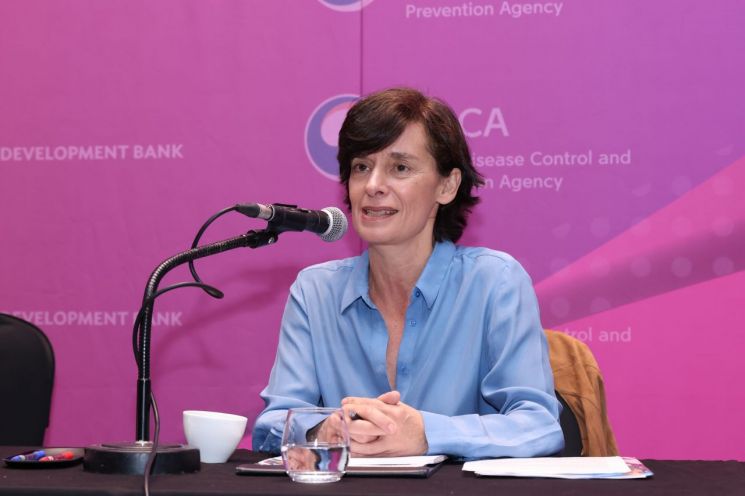 Carmen Perez, Manager of the PPPR Team at the international pharmaceutical procurement organization UNITAID, is meeting with reporters for an interview on the morning of the 21st at the Conrad Hotel in Yeouido, Seoul.
 [Photo by World Bio Summit]
Carmen Perez, Manager of the PPPR team at the international pharmaceutical procurement organization UNITAID, said this on the morning of the 21st at the Conrad Hotel in Yeouido, Seoul, during the '2023 World Bio Summit (WORLD BIO SUMMIT 2023).' This statement emphasized the need for governments, companies, and institutions worldwide to unite for the rapid development of treatments to combat pandemics.
UNITAID is a specialized international health organization launched in September 2006 to support the development of medicines and medical devices for the diagnosis and treatment of epidemic diseases such as Human Immunodeficiency Virus (HIV), tuberculosis, and malaria. During the COVID-19 pandemic, it also took the lead in distributing treatments and diagnostic kits to low- and middle-income countries.
After the morning session, Manager Perez met with reporters and stressed that countries worldwide must collectively enhance their capabilities for the development, production, and distribution of treatments. She said, "The capabilities for research and development (R&D), supply, and transportation of treatments must be sustainable even without a pandemic," adding, "If we can raise response capabilities to 80% at each stage of development, we will be prepared to respond whenever a pandemic occurs, so preparation is crucial."
International cooperation for the research and production of treatments is also a critical point in preparing for the next pandemic. Manager Perez explained, "UNITAID is assessing the research and production capacities of countries worldwide to prepare for the next pandemic," and added, "We are helping facilitate cooperation with other countries or companies if necessary."
She also emphasized that cooperation must be swiftly achieved to distribute treatments to low- and middle-income countries, one of UNITAID’s main missions. She said, "Countries like South Korea have the capabilities needed to solve global health problems, but the efforts of a single country alone cannot solve the treatment distribution issues in low- and middle-income countries," and added, "(UNITAID) helps these countries access healthcare products. The important thing is to act now."
Cooperation between international organizations and domestic pharmaceutical and biotech companies for the development and supply of pandemic treatments is also anticipated. Manager Perez said, "During the COVID-19 pandemic, with support from countries like South Korea, we delivered diagnostic kits and healthcare products to low- and middle-income countries," and added, "We aim to prepare for various infectious diseases by collaborating with Korean biotech companies that possess the innovative capabilities we need."
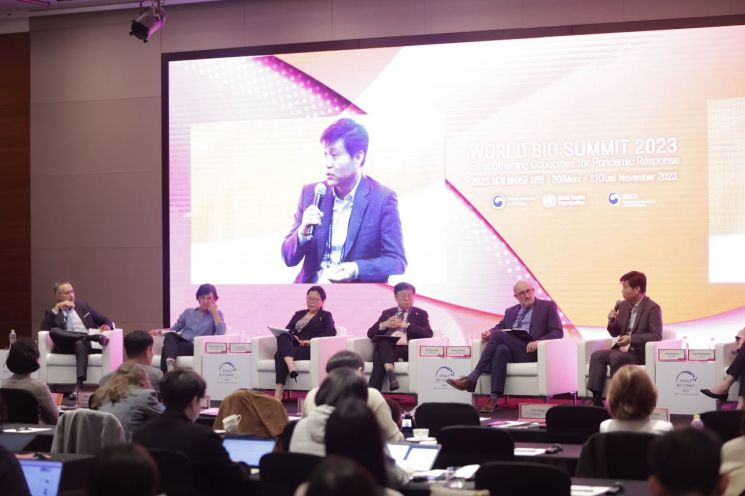 On the morning of the 21st, panelists are discussing at the '2023 World Bio Summit' held at Conrad Hotel in Yeouido, Seoul. [Photo by World Bio Summit]
Earlier that morning, a session held at the Bio Summit focused on the theme of 'Accelerating the Development and Production of Pandemic Response Treatments.' The panelists presented solutions for the development, production, and supply of treatments to respond to the next pandemic. The importance of global cooperation for treatment development was also discussed.
The session once again emphasized the need for equitable distribution of infectious disease treatments. During the early stages of the COVID-19 pandemic, some advanced countries secured vaccine supplies first, raising issues of distribution imbalance. Zhijie Dong, Director of Regional Production and Support at the World Health Organization (WHO), said, "Due to economic disparities and the concentration of production capacity in certain countries, equitable access to treatments is becoming more difficult," and stressed, "To improve access to treatments, technology transfer and local production must be expanded."
Lee Soo-young, Executive Director at Celltrion, highlighted the lessons learned and the importance of cooperation during the development, clinical trials, and manufacturing of Celltrion’s COVID-19 treatment 'Rekkirona.' Lee said, "The rapid development of Rekkirona was possible thanks to domestic and global cooperation," and added, "We were able to obtain swift approvals through collaboration with regulatory agencies in various countries."
Meanwhile, the World Bio Summit, co-hosted by the Ministry of Health and Welfare and WHO, was held over two days from the 20th to the 21st under the theme 'Strengthening Pandemic Response Capabilities: Preparedness of Workforce, Companies, and Civil Society.'
© The Asia Business Daily(www.asiae.co.kr). All rights reserved.


















