Even if someone mistakenly believes they are in a situation of self-defense and causes injury without actually being in such a situation, the Supreme Court has ruled that if there is a 'justifiable reason' for that mistake, they cannot be punished.
According to the legal community on the 22nd, the Supreme Court's 2nd Division (Presiding Justice Cheon Dae-yeop) overturned the original ruling that sentenced A (23 years old) to a fine of 2 million won on charges of injury, and remanded the case to the Seoul Northern District Court.
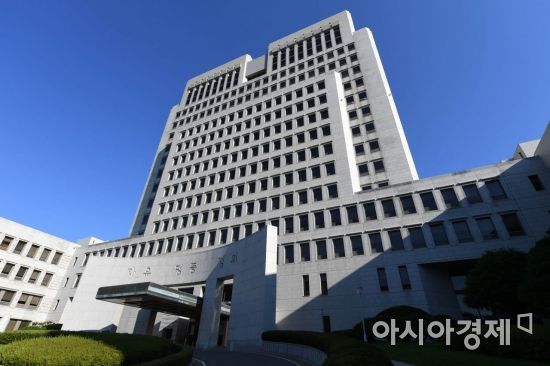
The court stated, "The original judgment contained errors that affected the verdict by misunderstanding the premise facts of the justification for illegality and the legal principles regarding the existence of justifiable reasons."
A, who worked as a coach at a boxing gym in Seongbuk-gu, Seoul (23 years old at the time of the incident), was prosecuted for assaulting gym member B (17 years old at the time) during a physical altercation with the gym director (33 years old at the time), causing a fracture to the middle phalanx of a finger with a recovery period of four weeks.
At the time, B had canceled his membership registration and was reprimanded by the director with "Don't look at adults with your eyes like that," after which he left the gym but returned an hour later to protest to the director.
When B protested to the director, saying "How did you open your eyes like that?", the director grabbed B by the collar, tried to trip him with his leg, pushed him out into the hallway outside the entrance, tightly hugged him with both arms lifting him up, pushed him down hard onto the floor, then choked, pressed, and rolled him sideways.
Suddenly, B put his left hand into his pocket and took something out, and A, who was watching the scuffle, mistakenly thought B had drawn a weapon, grabbed B's left hand, and forcibly opened his fist. During this process, B suffered a finger bone fracture.
What B had taken out of his pocket was not a weapon but a small portable recorder.
The prosecutor charged A with injury, but the first trial court acquitted A.
The court did not accept A's claim that there was no intent to injure but accepted A's argument that "A had a mistaken belief about the premise fact of justification for illegality (a self-defense situation) and that there was justifiable reason for that mistake, thus negating illegality."
Under criminal law, self-defense is also permitted for a third party who is in danger due to an unjust attack. Although the situation was not one where self-defense could be justified as A thought, at the time of the incident, A mistakenly believed B had drawn a Swiss Army knife and assaulted B to check the object in his fist, and there was sufficient reason for A to have such a mistaken belief.
The court judged, "If B had actually been holding a weapon as A perceived, the director could have been seriously injured or killed, and forcibly opening the hand was the only way to disarm the weapon."
The court concluded, "It should be recognized that the defendant had justifiable reason to mistakenly believe the premise fact of justification for illegality (self-defense), and therefore, under Article 16 of the Criminal Act, the defendant cannot be punished."
Article 16 of the Criminal Act stipulates, "An act committed under the mistaken belief that it is not a crime under the law shall not be punished if there is justifiable reason for the mistake."
However, the second trial court's judgment was different.
The second trial court overturned the first trial's acquittal and sentenced A to a fine of 2 million won, reasoning that there was no justifiable reason for A's mistake in mistaking the portable recorder for a weapon.
The court judged, "Considering the professions of the director and the defendant, the fact that the victim was a 17-year-old adolescent, the physical differences between the director and the victim, and the situation where the director assaulted the victim, even if they were close enough for the director to press down on the victim's body, the possibility that the victim could harm the director with the object in his hand seems low."
Furthermore, the court stated, "There is no particular circumstance suggesting that the defendant could have mistaken the object in the victim's hand for a weapon, and since the director had completely subdued the victim, it does not appear that the defendant was in an urgent situation requiring forcibly opening the victim's fist to take the object. Therefore, the defendant's mistake cannot be considered justifiable."
The Supreme Court overturned the second trial ruling again.
The court stated, "From the defendant's perspective, before visually confirming the object clenched by the victim, there was a reasonable basis to believe it might be a dangerous object capable of causing fatal harm to the director."
As grounds for this judgment, the court cited ▲ the fact that the physical differences between the director and B did not appear significant ▲ B had experience attending a boxing gym and thus had the ability to exert considerable physical force ▲ the scuffle between the two was not a momentary or accidental occurrence but happened after B returned intentionally with feelings of protest or revenge against the director following a reprimand and strong protest an hour earlier ▲ the 'small self-defense knife' that A claimed to have mistaken and the portable recorder were similar in size and length ▲ contrary to the prosecutor's claim that B was completely subdued by the director, B appeared to have no significant obstacle in using the portable recorder clenched in his left hand at the time.
Meanwhile, after the first trial acquittal, the prosecutor applied for and was granted a change in the indictment to delete the part stating that A's actions were motivated by "mistaking the object as a dangerous weapon and trying to take it away."
Regarding this, the court pointed out, "This recognition by the investigative agency is an objective evaluation of the situation at the time and supports that the defendant had justifiable reason to misinterpret the victim's actions. It was also the main reason the first trial court found no illegality in the defendant's actions. Given this, even if the original indictment was amended to delete this part, the investigative agency's initial recognition and evaluation cannot be retroactively changed."
This case has long been discussed in academia as an issue of 'mistake about the premise fact of justification for illegality,' such as mistaken self-defense or mistaken necessity.
For example, how to legally treat cases where a person uses violence believing they are acting in self-defense, but in reality, the situation does not justify self-defense, such as mistakenly assaulting a delivery person thinking they are a robber.
In criminal law, mistakes are broadly divided into mistakes of fact and mistakes of law. When there is a mistake about a constitutive fact, 'an act that does not recognize a fact that makes the crime particularly serious shall not be punished as a serious crime,' and intent is negated under Article 15 of the Criminal Act. On the other hand, in the case of a mistake of law (mistake of prohibition) where there is a lack of awareness of illegality, responsibility is negated if there is justifiable reason under Article 16 of the Criminal Act.
A mistake about the premise fact of justification for illegality is close to a mistake of fact in that it involves a factual error about the situation permitted at the time of the act, but it also has aspects similar to a mistake of law in that the person believed their act was not illegal. Although the Supreme Court has applied different legal principles in some cases, it has generally applied the mistake of law provision in Article 16 of the Criminal Act in cases like this, judging guilt or innocence based on whether there was justifiable reason.
© The Asia Business Daily(www.asiae.co.kr). All rights reserved.
![Clutching a Stolen Dior Bag, Saying "I Hate Being Poor but Real"... The Grotesque Con of a "Human Knockoff" [Slate]](https://cwcontent.asiae.co.kr/asiaresize/183/2026021902243444107_1771435474.jpg)
















