"Government Demand Survey: Hasty, Inadequate, Unfair... Condemning Public Opinion Manipulation"
As the Ministry of Health and Welfare announced the results of a demand survey for increasing medical school admission quotas by up to 4,000 students, the Korean Medical Association (KMA) declared a tough stance, even mentioning the possibility of a strike.
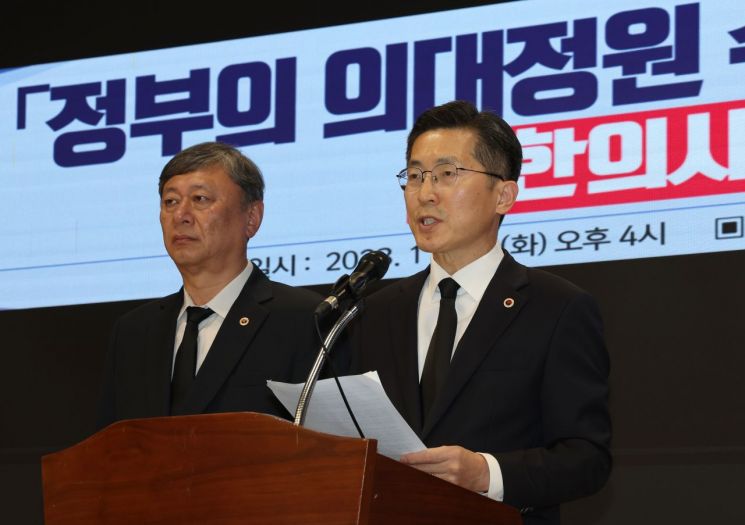
On the afternoon of the 21st, the KMA held an emergency press conference at its headquarters in Yongsan-gu, Seoul, stating, "If the government unilaterally enforces the medical school quota policy without scientific evidence and sufficient communication, we will unite the consensus of 140,000 doctors and are prepared to carry out a total medical strike."
The KMA claimed that the recent demand survey was conducted without scientific basis. The association said, "We define the government's demand survey, which only reflects the wishes of stakeholders, as a hasty, inadequate, and unfair investigation," and raised its voice, "We strongly condemn the government's attempt to use unscientific survey results as grounds for expanding medical school quotas to sway public opinion."
They also pointed out a lack of objectivity in the survey results. The KMA stated, "The government's demand survey lacks scientific analysis; the appropriate number of medical school quotas has become whatever universities and hospitals want, and whatever local politicians and municipalities desire," adding, "An unscientific and unprepared expansion of medical school quotas will only lead to a proliferation of cases like the failed Seonam University medical school in 2018."
The KMA argued that measures to secure essential and regional medical care should take precedence over increasing medical school quotas. The association emphasized, "The government should recall the original purpose of the medical school quota policy, which is to revive essential and regional healthcare," and stressed, "They must not succumb to political pressure or public opinion but genuinely seek solutions to save essential and regional medical care."
The KMA also criticized the government for not actively engaging in discussions related to medical school quota increases. The association expressed, "We feel strong anger at the government's biased demand survey and unilateral announcement of results, excluding the KMA as a negotiating party," and warned, "The government will face even stronger and more resolute medical community resistance than in 2020."
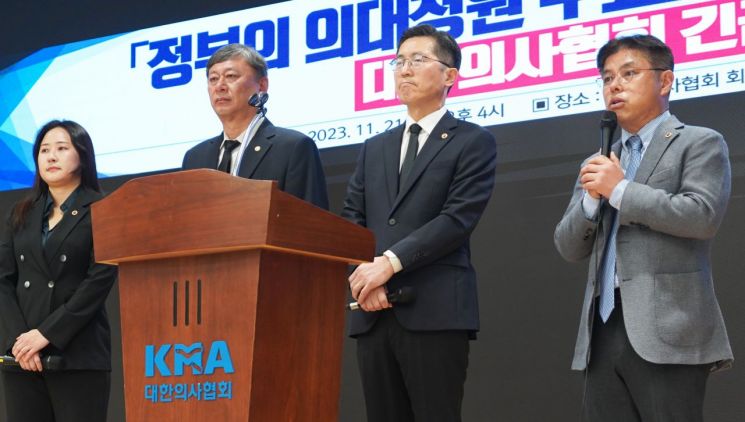 The Korean Medical Association held an emergency press conference on the afternoon of the 21st at the KMA Hall in Yongsan-gu, Seoul, regarding the "Government's Medical School Quota Demand Survey Results Announcement." KMA's Director of Public Relations Kim Yi-yeon, Executive Vice President Lee Jeong-geun, President Lee Pil-su, and Director of General Affairs Seo Jeong-seong. (From left) [Photo by Korean Medical Association]
However, the KMA did not specify the criteria or timing for initiating a strike. KMA President Il-su Lee said, "Despite various concerns and many issues raised by the Korean Institute of Medical Education and Evaluation, the government unilaterally announced the (medical school quota increase survey) results, which is a serious concern," and added, "If the government proceeds unilaterally based on today's demand survey, a strong struggle through a strike will be decided by member voting."
When asked if there was a scientific alternative to determine the scale of medical school quota increases, President Lee replied, "The KMA Medical Policy Research Institute is currently conducting an evaluation of appropriate medical personnel, and data is expected to be released next week," but added, "It will only be used within the Medical Issues Consultative Body and will not be disclosed externally."
Regarding a survey by the Health and Medical Workers' Union showing that 82.7% of the public supports expanding medical school quotas, a KMA official reiterated the existing position, saying, "No matter how many quotas are increased, it will not go toward essential or regional medical care," emphasizing that measures to address the collapse of essential and regional healthcare should come first.
Meanwhile, the Ministry of Health and Welfare announced the results of the medical school quota demand survey on the same afternoon. The ministry asked medical schools nationwide over two weeks about their desired medical school quota sizes for each year from 2025 to 2030.
According to the survey, the 40 medical schools nationwide indicated a minimum demand of 2,151 to a maximum of 2,847 additional students for 2025, the first year of quota expansion. By 2030, the sixth consecutive year of increases, the desired expansion ranged from a minimum of 2,738 to a maximum of 3,953 students. This is nearly double the current medical school quota. The minimum demand reflects the number of students each university can increase based on current faculty, facilities, and educational capacity, while the maximum demand represents the number of students medical schools could accommodate if additional educational resources are secured.
© The Asia Business Daily(www.asiae.co.kr). All rights reserved.


















